

Real Leather Recliners Worth the Investment


The recliner in the corner of a Lake Mary family room gets more seat time than any other chair in the house. Someone settles in after dinner, the footrest comes up, and the evening news runs its course. A year of that shows in the hide first, as a sheen on the arm caps and a soft crease at the seat front. Five years of it shows whether the frame and the mechanism were built for the job.
That's why the best real leather recliners reward a different set of questions than a sofa does. Leather is the surface you touch, but it's one layer of a system that also includes the frame, the foam, the recline hardware, and the finish that keeps the hide from wearing through.
Central Florida adds a variable most buying guides skip. Humidity here swings hard between a sealed, air-conditioned room and a garage that never quite dries out, and leather responds to both. Treat the chair as four parts, hide, finish, frame, and mechanism, and it becomes clear what each one needs to hold up in a Longwood or Winter Park home that uses the furniture.
What Counts as a Real Leather Recliner
A recliner may look like leather from across the room, but its upholstery can combine animal hide with vinyl or other materials. A real leather recliner has animal hide on the surfaces identified as leather; ask which panels are covered, since some chairs use matching upholstery on the sides or back. The hide shapes the chair's feel and appearance, while the reclining mechanism controls its movement.
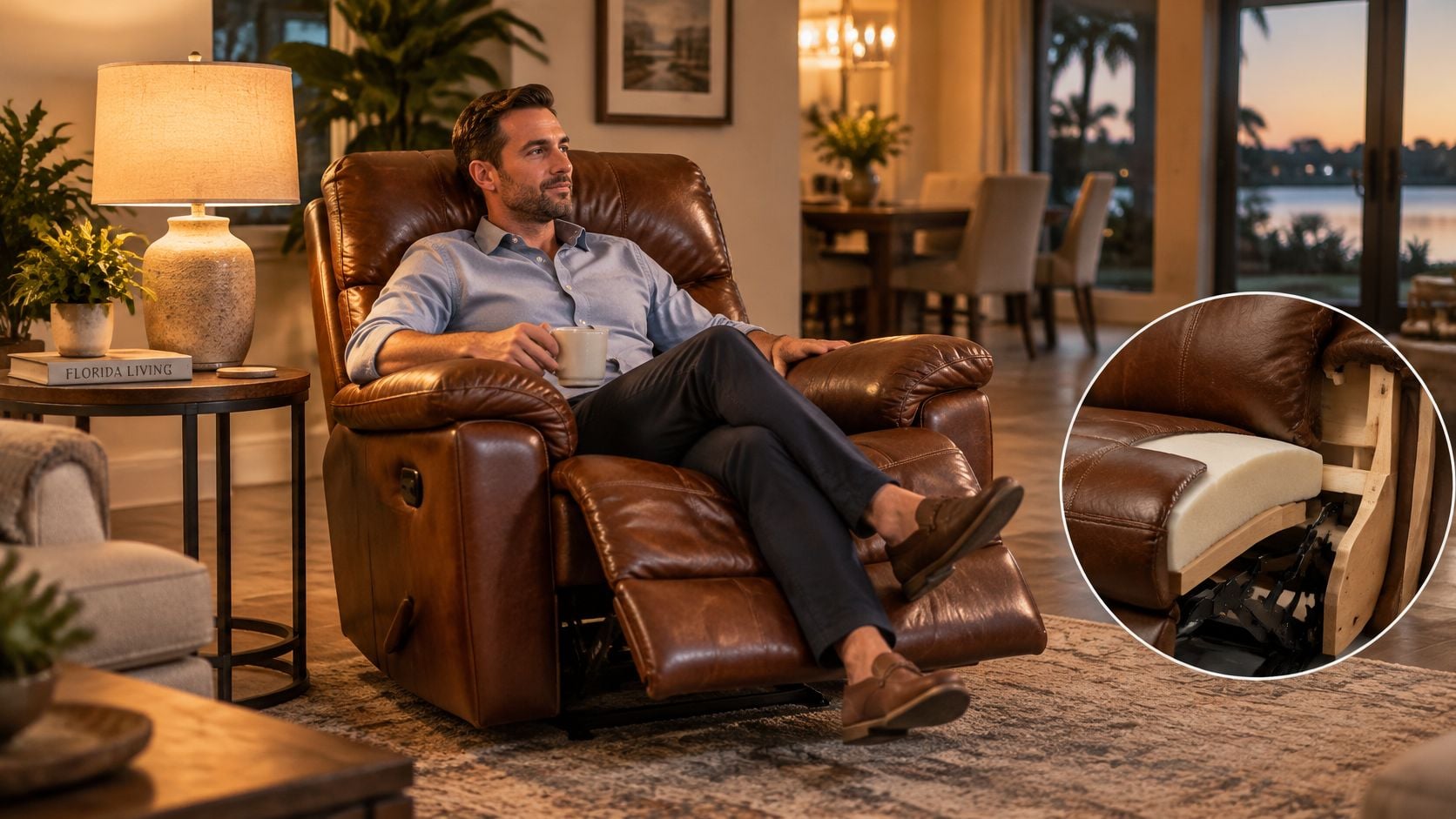
Three questions to settle in the showroom
- Which surfaces are leather? Ask whether the seat, arms, back, and footrest are hide, or whether leather is limited to the seating panels with color-matched upholstery elsewhere.
- What finish is on the hide? A protected surface and an open, less-coated surface can feel and clean differently. Ask what care the finish requires.
- What does “leather” mean on the product label? Terms can describe different materials and constructions. Learn how bonded and genuine leather differ before comparing chairs.
Slone Brothers Furniture has been creating interiors since 1980. In the showroom, these questions help clarify what you are touching and what the product description means.
Which Leather Grade Belongs on Your Recliner
A recliner in a family room sees repeated pressure at the seat, arms, and footrest. The leather grade matters, but so does the finish: a smooth, protected surface handles daily contact differently from a more open one.
Full-grain keeps the hide's original outer surface. Top-grain is lightly sanded or buffed for a more even face, while corrected grain is sanded further and finished with pigment or an embossed pattern. The labels describe the surface; they do not tell you how every panel of the chair is upholstered.
How to check a hide in the showroom
- Look for natural variation. Full-grain often has uneven markings and a less uniform pore pattern. Repeated embossing tends to look more regular.
- Check the back of a sample. Hide has a fibrous underside; coated fabric shows a woven backing.
- Inspect where panels meet. A visible cut edge can help distinguish hide from layered or fabric-backed material.
- Press gently with a fingertip. Leather tends to form a soft, irregular crease. A coated surface may fold more sharply.
The comparison below shows where each material is best suited to a recliner.
| Material | What it is | Look and feel | Daily wear | Best use |
|---|---|---|---|---|
| Full-grain | Outer hide with the natural grain left intact | Natural variation; develops patina over time | Durable hide; care depends on the finish | Seating used daily by someone who values a natural surface |
| Top-grain | Outer hide lightly sanded or buffed | Smoother and more even than full-grain | Durable, with a more uniform face | A refined look with the feel of leather |
| Corrected grain | Sanded hide finished with pigment or embossing | Uniform color and a more consistent surface | The finish can help resist stains | Busy rooms or lighter colors |
| Split | Inner layer of the hide | Soft nap or a coated face | More vulnerable to marks and moisture | Lower-contact side panels, rather than arm caps |
| Bonded | Leather fibers bound with adhesive | Even appearance, sometimes plastic-like | May crack or peel at stress points | Consider its construction carefully for a recliner |
| Faux | Coated textile or plastic with no hide content | Consistent and often cool to the touch | The surface may flake | A separate product category |
Bonded leather combines leather fibers with a binder and a surface coating. Recliner arms and seat edges receive repeated pressure, so those areas can reveal wear first. Faux leather is a coated textile or plastic with no hide content, so it belongs in a different product category.
Natural markings are part of leather's character. Growth marks, healed scars, and grain variation can make panels look different from one another. Slone Brothers Furniture notes that inherent markings in leather are considered natural character, not defects.
A 2024 update to the Higg Materials Sustainability Index reported lower estimated environmental impacts for bovine leather than earlier index values, based on data from facilities in multiple countries and including upholstery applications. Processing still contributes to a material's impact. For a recliner, the practical question is whether the chair's hide, finish, frame, and mechanism can continue serving the room as they age.
Match the finish to the way the room is used. A busy family room may call for a more protected surface; a quiet study can suit a less uniform finish. A repairable chair can remain useful even as its upholstery changes with time.
For a custom piece, American-made leather furniture can be a starting point for considering hide, color, and configuration together. A showroom sample also helps you compare surface feel and finish before choosing.
How Frames and Mechanisms Hold Up
The leather is the wearing surface. The mechanism is what reclines, and those have been separate engineering problems for well over a century. The Metropolitan Museum of Art holds an adjustable reclining-chair patent model by the American designer George A. Schastey, upholstered in its original fabric with paper tags intact, which shows that engineered recline was a finished-furniture idea long before motors existed.
The commercial milestone came later. The Henry Ford records that Edwin Shoemaker and Edward Knabusch founded their furniture company in 1927 and patented a reclining mechanism on January 24, 1929, and notes that early chairs relied on a separate ottoman before a built-in footrest arrived. Nearly a century on, the checklist hasn't moved: frame, movement hardware, cushioning, upholstery, and ergonomic support.
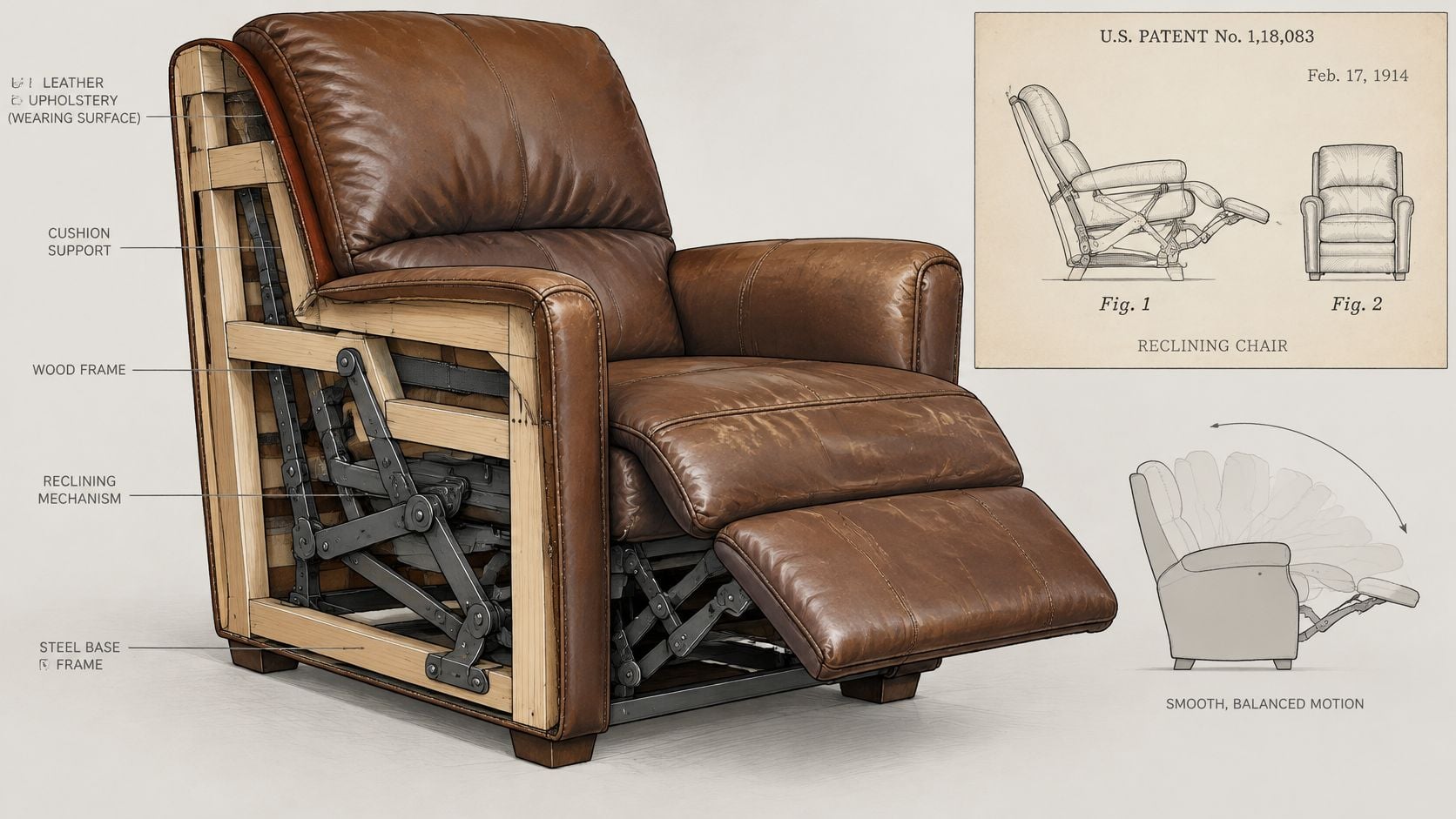
Five parts to judge before you judge the hide
- Frame. A kiln-dried hardwood frame with glued and screwed joints holds the arms and the pivot point steady. Thin composite frames flex where the mechanism bolts on, and that flex is what produces the wobble and squeak people blame on the leather.
- Cushions. High-density foam keeps the seat from collapsing into the frame and leaving a ridge under the thighs. A down wrap adds softness, but it needs regular fluffing and a foam core underneath it.
- Manual recline. A handle or press-back mechanism is quiet, cord-free, and repairable with simple parts. It's the right answer for a reading chair that never moves more than a few inches.
- Power. Motors for recline, lumbar, headrest, and footrest should be cycled in the showroom rather than assumed, because a hand control that feels vague on the floor will feel worse after five years of daily use.
- Motion geometry. A wall hugger slides forward as it reclines and needs only a few inches behind it, which suits the tighter living rooms common in Lake Mary and Winter Park. A zero-gravity position lifts the legs closer to heart level and distributes weight along the whole back.
Ask a direct question about service before the paperwork appears. Cushions, motors, and recline linkages wear before a good hide does, and a chair whose parts can be replaced in five years is a different purchase from one that can't. The types of power reclining seating sold today range from a single motor that lifts the footrest to independent headrest and lumbar motors, and the difference is easier to feel seated than to read on a spec line.
How Long Should the Finish Last
A recliner's finish wears where the hide meets repeated pressure and friction: across the seat, arm caps, headrest, and footrest. To assess durability, ask which abrasion test was used, how many cycles the sample endured, and what the test counted as failure. The leather abrasion testing methods described by Eurofins simulate rubbing against materials or surfaces under controlled conditions.
| Test | Standard | How the hide is stressed | Failure clue | Compare it only with |
|---|---|---|---|---|
| Martindale ball plate | DIN EN ISO 17076-2 | 37 steel balls under 12 kPa against an abrasive fabric | Finish gone at four or more spots and fibers visible, checked every 100 cycles | Other ball-plate results |
| Taber wheels | ISO 17076-1 | Two abrasive wheels at 2.5 N to 9.8 N on a rotating sample | Visible damage and color change after conditioning | Other Taber results |
The ball-plate method presses the leather against abrasive fabric in a way that resembles the changing pressure on a seat cushion. Inspectors check the surface at set intervals and record failure when the finish wears through in multiple places and fibers show. This makes the result more relevant to upholstery than a test that measures rubbing alone.
The Taber method uses rotating abrasive wheels to stress a conditioned sample. Its results describe a different kind of wear, so compare them with other Taber tests, not with ball-plate counts.
Reading a cycle count correctly
Request the test method, cycle result, and failure rule together. A cycle count is useful only when you know how the sample was tested and what the result means.
A sheen along an arm cap is patina, which can appear well before the surface fails. Abrasion testing describes the finish, not the chair's frame, motor, cushion, or seams. A high test result alone cannot show whether those other parts will remain serviceable.
Keep the comparison in writing: the standard, cycle count, and failure rule should appear together. For a broader view of durability across furniture components, read this guide to how long furniture should last.
How Should You Care for Leather in Florida
After an afternoon storm, a damp towel lands on the recliner arm while sunlight warms the seat through a west-facing window. Those everyday conditions matter because leather exchanges moisture with the air. In Central Florida, steady room conditions, prompt spill care, and protection from direct sun help preserve the hide and its finish.
Published leather care guidance recommends a clean, ventilated environment at roughly 45% to 65% relative humidity, a maximum temperature near 25 °C, and limited day-to-day fluctuation. Damp conditions raise mold risk. In a closed Florida home, air conditioning can help maintain a stable environment, while stagnant air and sharp changes in temperature or humidity make care more demanding.
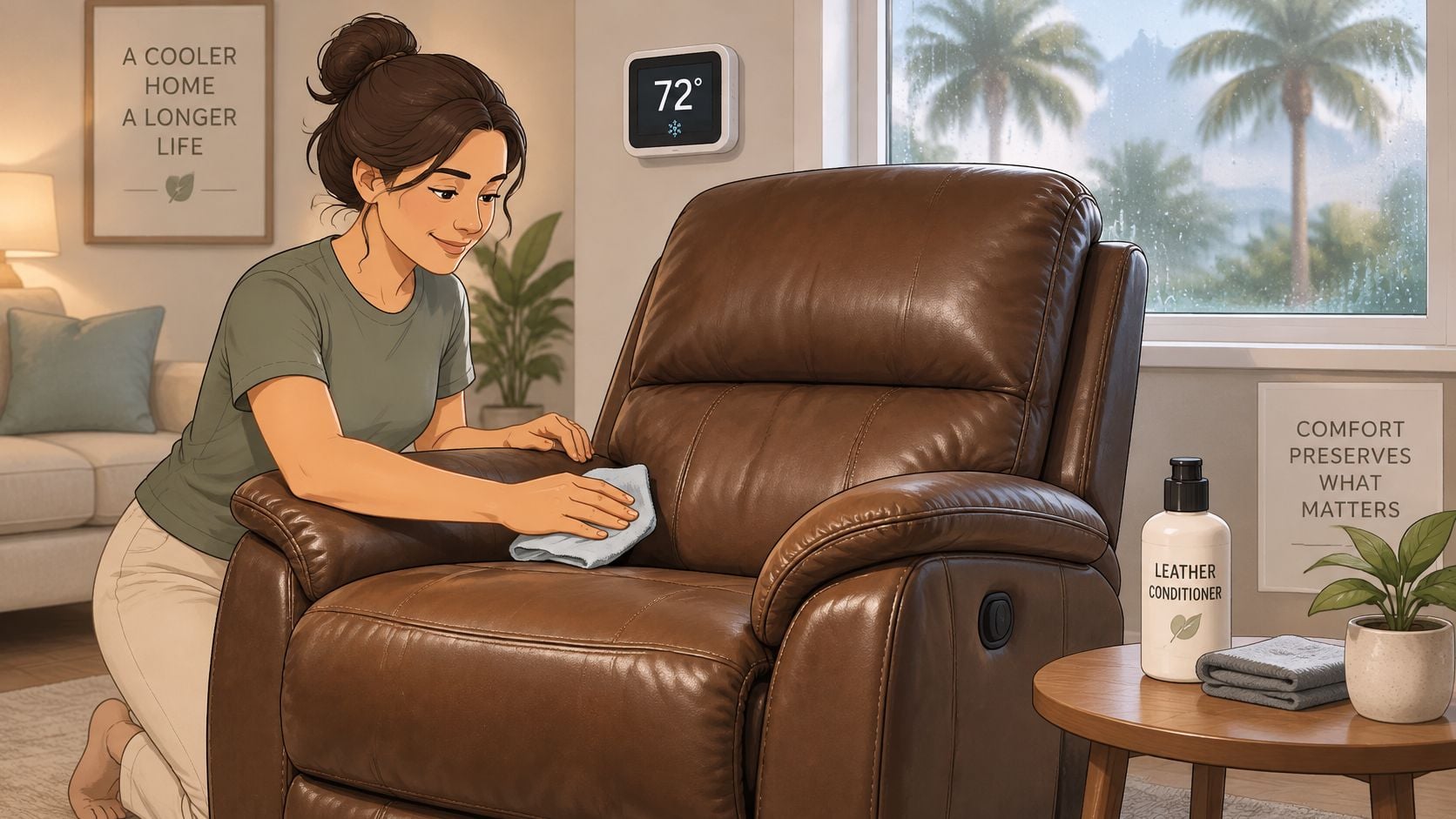
A five-step routine for a Florida room
- Choose the chair's position carefully. Keep it out of direct sun, away from heater vents and strong AC blasts, and clear of places where wet towels or swim bags are left.
- Blot spills promptly. Press a soft, absorbent cloth against the spill, then stop. Soaking the hide with cleaner or conditioner drives moisture deeper.
- Let damp leather dry in shade. Use gentle airflow. Drying leather in direct heat causes hardening and surface cracking.
- Match the care product to the finish. A conditioner made for pigmented leather can darken or streak an open aniline hide.
- Confirm the finish before ordering. Aniline, semi-aniline, and pigmented surfaces differ in stain resistance, appearance, and care needs.
| Finish | Look | Stain resistance | Care routine |
|---|---|---|---|
| Aniline | Open, natural, and rich | Lowest; marks and stains quickly | Blot at once; use only the maker's named cleaner |
| Semi-aniline | Natural look with a light protective coat | Moderate | Blot spills fast; follow the maker's product list |
| Pigmented | Uniform color with a surface coating | Highest of the three | Standard routine; confirm with the maker |
Set expectations for normal changes in appearance. Fabrics, leathers, and wood finishes are not warranted against fading, stretching, staining, pilling, excessive wear, dye transfer, or color variation from samples. Sun exposure, dark denim transfer, and minor shade differences from a swatch are normal ownership effects, not defects.
Check the room before summer humidity peaks. A guide to protecting leather furniture can help you prepare for the wet months and respond to spills without over-treating the hide.
Which Recliner Fits Your Home and How to Test It
The right chair is the one whose support, scale, and leather a household still wants in ten years, and that verdict comes from sitting in it. A photo shows a silhouette; it can't show whether the lumbar curve fills the small of your back at full recline. Bring the room's width measurement, the ceiling height if the chair will sit under a window, and a note on who uses it daily and for how long.
Four tests to run before you decide
- Lumbar contact. Recline fully and check whether the lower cushion fills the arch of your back or leaves a gap that turns into a ache after an hour.
- Head and neck support. A headrest should meet the back of the skull without pushing the chin toward the chest.
- Arm height. Sit as you would with a book or a tablet. If your elbows have to lift to reach the arm caps, the chair is too tall for you.
- Footrest clearance. Extend the footrest with the coffee table in its real position, and confirm the chair's depth at full recline fits the room.
Try the motions in this order
Start with a manual mechanism so you have a baseline for effort and noise, then move to power. Cycle every motion the chair offers, because features that look identical on a tag feel very different in use. The full range available across recliner models includes power recline, manual recline, power lumbar, power headrest, power footrest, zero gravity, massage, USB charging, and wall hugger designs, and each one earns its place only if someone in the house will adjust it.
Matching a maker to the way you sit
- Stressless (Norway). Norwegian ergonomic engineering with patented Glide systems and deep lumbar support, for the reader who wants the chair to follow the body rather than the other way around.
- American Leather. American-built performance leather, precision mechanisms, and the Comfort Sleeper for rooms that need a chair to do double duty.
- Smith Brothers. Custom bench-made American frames and unusually deep leather customization, which suits a specific color or hide grade.
- Stickley. Arts and Crafts heritage, heirloom solid wood construction, and handcrafted joinery for a chair meant to be handed down.
- Bassett and Craftmaster. Classic American-made quality and upholstery at an accessible luxury level.
- Palliser. Canadian contemporary leather and fabric seating, including sectional and home theater configurations.
A useful hour in a showroom: sit one Norwegian ergonomic chair and one American custom leather chair back to back, in the same light, on the same afternoon.
Design consultants who work with hide, finish, and configuration daily can specify a chair to a room rather than to a photograph, and a home visit settles questions that a catalog can't, like whether a wall hugger is needed or whether the chair will block a doorway. For measurements, lead times, or a delivery window, customers can call or text 407-331-0001. White glove delivery runs within 50 miles of the showroom for a nominal fee of $199.00, which covers the rooms in Longwood, Sanford, Lake Mary, and the greater Orlando area.
A leather recliner is one of the few pieces of furniture a family uses every single day, so it deserves more than a photo and a spec sheet. Slone Brothers Furniture keeps real leather recliners on the floor in Longwood, along with the hide samples, mechanism options, and design consultants who can match a chair to your room, your height, and the way your household sits. Visit Slone Brothers Furniture to put a hand on the leather, run every motion, and get straight answers from a person rather than a chatbot.