
Coastal Dining Tables: The Central Florida Guide


The most popular advice about coastal dining tables is also the least useful: choose something blue and white, add a few nautical accents, and call the room finished. That approach creates a theme, not a refined interior. In Central Florida, a better coastal dining room begins with honest materials, disciplined proportions, and construction that respects humidity.
For homeowners in Longwood, Orlando, Lake Mary, Sanford, Winter Park, and Altamonte Springs, the dining table must do more than look relaxed. It needs to suit an open floor plan, tolerate daily family use, and remain structurally sound through Florida's changing moisture levels. The strongest choice is an investment piece with a quiet coastal character, not a disposable table dressed up as beach décor.
What Defines Modern Coastal Dining Tables
Modern coastal dining tables should feel at home in a refined interior without relying on shells, anchors, nautical stripes, or a rigid blue-and-white palette. The strongest interpretation uses light neutrals, soft blues, warm woods, woven textures, and organic shapes to create an airy setting with lasting appeal. This guide to coastal design style also places the emphasis on relaxed elegance rather than literal seaside motifs.
That distinction matters in an upscale Central Florida home. A blue-painted table can work in a casual cottage, yet it may feel out of place beside architectural millwork, wide-plank flooring, upholstery with clean lines, and a carefully considered open-concept living area. Natural oak, teak, or softly finished solid wood offers greater flexibility. The same table can feel coastal beside linen chairs, transitional beside upholstered seating, and contemporary beneath sculptural lighting.
Material authenticity matters more than color
A coastal room should suggest the shoreline through texture and light, not through obvious decoration. Natural wood, rattan, wicker, jute, bamboo, linen, and driftwood-inspired finishes bring the relaxed character homeowners want without turning the dining room into a themed space. Coastal furniture guidance from Living Spaces likewise points to light neutrals, soft blues, and natural materials as defining elements.
The table remains the room's visual anchor. A pale finish reflects light and helps a dining area feel open. A warmer wood tone gives a large Florida interior more depth and prevents the room from appearing washed out. Visible grain adds substance and keeps the surface from looking mass-produced. Choose a matte or low-sheen finish over a glossy one, particularly with woven seating and handmade ceramics.
Quiet quality should be visible in the material, not announced by decoration.
Choose shape for the architecture
Shape should follow the room's proportions and circulation. In open-plan homes around Greater Orlando, an oval table softens the boundary between dining and living areas. A round pedestal table makes a compact dining zone more sociable while reducing visual congestion. Rectangular tables suit longer rooms and larger gatherings, especially when an extension mechanism keeps the everyday footprint restrained.
Design principle: Coastal elegance should feel collected, not decorated. If the table needs shells and nautical accessories to explain its identity, the material and form are not doing enough work.
The global dining table category also shows why this purchase deserves careful consideration. One market estimate values the category at USD 8.68 billion in 2025, projecting USD 12.52 billion by 2031 and a 6.29% CAGR from 2026 to 2031. Another estimates USD 16.01 billion by 2034, with a 7.19% CAGR, indicating that dining furniture remains a substantial, changing home-furnishing category (Mordor Intelligence dining table market data).
Which Materials Withstand Florida Humidity and Coastal Conditions
Central Florida's humidity and salt air expose weak furniture choices quickly. A coastal dining table should be specified for moisture movement, corrosion, and long service life, not finished with a beach-inspired color after production. Teak, well-prepared white oak, stable construction, and corrosion-resistant metal systems offer a stronger foundation for quiet-luxury coastal interiors.
Why wood preparation matters
Wood exchanges moisture with the surrounding air. Interior-use lumber kiln-dried to about 8% moisture content can swell significantly as it approaches a coastal equilibrium moisture content of approximately 16% at roughly 80% average relative humidity. That movement can warp tabletops, loosen joints, and damage veneers (wood moisture guidance for coastal environments).
Choose construction that allows for that movement. Quality makers acclimate stock to local shop conditions for several weeks, use joinery that accommodates seasonal expansion and contraction, and avoid rigidly restraining wide solid-wood components. Ask how the lumber was dried, stored, and assembled before judging the species.
Teak earns special consideration because its natural oil content helps it resist moisture, rot, and insects in humid coastal settings (coastal home design guidance on teak). White oak and Spanish cedar can also perform well when properly dried, finished, and assembled. Species alone does not determine durability. Sound joinery and controlled wood movement matter more than a fashionable name attached to weak construction.
For a closer comparison of solid species, grain, hardness, and suitability, review this guide to wood types for dining tables.
Metal bases require marine-minded protection
Salt air attacks welds, coating micro-cracks, and points where dissimilar metals meet. Aluminum and marine-grade alloys are sensible choices for table bases on covered patios, enclosed lanais, and properties exposed to ocean air. For indoor dining rooms, specify protection according to the room's actual exposure rather than selecting metal for appearance alone.
Higher-exposure projects may call for a frame thickness of at least about 1.5 millimeters, a powder coating of roughly 100 micrometers, and a minimum 500-hour salt-spray benchmark to reduce premature coating breakdown and structural degradation (outdoor dining table construction guidance). These specifications separate an outdoor-capable base from an indoor frame with a coastal finish.
Use the 2026 salt spray corrosion guide to understand how coating systems are evaluated. Before purchase, ask about finish preparation, weld quality, drainage, and maintenance instructions. Those answers reveal whether the table was built for Florida conditions or merely styled for them.
How Do You Choose the Right Size and Seating Configuration
A coastal dining room loses its relaxed character when chairs collide with walls, islands, or the back of a sofa. The correct table size depends on clearance, circulation, chair width, and actual hosting habits, not merely on the number of people a manufacturer lists.
The most reliable process starts with painter's tape on the floor. Mark the proposed tabletop, place chair footprints around it, and test the main walking routes. A table that looks elegant on a plan can feel oversized once chairs are pulled out and guests are carrying serving dishes through the room.
Match the table to the room first
A rectangular table generally suits a long dining zone, while an oval table is useful where circulation must flow around softened corners. Round tables work especially well in compact areas, but a pedestal base is preferable because it gives diners more freedom for leg placement.
The following guide uses qualitative planning categories rather than unverified measurements. Exact dimensions should be confirmed against the selected table, chair depth, and room architecture.
| Table Shape | Dimensions (Inches) | Comfortable Seating | Minimum Room Size |
|---|---|---|---|
| Round pedestal | Compact tabletop selected to suit the room | Intimate everyday dining | Compact dining zone with clear chair movement |
| Oval | Medium or large proportion matched to circulation | Flexible family dining | Open area with uninterrupted movement at the ends |
| Rectangle | Length selected for daily and extended seating | Everyday meals and larger gatherings | Long dining room or defined open-plan zone |
| Extension rectangle | Closed size for daily use, expanded size for hosting | Variable household and guest seating | Room must accommodate the expanded footprint |
| Trestle rectangle | Substantial top with clear base placement | Sociable family dining and bench seating | Larger dining area with room at both ends |
Homeowners should also account for the relationship between table and nearby furniture. A dining table placed behind a sofa needs enough room for chairs to pull back without blocking the living zone. In a Lake Mary or Winter Park home with a broad open floor plan, the table should define the dining area while preserving a visible path through the room.
Plan for two modes of living
An extension table is often the strongest solution for households that dine with a small group most days but host extended family during holidays or summer visits. Its closed form keeps the room composed, while the expanded form supports longer meals without requiring a permanently oversized table.
Bench seating offers a similar advantage. A bench can slide beneath the table when not in use and accommodate several diners informally, although it should be balanced with comfortable chairs at the ends or opposite side. For exact planning help, the dining room table size guide provides a useful starting point before a showroom consultation.
Practical rule: The table should serve the room's ordinary life first. Occasional entertaining can be handled with an extension, rather than allowing rare gatherings to dictate every daily movement.
How Do You Style a Coastal Dining Room Without Looking Themed
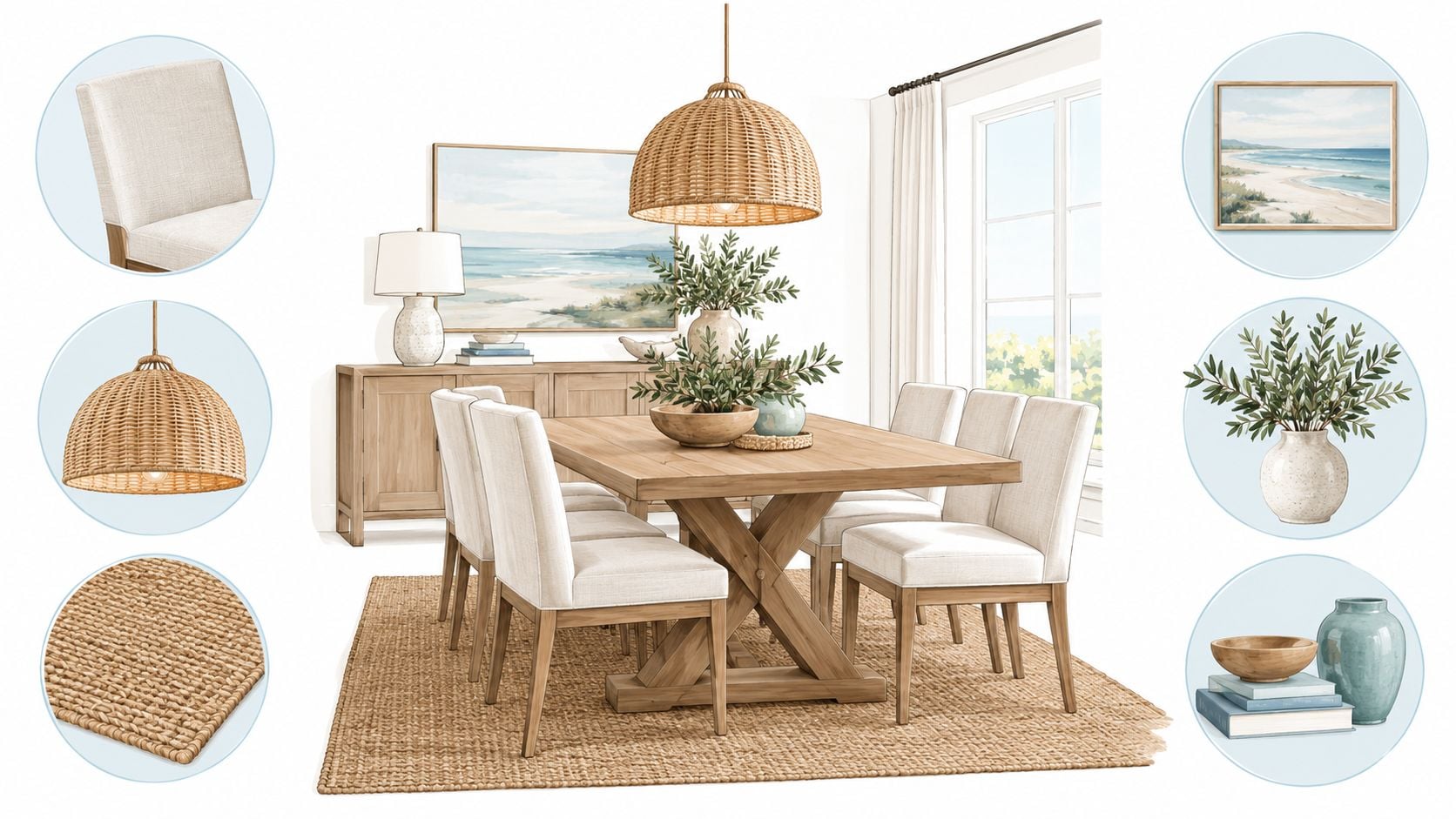
The refined coastal dining room relies on contrast. A solid wood table gains elegance from linen upholstery, woven texture, restrained brass, and carefully chosen lighting. A room filled entirely with pale surfaces can feel flat, so natural variation and warmer accents are essential.
Build the room around one substantial anchor
A warm oak or teak table can carry the room without excessive accessories. Around it, upholstered dining chairs in linen, sand, soft gray, or muted blue introduce comfort and soften the visual weight of solid wood. Woven chair backs or rattan details can reinforce the coastal connection, but repeating too many woven elements makes the room feel staged.
Lighting should add shape rather than only provide brightness. A woven pendant, linen shade, or aged brass fixture can sit above the table as a textural counterpoint. In a high-ceilinged Central Florida home, a larger organic fixture may balance the volume of the room. In a lower space, a lighter silhouette keeps the dining area open.
Natural rugs, ceramic tableware, timber serving pieces, and restrained artwork create a layered setting. The most successful artwork may reference water, terrain, or light without showing a literal beach scene. That distinction keeps the room connected to coastal design while preserving a sense of place and personal history.
Use repetition without matching everything
A dining room connected to a living room needs a visual conversation between the two spaces. Repeating a wood tone in a nearby console or coffee table can make the open plan feel intentional. A shared color from a sofa cushion, dining chair, or artwork is enough to connect the zones without creating a coordinated showroom set.
The guide to mixing furniture styles offers a sound principle for this approach: pieces should relate through proportion, finish, or texture, but they don't need to come from one collection. A Canadel dining setting, for example, can feel more individual when paired with complementary lighting and collected accessories rather than an entire matching suite.
A restrained palette works best:
- Foundation: Warm white, sand, oatmeal, pale gray, or natural wood.
- Secondary tone: Sea-glass green, muted blue, driftwood gray, or soft charcoal.
- Metal accent: Aged brass, bronze, or a properly finished aluminum base.
- Texture: Linen, rattan, jute, cane, ceramic, and visible wood grain.
A single sculptural bowl, a vase of branches, or a stack of linen napkins usually contributes more than a crowded collection of shells. Coastal design should suggest an easy Florida lifestyle, not recreate a souvenir shop.
How Do You Protect Wood and Metal Finishes in a Humid Climate
Heirloom furniture rewards consistent care, and Florida homes need a straightforward maintenance routine. The priorities are stable indoor humidity, prompt spill removal, gentle cleaning, and protection from abrasive grit. Care preserves both the finish and the structural stability of the table.
Control the indoor environment
For wood furniture, experts commonly recommend maintaining indoor relative humidity between 40% and 60% to reduce cracking, shrinking, and warping caused by dry or unstable air (wood furniture humidity guidance). Central Florida homeowners should monitor rooms that receive strong air-conditioning, especially when the table sits near a supply vent, exterior door, or sun-washed window.
A stable environment is more important than chasing a perfect daily reading. Direct sunlight can alter finishes and create uneven color, while sudden changes in air moisture can stress wide solid-wood tops. Window treatments, sensible furniture placement, and properly maintained climate control all support the table's longevity.
Follow a disciplined cleaning routine
Use a soft, clean cloth for routine dusting. Spills should be blotted promptly rather than rubbed across the surface, and cleaning products should follow the manufacturer's finish instructions. Harsh solvents, abrasive pads, standing water, and silicone-heavy polishes can compromise a carefully developed matte or natural finish.
Placemats and coasters are useful, but they shouldn't hide the table's character. Felt pads beneath decorative objects can prevent scratches, while serving boards provide a practical barrier for hot dishes and rough ceramics.
Maintain metal and outdoor pieces
Metal bases need regular inspection around welds, fasteners, joints, and drainage points. Fine sand or salt residue can abrade a coating when wiped dry, so a gentle cleaning process with clean water and a soft cloth is safer than aggressive scrubbing. Outdoor tables should be kept covered when appropriate, but covers must allow ventilation so trapped moisture doesn't remain against the finish.
“The strongest maintenance plan is quiet and consistent. Five careful minutes after a gathering protect an investment far better than an aggressive restoration after neglect.”
For detailed guidance on solid wood surfaces, the wood furniture care guide can help homeowners establish a routine suited to a fine dining table. The aim isn't to keep a family table untouched. It's to let the piece develop character without allowing preventable damage to become permanent.
Why Should You Invest in Custom-Order and American-Made Furniture
A coastal dining table is a significant visual and functional commitment. Custom-order and American-made furniture justify a higher initial investment through better material selection, stronger joinery, serviceable construction, and control over dimensions and finish.
Mass-produced furniture often prioritizes quick assembly, standardized sizing, and broad market appeal. That approach can work for temporary needs, but it creates risk for a homeowner with a specific room, a demanding climate, or an expectation that the dining table will remain in the family. Online photographs also can't reveal the weight, edge treatment, finish depth, joint quality, or comfort of the chairs.
Construction determines long-term value
Solid wood has structural integrity, weight, and repair potential that thin veneers, particle board, and disposable flat-pack construction generally don't match. Traditional joinery allows makers to build for movement instead of treating seasonal expansion as an inconvenience. Hand-finished surfaces also offer a depth and variation that mass finishing rarely reproduces.
Custom ordering matters when a Central Florida home has an unusual dining niche, a long sightline, or an open plan that demands a particular proportion. Homeowners can select the wood, stain, edge profile, base, extension function, and seating configuration instead of forcing the room to accommodate an arbitrary stock size.
Heritage lines offer different strengths
Stickley represents timeless Arts and Crafts heritage, heirloom solid-wood construction, and handcrafted joinery. Its visual language suits homeowners who want a dining table with architectural clarity and enduring character.
Amish craft focuses on hand-selected solid hardwoods, traditional joinery, and custom American craftsman furniture. Mavin offers precision solid-wood dining and bedroom collections built by custom bench-carvers in Amish country.
For custom dining furniture, Canadel is known for hand-finished solid birch pieces crafted to individual design specifications. Amisco provides modern, durable Canadian-made metal and wood dining and bar seating, which can be especially useful when a room calls for a lighter metal silhouette.
Other furniture categories demonstrate the same principle. Smith Brothers is associated with custom bench-made comfort, premium frame construction, and extensive fabric and leather customization. Bassett and Craftmaster represent classic American-made quality, custom upholstery, and accessible luxury. American Leather combines high-performance luxury leather with precision engineering and the Comfort Sleeper®.
For ergonomic seating elsewhere in the home, Stressless from Norway is recognized for Norwegian ergonomic engineering, patented Glide® systems, and lumbar support. Palliser offers contemporary North American leather and fabric home theater and sectional seating.
The point isn't to purchase a label for its own sake. It's to select a maker whose construction philosophy matches the household's expectations. A table that can be refinished, adjusted, or handed down carries emotional value as well as practical value. A local showroom can also inspect the room, evaluate the finish in person, and coordinate delivery, rather than leaving a homeowner to resolve fit and quality questions after an online shipment arrives.
Ready to Transform Your Central Florida Dining Space
A successful coastal dining room in Central Florida begins with a clear decision. The table should be natural but not rustic by default, relaxed but not flimsy, and distinctive without relying on nautical decoration. Warm woods, soft neutrals, woven accents, curved profiles, and durable finishes create a room that feels connected to the coast while remaining appropriate for an established Orlando-area home.
A homeowner in Longwood may need a compact round table for an intimate breakfast area. A family in Lake Mary may benefit from a substantial extension table that remains composed during everyday dinners and opens for gatherings. A Sanford or Winter Park residence with a defined dining room may call for a long solid-wood piece that relates to existing floors, millwork, and lighting.
Those decisions are easier to make with real samples and experienced guidance. A design consultant can assess circulation, compare wood tones in the home's light, coordinate chair comfort, and determine whether a table belongs indoors, on a screened porch, or in a more demanding outdoor setting. That level of attention matters when the purchase is intended to serve the household for years rather than fill an empty room temporarily.
Slone Brothers Furniture has served Central Florida as a local, family-owned showroom since 1980, with more than 46 years of local expertise. Its broader offering includes dining furniture, American-made and Amish-crafted pieces, custom-order options, complimentary in-home design services, and home delivery. The showroom experience is designed around conversation and careful selection, not automated recommendations or pressure to choose before the room has been understood.
The best coastal dining tables don't merely complete a design scheme. They establish where people gather, how a room moves, and what kind of care a household values. For a discerning homeowner, that makes the selection worth approaching as a design consultation and a long-term furnishing decision.
Ready to invest in furniture that lasts a lifetime? Skip the online guesswork and automated digital chatbots. Visit Slone Brothers Furniture in Longwood, Florida, to compare coastal dining tables, discuss custom finishes and seating configurations, and work face-to-face with experienced design consultants on a dining room built for Central Florida living.