

Wall Art Near Me: The Central Florida Sourcing Guide


The most popular advice about wall art is wrong: art shouldn't be the last decorative item added to a room. In a well-furnished Central Florida home, it establishes scale, anchors furniture, and controls where the eye settles. Searching for “wall art near me” should therefore begin with the wall, the furniture beneath it, and the room's natural light, not with a scroll through attractive but unmeasured images.
That distinction matters in Longwood, Lake Mary, Sanford, Winter Park, Altamonte Springs, and throughout Greater Orlando. A premium sofa, dining table, or bedroom collection is selected for proportion and construction. Wall art deserves the same discipline. The global wall art market was valued at USD 66.89 billion in 2025, with a projected value of USD 145.49 billion by 2034, according to Fortune Business Insights' wall art market forecast. The category is now a substantial furnishing segment, not an afterthought.
Why Wall Art Is a Spatial Decision, Not Just Decor
Wall art is architecture for the eye. A large canvas can make a generous wall feel intentional, while a small print above a substantial sofa leaves the room visually unfinished. The mistake isn't choosing the wrong color. It's choosing a piece without considering the structure around it.
A room's furniture creates zones. The sofa defines conversation, the dining table establishes gathering, and a console controls the entry sequence. Art should reinforce those zones rather than float independently above them. That's why professional designers treat scale, alignment, negative space, and sightlines as primary decisions. The principles of scale and proportion in design are especially useful when a homeowner is furnishing an open-plan Orlando residence where one wall may serve several visual functions.
Design authority: If the furniture feels substantial, the art must have enough physical and visual presence to meet it.
The room should come before the artwork
A discerning homeowner shouldn't ask only whether a piece is beautiful. The better questions are:
- What does it anchor? A sofa, bed, console, fireplace, or dining area should have a clear relationship with the artwork.
- What does the wall require? A tall wall needs vertical presence, while a broad wall may call for a horizontal composition or a gallery block.
- What does the room already contain? Wood tones, upholstery, metal finishes, rugs, and lighting should inform the frame and palette.
- What should endure? A thoughtfully selected piece should remain relevant if the room's accent pillows or paint color change.
The case for quality is equally strong. Mass-produced prints can fill a blank wall quickly, but they rarely provide the material depth, frame integrity, or personal meaning expected in an heirloom-oriented home. A Central Florida homeowner investing in solid wood furniture, premium upholstery, or ergonomic seating shouldn't finish the room with art that looks temporary.
Local sourcing also improves the decision. In a Longwood showroom, a buyer can compare the art's scale and finish with furniture at actual room proportions. That physical judgment is difficult to reproduce through a screen, particularly when a piece's texture, frame profile, and color response under Florida daylight determine whether it feels refined or merely acceptable.
How to Calculate the Perfect Size and Placement
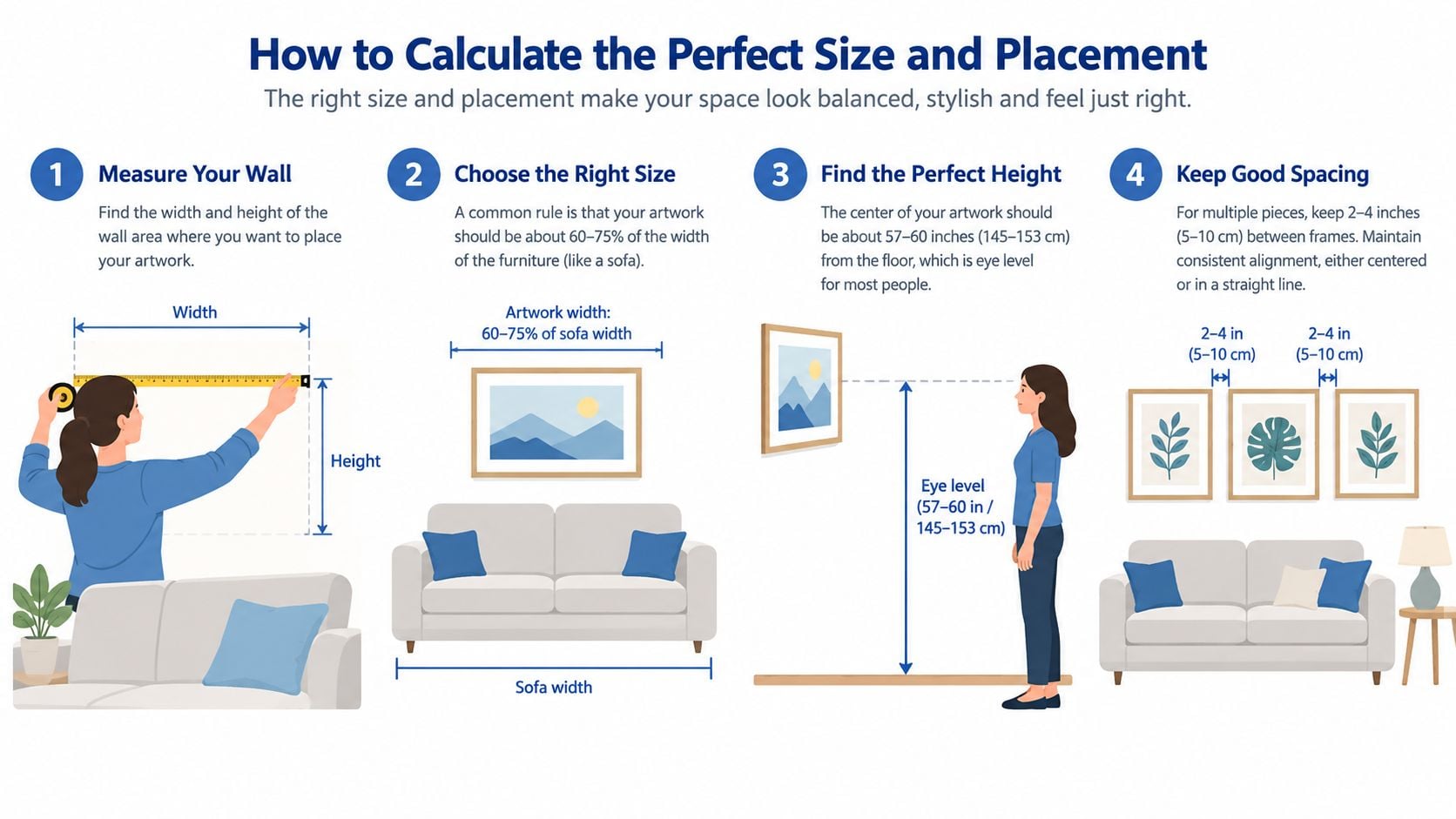
The most reliable approach is mathematical before it becomes aesthetic. Measure the furniture, define the usable wall, and treat a gallery arrangement as one combined composition. These steps prevent the two most common failures, art that is too small and art that is hung too high.
Start with the furniture beneath it
Measure the width of the sofa, console, bed, or other furnishing that will sit below the art. The artwork or complete gallery block should occupy about 60% to 75% of the usable wall width, or approximately two-thirds to three-quarters of the furniture's width, as outlined in Wayfair's wall art size guide.
For example, a gallery wall above a long console should be measured as a single rectangle. Add the width of every framed piece, including the visual gaps between them, then compare that total with the console and the wall. A single narrow print may be attractive on its own, but it won't carry the composition if the furniture beneath it is broad and visually heavy.
Set the vertical relationship
Leave roughly 4 to 12 inches between the bottom of the artwork and the top of the furniture. The correct gap depends on frame depth, furniture height, and whether lamps or accessories occupy the surface, but the art should feel connected to the furnishing rather than suspended above it.
For an unanchored piece, such as art on an open hallway wall, position the center around 57 to 60 inches from the floor, using the guidance in the same wall art sizing reference. Eye level remains the governing principle, but the room's architecture still matters. A very tall ceiling doesn't justify pushing a modest piece toward the crown molding.
Practical rule: Measure the whole gallery wall as though it were one oversized artwork. The furniture should relate to the outer edges of the group, not to one favorite frame in the middle.
Use room-specific judgment
A sofa generally needs a horizontal composition or a gallery block wide enough to balance its mass. Above a bed, the art should align with the bed's centerline and respect the headboard's height. Above a dining table, the arrangement must remain visually connected to the table without creating a collision risk for seated occupants.
Televisions require more restraint. The art should not compete with the screen, and the wall composition should account for glare, cabinetry, and viewing height. Slone Brothers' guidance on art above a television is useful for homeowners who want the entertainment wall to feel integrated rather than overloaded.
Before drilling, place paper templates on the wall or use removable painter's tape to mark the outside dimensions. Stand at the room's principal viewing points, including the sofa, doorway, and adjacent circulation path. If the composition looks undersized from the entrance, adding a smaller frame won't solve the problem. The entire arrangement needs more scale.
Which Materials and Styles Suit Central Florida Homes
Central Florida light is generous, and that changes how wall art reads throughout the day. A finish that looks balanced under showroom lighting may appear cooler, flatter, or more reflective beside a bright window in Winter Park or a sun-filled living room in Lake Mary. Material selection should account for both visual character and the conditions surrounding the art.
Canvas remains a strong choice for rooms that need softness and depth. A gallery-wrapped canvas reduces the visual weight of the frame and works well above upholstered seating, in bedrooms, or alongside transitional furniture. Framed art introduces sharper architectural definition, making it effective above a solid wood console, formal dining piece, or American-made upholstery.
Metal art offers a cleaner, more reflective expression. It can suit contemporary homes, but it needs careful placement near windows and direct lighting because reflection can distract from the image. The finish should support existing hardware and furnishings, not introduce a disconnected metallic note.
Match finish to the room's existing language
Current wall art demand is broad rather than confined to one look. Recent trend coverage identifies abstract wall art as a dominant search category, with canvas maintaining stronger interest than metal or framed alternatives, while also noting attention around warm metals, wood elements, French country influences, and color drenching. Those observations appear in current wall art trend coverage, but a local buyer should still prioritize the architecture and furniture already in the home.
- Transitional rooms: Choose framed abstracts, restrained botanicals, or artwork with warm wood and aged metal details.
- Coastal-modern rooms: Favor quiet movement, layered neutrals, organic textures, and canvas that echoes the region's relaxed light without relying on theme-driven beach imagery.
- Contemporary rooms: Use clean-lined metal, graphic abstraction, or a large-scale canvas with controlled color.
- Traditional rooms: Consider substantial frames, classical proportion, and art with enough tonal depth to stand beside carved or richly finished furniture.
A natural object can also bring geological texture into a room without making the wall feel mass-produced. For homeowners considering an organic focal point, a unique septarian stone slice offers a reference for how mineral pattern, natural variation, and sculptural presence can influence a curated wall.
Protect color and coordinate with furniture
Sun exposure should influence placement and glazing decisions. No finish should be selected in isolation from the window orientation, wall color, and nearby upholstery. A piece that coordinates with a sofa in the showroom should be viewed beside the actual fabric, wood tone, or leather whenever possible.
The strongest rooms use repetition without exact matching. A warm frame can echo a dining table's wood, a muted mineral tone can support a rug, and a brushed metal detail can relate to lighting or cabinet hardware. The objective isn't a themed room. It's a composition where every element appears to belong.
For broader room planning, interior design guidance for Florida homes can help connect wall art with furniture scale, natural light, and the practical demands of Central Florida living.
Where to Source Premium Wall Art in Greater Orlando
The venue matters because wall art is a tactile purchase. Online images can communicate subject and approximate color, but they rarely reveal frame depth, canvas tension, surface sheen, or how a piece relates to a full-scale room. That uncertainty is especially costly when the art is intended to complete a carefully furnished home.
A local showroom offers a different sequence. The homeowner can bring dimensions, fabric samples, room photographs, and paint information, then assess potential pieces in relation to furniture and lighting. A design consultant can identify when a preferred piece is beautiful but structurally wrong for the wall, which is precisely the kind of mistake that a screen-based purchase makes easy.
The difference is visible before installation
A useful comparison looks like this:
| Online-only selection | Local showroom selection |
|---|---|
| Color is judged through a screen | Color is assessed in person |
| Texture and frame depth remain uncertain | Surface and construction can be examined |
| Scale depends entirely on measurements | Scale can be considered beside full-size furniture |
| Room coordination happens after purchase | Furniture, finishes, and art can be coordinated together |
| Returns may become part of the design process | The decision is refined before installation |
This isn't an argument against research. Digital browsing can help a homeowner clarify preferred subjects, formats, and palettes. It shouldn't replace the final evaluation of a substantial piece intended for a permanent room.
Choose local expertise over isolated inventory
For residents searching for wall art near me in Longwood or Greater Orlando, Slone Brothers Furniture provides wall décor alongside living, dining, bedroom, and other furnishings. The showroom has served Central Florida as a family-owned business since 1980, giving local homeowners a place to evaluate décor within a broader furnishing environment rather than as an isolated purchase.
The distinction is meaningful for homeowners furnishing several rooms after moving to Lake Mary, Sanford, or Altamonte Springs. Wall art may need to coordinate with a dining collection, bedroom casegoods, a home office, or a living room sectional. A showroom that understands the complete home can help maintain continuity across those spaces.
Quality also deserves scrutiny. American-made and Amish-crafted furniture often earns its higher initial price through solid materials, careful joinery, and repairable construction. The same long-term-value principle applies to art. A properly framed, well-finished piece that remains relevant can serve the home for years, while an impulsive purchase may be replaced as soon as the room evolves.
For homeowners planning a large wall, big wall art ideas provide a useful starting point, but dimensions and room photographs should guide the final selection. The right piece isn't just large. It must be large in proportion to the furniture, the ceiling, and the visual rhythm of the room.
How Custom Orders and Design Services Guarantee a Perfect Fit
Custom art is not an indulgence when the wall has difficult dimensions. It is a practical solution for oversized rooms, narrow corridors, tall stairwells, unusual niches, and furnishings that require a precise visual relationship. Off-the-shelf art often forces the homeowner to compromise on width, frame, mat, palette, or orientation.
A custom-order process reverses that compromise. The design begins with the wall and the room's purpose, then moves toward image, material, framing, and installation. That sequence protects the investment because the art is selected to serve the architecture instead of asking the architecture to accommodate a random purchase.

The consultant should solve the room, not push a product
An experienced design consultant begins with questions:
- What furniture is already committed? The art must respect the sofa, bed, dining set, or console that anchors the wall.
- What must the room communicate? A formal dining room, relaxed family room, and quiet bedroom need different visual energy.
- What conditions affect the material? Window exposure, humidity, circulation, and cleaning needs influence format and finish.
- What should remain flexible? A neutral frame or adaptable palette may help the homeowner move the piece as the home changes.
Complimentary in-home design service has practical value here. Measurements taken in the actual Longwood, Orlando, or Central Florida residence reveal problems that showroom dimensions can't, including offset windows, low outlets, switch plates, molding, sightlines, and furniture that sits away from the wall.
Slone Brothers' furniture stores with design services resource reflects the value of face-to-face planning. The service should feel collaborative, not transactional. A homeowner should be able to reject a recommendation, compare alternatives, and understand why a particular size or frame works.
Custom work rewards patience
Custom luxury furniture commonly takes 8 weeks to 6 months, with straightforward pieces often taking 8 to 12 weeks and complex work extending to 16 to 24 weeks, according to custom furniture timeline guidance. Custom upholstery guidance similarly places many orders in the 8 to 14 week range, with production taking 6 to 12 weeks and shipping and final delivery adding 1 to 4 weeks in some cases, as described by industry upholstery timing guidance.
Those timelines reinforce a broader principle. A carefully planned room should not be rushed by an impatient wall-art purchase. If the sofa, dining table, or bedroom furniture is being custom ordered, art should be coordinated during the same design process so the final room feels deliberate from the beginning.
How to Light and Protect Your Art Investment
Good art lighting reveals surface, color, and texture without creating glare. A single harsh spotlight often produces a bright hotspot in the center and leaves the surrounding wall visually dead. Even wash lighting gives the artwork a more controlled presence and makes the entire composition feel intentional.
Professional wallwashing guidance recommends placing luminaires approximately one-third of the room height away from the wall, with fixture spacing generally matching the distance from the wall. The geometry is explained in professional artwork lighting guidance. Wider beam angles and an aim slightly away from the direct sightline usually produce a calmer, more uniform result.
Build the lighting around the material
Canvas can tolerate a softer, broader wash that brings out its surface without exaggerating texture. Glass-fronted framed art needs more attention to angle because direct illumination can reflect into the viewer's eyes. Metal art should be tested from the room's principal seating positions before fixtures are permanently installed.
Homeowners can also explore practical approaches to mood lighting for any budget, provided the chosen fixtures support the artwork rather than turning it into a glare source. Lighting should complement the room's existing lamps and architectural illumination, not compete with them.
Control the Florida environment
Central Florida homes face bright daylight, humidity, and frequent air-conditioning cycles. Artwork should remain away from direct sun whenever possible, and the room should avoid abrupt environmental extremes. A stable interior environment, quality framing materials, careful dusting, and clean hands during handling all contribute to long-term preservation.
Use a soft, dry cloth on frames and surrounding surfaces, and follow the manufacturer's care instructions for canvas, metal, glass, and natural materials. Don't spray cleaner near the artwork. For valuable or delicate pieces, professional framing and installation are more prudent than improvised hardware.
The best wall art near me search ends with more than a purchase. It ends with a correctly scaled piece, a compatible frame, controlled illumination, and a room where the artwork appears to belong.
For Central Florida homeowners, Slone Brothers Furniture offers curated wall décor, custom-order furniture, complimentary in-home design services, and face-to-face guidance for coordinating art with living, dining, bedroom, and office spaces. Visit Slone Brothers Furniture in Longwood, FL to bring room dimensions, photographs, and finish samples, then work with experienced design consultants on a wall-art plan built for lasting value.