

Small Glass Dining Sets: A Buyer’s Guide for Real Homes


The table looked perfect in the showroom, but the dining nook in a Longwood home told a different story. Once four chairs were pulled out, one blocked the kitchen passage, another pressed against the wall, and the family's supposedly compact dining area became a daily obstacle course. That's the moment many Central Florida homeowners realize that choosing small glass dining sets isn't mainly a style decision. It's a decision about safety, circulation, construction, and how the household lives.
Glass can make a tight room feel brighter and less crowded, but a visually light tabletop still needs a stable base, proper clearance, and a surface built for daily use. The recommendations below focus on what matters in a condo near Orlando, a breakfast nook in Lake Mary, a narrow dining area in Sanford, or a transitional home in Winter Park. The right piece should look refined, support everyday routines, and remain comfortable long after the initial design appeal fades.
Why Small Glass Dining Sets Work for Real Homes
A dining area in a Central Florida home may sit between the kitchen and living room, handle homework, and host guests without accommodating a full-size formal suite. Choosing small glass dining sets involves decisions about safety, circulation, and construction, not just aesthetics. Glass earns consideration because it preserves sightlines and keeps a compact room from feeling visually blocked.
A clear tabletop leaves the flooring, rug, chair legs, and architectural details visible. That openness suits open-concept layouts, where the dining table must define a zone without shutting it off. Round tops soften square nooks, while narrow rectangular tops follow the lines of a passage or kitchen wall.
The material still needs sound construction. Look for a stable base, a properly finished edge, and seating that supports the household's daily routine. A visually light surface should never excuse a shaky frame or awkward chair placement.
The room still decides
A substantial base, wide apron, and oversized chairs can still make a compact set feel intrusive. A pedestal that spreads into the walking lane creates the same problem. Judge the set with chairs pulled out and people seated, not with every chair pushed neatly under the table for a showroom photograph.
Household use should guide the choice. A couple who eats at the table occasionally may suit a smaller round design with sculptural seating. A family with children needs a stable base, cleanable upholstery, and enough room for chairs to move without striking nearby cabinetry. Frequent hosts should give priority to stability and usable surface area over an ultra-minimal silhouette.
Showroom rule: A small glass dining set works when it reduces visual weight without reducing physical comfort.
The wider market also shows that glass remains relevant in dining-related products. The glass tableware market, which includes dining-related tabletop goods, was valued at USD 10.56 billion in 2023 and is projected to reach USD 17.69 billion by 2030, with a 7.8% CAGR from 2024 to 2030, according to market information on glass tableware and dining products. Dinnerware represented the largest product share at 42.5% in 2023, while Asia Pacific held a 38.1% revenue share.
Those figures do not make every glass table suitable for a fine home. They do show that the material has lasting commercial relevance beyond a passing accent. Choose the construction according to the room, the household, and the expected lifespan of the investment. A showroom evaluation should confirm stability, edge quality, chair comfort, and how the full set occupies the room.
How to Size a Small Glass Dining Set the Right Way
The most important measurement is the open space around the table. A small glass dining set should have at least 36 inches of clear space from the table edge to the nearest wall or obstruction, because chairs need room to pull out while people pass behind them, as explained in this guide to dining tables for small spaces. In a busier route between a kitchen, patio door, and living room, 42 to 48 inches is the more comfortable target.
That clearance rule should be tested with the chairs in use. A table that technically fits with chairs tucked underneath may fail once someone sits down, another person walks behind them, or a cabinet door opens nearby.
Measure the room before choosing the shape
Use this simple process before visiting a Longwood showroom:
- Measure the entire dining zone. Record the distance between walls, counters, islands, doors, and furniture that won't move.
- Mark the proposed footprint. Painter's tape on the floor creates a more honest test than visualizing dimensions from a screen.
- Pull out chair zones. Mark the table edge and the space required for a chair to slide back.
- Trace traffic paths. Walk from the kitchen to the living room, entry, lanai, and patio. Any route that feels pinched needs more clearance.
- Check the underside. Plan for at least 27 inches of knee clearance under the table when accessible planning or generous legroom matters, within the 42 to 48 inches of clear floor space often used for wheelchair-accessible layouts, based on small-space dining table sizing guidance.
A 36-inch round top is a strong candidate for four people in a compact nook, provided the surrounding clearance works. A 48-inch rectangular top can serve a smaller household well, but seating depends on chair width, leg placement, and whether the ends remain usable. A design consultant should confirm the actual chair positions rather than relying on a nominal seat count.
Match height and seating
Standard residential dining tables are generally 28 to 30 inches high, a range that supports comfortable chair pairing and practical leg clearance, according to this standard dining table height guide. Counter-height chairs shouldn't be paired with a standard dining table just because the set looks attractive together.
The right sizing worksheet has three answers:
- Daily users: Who sits at the table most nights?
- Peak users: How many people need seating during regular entertaining?
- Traffic priority: Which side needs the widest passage?
For most compact homes, daily comfort should drive the size. Occasional guests can be addressed with flexible seating, but a table that crowds the room every evening is the wrong investment.
Tempered Glass and Frames That Earn the Space
A glass tabletop should be specified as thermally tempered safety glass, not just described as “strong glass.” Tempering uses controlled heating and rapid cooling to create internal compressive stress, making the surface more resistant to impact and rapid temperature changes. If properly tempered glass fails, it generally breaks into small, regular fragments rather than long sharp shards, as detailed in this explanation of glass dining table practicality and safety.
Annealed glass is a different proposition. It doesn't receive the same strengthening treatment, and its failure pattern can produce larger, sharper pieces. A daily dining surface in a tight room deserves a documented tempering specification, not a vague showroom description.

Read the construction details
A careful buyer should ask for the following information in writing:
- Glass type: The product literature should identify thermally tempered safety glass.
- Edge treatment: A polished, smoothly finished edge is preferable to a raw or poorly finished perimeter, especially where chairs may contact the tabletop.
- Support design: The glass should rest on engineered supports or clearly defined attachment points, not an improvised arrangement.
- Base geometry: Broad, well-balanced support is more reassuring than a narrow pedestal that concentrates weight high above the floor.
- Testing language: Ask whether the complete table, not only the glass, has undergone impact, stability, and static-load testing.
Independent consumer testing found that some glass-top tables failed stability and glass-breakage checks. Examples included tops breaking into large, dangerous shards and tables overturning under downward force, which is why furniture safety testing guidance deserves attention during selection.
Choose the frame for the household
A tempered glass top on a solid hardwood base is the most forgiving pairing for many compact dining areas. Wood adds visual warmth and substantial support, while the glass keeps the room from feeling overloaded. A steel base can work beautifully in a contemporary Orlando condo, but the finish must be durable and the geometry must resist tipping. Mixed-material frames can bridge modern and transitional interiors, though every joint and connection deserves inspection.
The material itself isn't enough. A beautifully polished top on an unstable base is still a poor purchase. For homeowners comparing metal details, this guide to metal accents can help clarify how finish and structure influence the surrounding room.
Style Pairings That Make the Set Feel Built In
The best small glass dining sets don't look dropped into a room. Their base, chairs, lighting, and nearby case goods should make the table feel intentional, almost architectural. A clear or low-iron glass top keeps the surface quiet, so the frame and seating carry more of the design responsibility.
Wood, metal, and mixed frames
A wood base brings the strongest sense of permanence. It suits a craftsman or transitional home in Longwood, particularly when the dining area connects to hardwood flooring, paneling, or warm cabinetry. Stickley's craftsman heritage offers a useful reference point for homeowners who value visible joinery, traditional proportion, and furniture with a lasting presence. A glass surface can make that substantial character feel more approachable in a compact room.
A metal base creates a cleaner contemporary line. It pairs well with slim upholstered chairs, neutral walls, and modern lighting in a Winter Park condominium or an open Orlando interior. The weak choice is an overly thin or decorative metal structure that prioritizes appearance over balance.
A mixed wood-and-metal base is more adaptable. It can connect warm cabinetry to black hardware, or soften a modern room without making the dining area look formal. Canadel's dining craftsmanship, along with American-made lines from Bassett and Craftmaster, demonstrates how finish, proportion, and seating can shift the personality of a dining setting.
Let the chairs complete the scale
Avoid pairing a delicate glass top with bulky armchairs on every side. That combination consumes the very space the glass was meant to preserve. Slim side chairs with supportive backs usually maintain better circulation, while a single pair of armchairs can define the ends of a rectangular table without overwhelming it.
Upholstery should be chosen for both comfort and maintenance. A performance-oriented fabric can make sense for an active household, while leather adds a refined appearance and wipes clean easily when properly cared for. Homeowners comparing traditional, modern, coastal, and craftsman elements can use this guidance on mixing furniture styles before committing to a frame finish.
The same tabletop can feel entirely different in two homes. In a Lake Mary family room, a warm wood base and textured chairs can make it welcoming. In a Sanford or Winter Park condo, a dark metal base and crisp, urban seating can make the same footprint feel sharp and modern. The table should support the room's existing language, not force the entire home into a new style.
Honest Pros and Cons for Daily Living
Glass performs well in many homes, but only when the tabletop is properly tempered and the base is stable. The surrounding construction determines whether a glass set stays safe and satisfying over time, so treat safety and longevity as the first buying tests, not afterthoughts.
The practical advantages are clear. Glass preserves sightlines, reflects available light, wipes clean without absorbing food spills, and keeps an interesting base or rug visible. In smaller Central Florida dining zones, those qualities prevent the table from feeling visually dominant.
What glass does well
- Visual openness: A transparent surface keeps the room's architectural lines visible.
- Flexible styling: The top works with wood, steel, mixed-material, modern, or transitional bases.
- Straightforward cleaning: Everyday spills usually remain on the surface instead of sinking into a porous material.
- Space efficiency: A compact footprint feels less imposing when the tabletop does not interrupt the view.
- Design longevity: A restrained glass surface can adapt as chairs, lighting, and surrounding décor change.
Daily drawbacks deserve equal attention. Fingerprints show quickly, sunlight can create glare, and hard objects placed carelessly may produce an unpleasant clang. Young children, energetic pets, and frequent entertaining increase the importance of a stable base and verified impact performance. Choose glass for its construction, not just its airy appearance.

The failure modes that matter
The main concerns are poor tempering, unstable bases, and careless placement. Independent testing has found that some glass-top tables produced dangerous uneven shards or overturned under downward force. That finding applies to product quality and testing, not to every glass table. Ask how the glass was tempered, how the base is secured, and whether the complete table was tested as a unit.
Pets and children also create edge-to-edge impact risks in cramped rooms. A rounded top can reduce corner encounters, but it cannot correct an unstable base or inadequate glass construction. For a particularly active household, solid hardwood offers more forgiveness. A well-built tempered design remains appropriate when its safety and stability details are verified before purchase.
Care and Cleaning Routines for Central Florida Homes
Central Florida homes put furniture through humidity, strong sunlight, air-conditioning cycles, and busy indoor-outdoor routines. A small glass dining set can stay elegant in that environment, but care should protect both the tabletop and the frame.
Begin with a soft microfiber cloth for daily dust and crumbs. For fingerprints or food residue, use a glass cleaner that is compatible with the frame finish, apply it to the cloth rather than flooding the tabletop, and dry the surface completely. Excess liquid should never be allowed to collect around metal fittings, wood joints, or support pads.
Protect the frame as carefully as the glass
A hardwood base needs a controlled routine suited to its finish. Clean spills promptly, avoid abrasive pads, and keep standing moisture away from joints. The Slone Brothers guide to caring for wood furniture provides a useful reference for maintaining solid wood surfaces without stripping their protective finish.
Metal bases require equal attention in rooms near pools, patios, or frequently opened doors. Untreated metal can react poorly to persistent moisture and treated outdoor air, so the finish should be inspected periodically for scratches or exposed areas. Silicone or felt pads beneath accessories can prevent unnecessary contact, while properly fitted floor protectors beneath chairs reduce dragging and noise.
A practical maintenance checklist
- Daily: Remove crumbs and wipe visible fingerprints with a soft cloth.
- Weekly: Clean the full tabletop and inspect the edges, supports, and base connections.
- As needed: Replace worn chair-leg pads before they mark flooring or create unstable movement.
- Seasonally: Check whether direct sunlight reaches the same frame area for long periods and adjust window treatments when appropriate.
- Always: Lift objects instead of sliding them, and keep abrasive cleaners away from glass and finished wood.
Avoid ammonia-heavy products when the frame manufacturer warns against them, abrasive scouring materials, and improvised cleaners that can dull a finish. Sun exposure should also be managed thoughtfully. Window treatments, furniture placement, and occasional rotation of decorative objects can help keep a dining area visually consistent over time.
Buying Small Glass Dining Sets in Longwood and Greater Orlando
Measure the room before you shop, then test the complete set in person at a Longwood showroom. Physical inspection reveals details a screen cannot, especially stability, glare, tabletop edges, and chair comfort. Press against the base, sit in every chair, and check how the set handles the room's actual traffic pattern.
Slone Brothers Furniture offers dining furniture, custom-order options, complimentary in-house design services, home delivery, and a clearance outlet for buyers weighing different paths. Consider the Low Price Promise and flexible financing alongside construction quality and expected service. Neither should replace a close inspection of the glass, frame, and seating.
A local decision path
- Bring measurements. Record wall lengths, door swings, kitchen traffic, and nearby furniture before visiting the showroom.
- Test the complete set. Sit in each chair position and pull every chair back as far as the room requires.
- Ask for specifications. Confirm tempered glass, edge finishing, support design, and stability information.
- Review custom options. A custom-order program can help match the finish, frame, upholstery, and configuration to your home.
- Discuss delivery. White-glove home delivery and order tracking matter when a substantial tabletop must arrive safely and be positioned correctly.
- Check immediate availability. A clearance outlet may provide an immediate-value option, but apply the same inspection standards.
Use this compact dining set selection guide if you are still comparing footprints or considering dining beyond an indoor setting. For a broader local search, review furniture stores in Orlando and pay attention to whether you can view a complete room setting or only an isolated item.
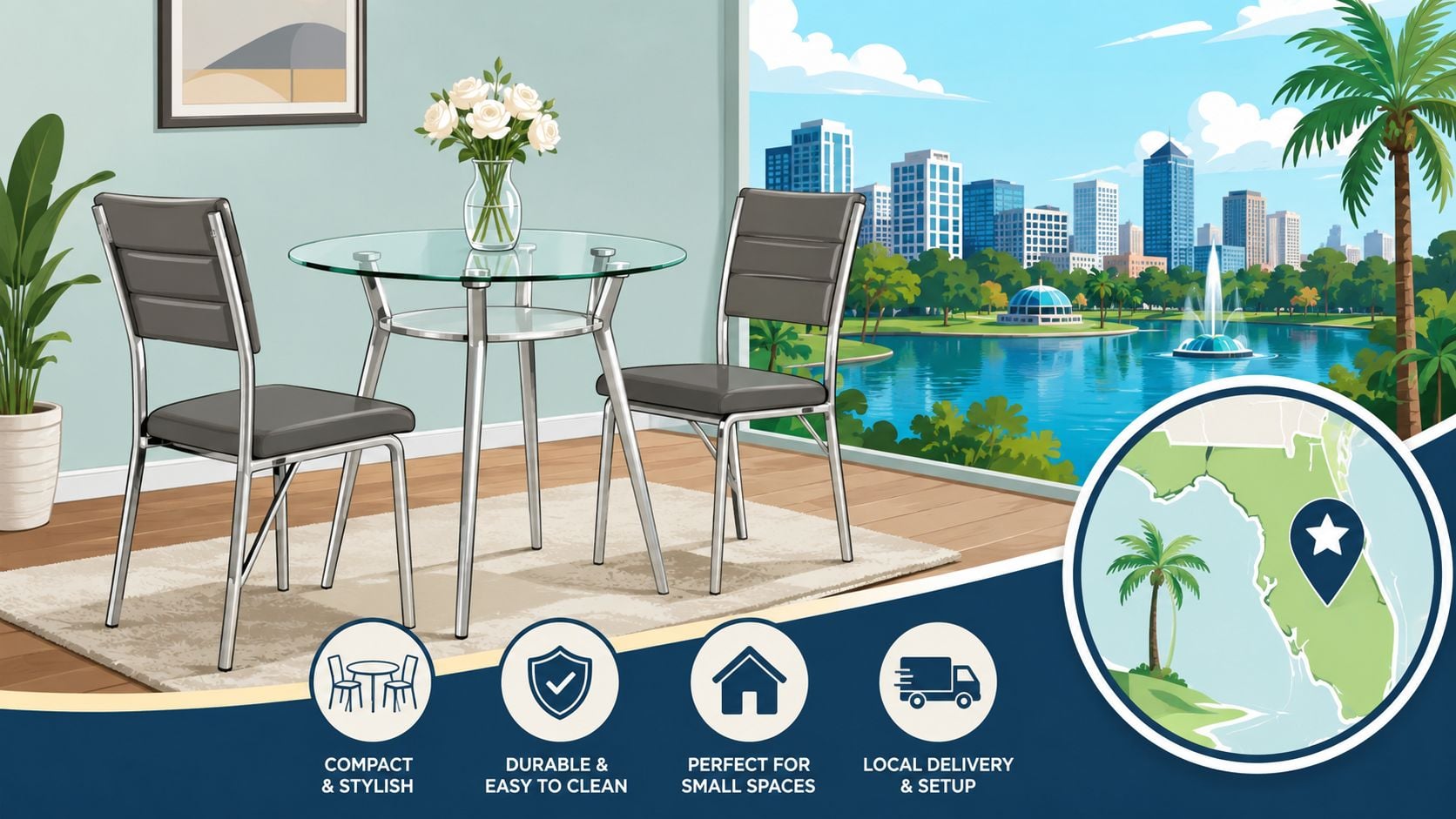
Choose small glass dining sets only after confirming clearances, specifying tempered safety glass, testing the base under pressure, and matching the chairs to the room's traffic. A well-chosen set should simplify daily meals and movement through the room.
Ready to invest in a dining set suited to the room and built for lasting use? Visit Slone Brothers Furniture in Longwood, FL. Experienced design consultants can review measurements, discuss custom finishes, and arrange white-glove delivery for a carefully chosen piece. Homeowners from Orlando, Lake Mary, Sanford, Winter Park, and Altamonte Springs can evaluate the glass, frame, and seating in person.