

Dining Room Sets on Clearance: How to Buy Smart


A Saturday morning clearance listing can create the wrong kind of urgency. A Longwood homeowner spots a solid-wood dining table with a final-sale tag, imagines holiday dinners around it, and feels pressure to buy before someone else does. That pressure is exactly why discerning shoppers need a method.
Dining room sets on clearance can offer genuine long-term value when the markdown reflects a discontinued finish, floor-model status, or end-of-line configuration rather than weak construction. The right purchase isn't the set with the lowest ticket. It's the set with sound joinery, appropriate proportions, complete components, manageable delivery, and a finish that still suits the home years from now.
Central Florida homes also demand practical judgment. Humidity, bright sunlight, active family use, narrow doorways, and rooms that serve as dining areas, homework spaces, and entertaining zones all affect the decision. A clearance set should be evaluated as an investment piece, not treated as disposable furniture.
Why Smart Central Florida Homeowners Buy Dining Room Sets on Clearance
A Longwood homeowner may find a discounted dining set after a showroom rotation, a collection change, or a seasonal inventory push. The markdown creates an opportunity, but it also demands judgment. Buy the construction and proportions first. Let the price confirm the decision.
Dining room sets on clearance make sense when the reason for the reduction is clear. A discontinued finish, floor-model status, last-chance inventory, or replaced configuration can lower the ticket without changing the underlying quality. Amish and American-made construction cues deserve particular attention: solid wood, sound joinery, repairable parts, and a finish that can live with everyday family use. A discounted set with those qualities can become an heirloom. A cheap set with weak structure remains a poor purchase.
Clearance inventory matters because dining furniture occupies substantial showroom and warehouse space. Retailers need to turn bulky pieces into cash flow, especially during promotion-heavy periods. A table may be reduced because its stain is no longer offered, a new size is arriving, or the display needs to change. Those reasons call for inspection, not automatic rejection.
The clearance reasons worth pursuing
Ask why the set was marked down before focusing on its silhouette:
- Discontinued finish: The manufacturer may still support the construction, while the exact stain or paint color is no longer available.
- Floor model: Inspect for handling marks, sunlight exposure, loose hardware, and other display wear.
- Last-chance inventory: Confirm that the table, chairs, leaves, and hardware are complete. Replacement pieces may be difficult to source.
- Configuration change: A retailer may be making room for a different table size, chair profile, or collection.
The wider market also supports regular clearance activity. Market reporting places the global living and dining room furniture market at USD 256.10 billion in 2026, with a forecast of USD 314.43 billion by 2031 and a 4.19% CAGR over that period, according to market data on living and dining room furniture. Holiday pricing analysis reported average home-furniture discounts of around 25% in late 2023, making it the most discounted retail category in that comparison.
Historical U.S. sales data also shows substantial dining-furniture demand, rising from USD 11.44 billion in 2019 to USD 12.62 billion in 2020 and USD 14.96 billion in 2021, a two-year increase of about 30.7%, according to Furniture Today business data. That volume helps keep clearance channels supplied.
For homeowners in Longwood, Lake Mary, Sanford, Winter Park, or Altamonte Springs, the rule is direct: treat the markdown as permission to inspect carefully. A curated clearance and closeout furniture selection earns consideration when the set fits the room, the chairs feel comfortable, the components are complete, and its construction can support years of family meals.
What to Look for in Quality Construction on a Clearance Floor

A clearance tag tells you what the retailer needs to move, not what the furniture is worth. Inspect the set as if you were selecting an heirloom. Start with the table's material, then examine its joints, underside, hardware, and finish. A beautiful stain cannot compensate for a weak frame, unstable chair, or incomplete extension system.
Read the wood before reading the price
Run your hand along the tabletop edge. Solid wood usually shows natural grain movement across the surface and edge. A thin veneer over engineered material may reveal a different pattern along the edge or underside. Particle board can serve in limited applications, yet it does not provide the same structural integrity, weight, repairability, or aging character as a well-built solid-wood table.
Look underneath. Quality dining tables often use mortise-and-tenon joinery, where a shaped tenon fits into a matching mortise. That mechanical connection suits a load-bearing piece and reflects the traditional construction associated with well-made Craftsman furniture, as described in this overview of Craftsman dining construction.
Practical rule: A clearance tag makes inspection more important, not less.
Open every drawer and extension leaf. The leaf should move smoothly, meet the tabletop cleanly, and lock without forcing the mechanism. Check for warped panels, uneven finish, scratches, dents, loose bolts, and wobble under ordinary pressure. Examine screws, bolts, joints, finish consistency, and overall stability, using this dining table and chair inspection checklist as a useful reference.
Examine chairs where wear appears first
Turn a chair over if the showroom permits it. Mortise-and-tenon joints, corner blocking, properly fitted hardware, and substantial frame components indicate stronger construction than a frame held mainly by staples and glue. Sit in every chair, because a floor model may have experienced uneven use.
Pay close attention to:
- Chair rails and seat edges: Handling wear appears here quickly.
- Leg bottoms: Scrapes can reveal careless moving or repeated shifting.
- Connections: Loose joints become more obvious under body weight.
- Drawer operation: Full-extension glides and soft-close action can indicate better case-piece construction.
- Warranty coverage: Confirm which items remain covered and which are sold as-is.
American-made and Amish construction cues deserve attention, including careful wood selection, substantial components, and traditional joinery. They are useful indicators, not substitutes for inspection. Judge the actual set in front of you.
Before signing, confirm that every chair, leaf, bench cushion, and hardware component is included. A missing part can turn a strong markdown into a long-term compromise. For a clear explanation of showroom quality checks, review Slone Brothers' quality assurance processes.
Measuring, Fitting, and Configuring the Right Set for Your Home
A dining set isn't a smart purchase until it fits the room and the route into the room. A table can look restrained on a showroom floor and become oppressive in a Central Florida dining area once chairs, walls, a buffet, and traffic paths are added.
Begin with the room's width, length, and ceiling height. Then measure the doorway, hallway turns, stair landings, and elevator openings that the delivery crew must pass through. A clearance set that can't enter the house is not a value, regardless of its construction.
Use the room as a working plan
Mark the table footprint with painter's tape or removable paper. The plan should account for chair pullback, walking space, and access to nearby doors. A 36-inch traffic path around the table perimeter gives chairs room to move without striking walls or nearby furniture.
Rectangular tables generally need about 24 inches of width per diner, with approximately 12 inches of table edge per place setting. Those figures are practical planning references, not substitutes for sitting in the actual chairs. Armchairs, wide upholstered seats, and counter-height designs change the amount of usable space.
An extendable table is often the most intelligent clearance find for a household that hosts relatives or wants one room to perform several jobs. Inspect whether the leaves store inside the table, whether the support system remains stable when open, and whether the expanded configuration still leaves a comfortable path through the room.
| Dining Set Sizing Reference | |||
|---|---|---|---|
| Table Size | Seats Comfortably | Recommended Room Width | Best For |
| 60-inch round | Four | Confirm with the room footprint and chair depth | Smaller dining areas and conversation-focused meals |
| 84-inch rectangular | Six to eight | Allow table depth, chair pullback, and traffic space | Family meals and regular entertaining |
| Extendable rectangular | Varies by closed and open configuration | Measure both positions before purchase | Flexible rooms and holiday hosting |
| Counter-height set | Varies by product | Account for taller seating and visual proportions | Casual dining areas and open-plan kitchens |
Photographing the room, doorways, and adjacent furnishings can help a design consultant assess the arrangement before delivery. The room-measuring guide for furniture provides a useful starting point, but hands-on confirmation remains valuable when the set includes a heavy solid-wood table.
Clearance Versus Custom and Floor Models
The right buying path comes down to how soon the room must be furnished, how specific the design requirements are, and how much selection the homeowner will sacrifice. Clearance is immediate but limited. Custom furniture gives you control but requires patience. Floor models sit between those choices.
Clearance stock moves quickly as the showroom makes room for new inventory. The finish, chair count, and table size may be fixed, so buy only when the displayed configuration fits your room and your standards. Inspect the joinery, finish, chair stability, and surface condition. A reduced price does not excuse loose construction or damage that will remain visible after delivery.
Custom furniture earns its higher price when the dining room needs a particular width, finish, wood species, chair fabric, or seating plan. A straightforward custom piece commonly takes 8 to 12 weeks after approval. More complex work may require 16 to 24 weeks, with material sourcing adding another 1 to 8 weeks, according to custom furniture timeline guidance. Amish dining pieces may take 10 to 16 weeks, reflecting construction, finishing, and cure time rather than warehouse availability, as outlined in this Amish furniture lead-time guide.
A practical comparison
| Buying Path | Typical Discount | Lead Time | Selection | Best For |
|---|---|---|---|---|
| Clearance stock | Varies by item and condition | Usually immediate or near-immediate | Fixed inventory | A complete, well-fitting set with sound construction |
| Custom order | Usually priced for selected specifications | Weeks rather than days | Finish, size, material, and configuration choices | Design-specific rooms and heirloom purchases |
| Floor model | Often reduced because the display is changing | Immediate, subject to delivery scheduling | Existing showroom configuration | Buyers who want to test the furniture in person |
Material and finish affect production timing. Published furniture order guidance lists some powder-coated or laminate, Corian, and acrylic-top tables at 6 to 8 weeks, while chrome, quartz, wood, or custom-top versions may take 10 to 14 weeks or more, as shown in this furniture lead-time calendar.
A hybrid purchase can make sense. Secure a well-built clearance table now, then add compatible chairs or benches later only after confirming that the manufacturer still supports the finish and dimensions. If you are weighing custom details, review this custom-order furniture guidance before choosing speed over a precise, lasting design.
Understanding the Total Cost Beyond the Price Tag
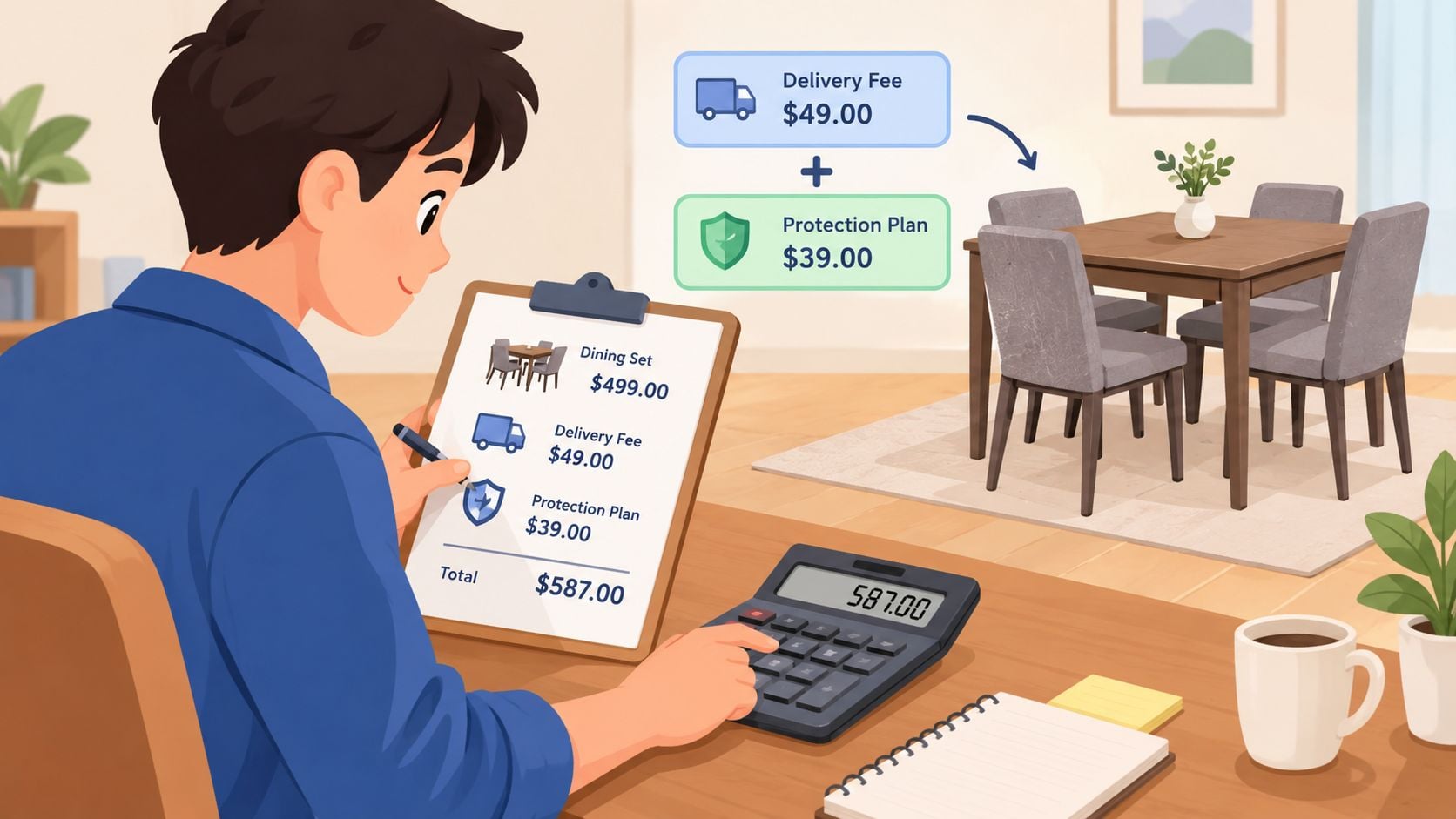
A clearance tag can look convincing under showroom lighting. The better question is what the dining set will cost to inspect, deliver, complete, protect, and use over time. Calculate the complete landed cost, not merely the amount printed on the ticket.
Start with the set, then account for every required service. Central Florida delivery may include room-of-choice placement, but confirm the exact service before paying. Assembly, stairs, narrow entry points, and packaging removal can change both the final arrangement and the value of the purchase. A low-priced table that cannot reach the dining room is no bargain.
Build the calculation before committing
Use this planning formula:
Sticker price + delivery + sales tax + protection plan + assembly or service charges + contingency for missing or damaged components = realistic budget
Set aside room for missing pieces. An extension leaf, matching chair, bench cushion, or original hardware may be absent. Parts for discontinued collections can be difficult to source, and a substitute that does not match can weaken the appearance of an otherwise carefully built room.
Protection plans require close reading. Solid wood benefits from sensible care in Florida's humidity and strong indoor light, but coverage should match the risks you face. Check exclusions and the replacement process. Confirm whether a claim leads to repair, replacement, or store credit.
Final sale changes the risk
Clearance, outlet, and floor-sample purchases often carry stricter return terms than standard merchandise. The policy may classify these items as final sale, with no return or exchange. Treat that condition as a reason to inspect carefully, not as a reason to avoid every markdown.
Ask whether the set is new, boxed, returned, or displayed. List every included piece on the invoice, photograph existing marks, and confirm that the manufacturer warranty remains active. Check joints, slides, chair frames, finish consistency, and hardware before the paperwork is complete.
For a clearer view of why construction affects price, read this explanation of furniture pricing. Materials, labor, joinery, and finishing can raise the initial cost, while better construction can support longer service and more practical repair. That is the quality-curation test: choose the discounted set whose build justifies keeping it for family meals, rather than chasing the lowest tag.
How to Use the Low Price Promise and White-Glove Delivery
A Low Price Promise should be used as a verification tool, not as a performance of aggressive haggling. The buyer should bring a written quote or clear product details, including dimensions, wood or material specifications, finish, chair count, delivery terms, and warranty information.
A lower number means little if it describes a different table, a smaller configuration, an incomplete set, or a delivery arrangement that leaves the homeowner responsible for difficult placement. Experienced showroom consultants can compare the actual specifications and determine whether the products are comparable.
Delivery is part of furniture quality
White-glove delivery matters more with a heavy solid-wood table than with a lightweight flat-packed product. Proper service can include room-of-choice placement, protection for finished floors, careful navigation through the home, and removal of packaging debris. The details should be confirmed in writing, especially for homes with stairs, tight turns, delicate flooring, or limited parking access.
A delivery appointment also gives the homeowner an opportunity to verify the furniture at arrival. Before the crew leaves, inspect the tabletop, corners, chair frames, extension mechanism, and any visible finish. Existing floor-model marks should already be documented, while new damage should be reported immediately under the delivery procedure.

Use design help before the truck arrives
An in-home design consultation can confirm whether the table leaves enough room for chairs, whether the finish works with existing flooring, and whether nearby lighting or wall decor needs adjustment. This is especially useful for homes in Longwood, Lake Mary, and greater Orlando where open-plan rooms often combine dining, living, and circulation areas.
A local showroom's value isn't limited to reducing a price. Slone Brothers Furniture provides clearance furniture, custom-order options, complimentary in-home design services, and home delivery through a face-to-face showroom experience. Those services help the homeowner make a sound decision before the purchase becomes difficult to reverse.
The best use of pricing support is to protect long-term satisfaction. Verify the match, confirm the service, inspect the set, and choose the arrangement that works in the home. A modest saving on the wrong table isn't a victory.
Your Visit, Your Set, and a Lifetime of Family Meals
The final decision should feel methodical, not rushed. A clearance dining set earns consideration when it passes a short list of practical checks and supports the way the household lives.

The pre-purchase checklist
- Measure the route: Confirm doorways, hallways, stair turns, elevators, and the final dining-room footprint.
- Test the extension: Open every leaf, check the support system, and verify that the lock-and-release action feels secure.
- Inspect the chairs: Sit in each one, examine the joints, and look for wear on rails, legs, and high-touch edges.
- Confirm completeness: List every chair, leaf, bench cushion, fastener, and accessory on the invoice.
- Calculate the landed cost: Add delivery, tax, protection, assembly, and any realistic replacement contingency.
- Document condition: Photograph existing marks and clarify whether the item is boxed, returned, displayed, or sold as-is.
- Schedule delivery carefully: Confirm room-of-choice placement, floor protection, packaging removal, and arrival inspection.
Those habits aren't excessive for an heirloom-oriented purchase. They're how a homeowner separates a genuine opportunity from a set that creates avoidable expense and frustration.
A dining room also needs visual balance beyond the table and chairs. Once the core furniture is selected, homeowners may find shop wall art online helpful for choosing artwork that complements the wood tone, scale, and lighting without overwhelming the dining area.
Why an in-person visit still matters
A photograph can't reveal a chair's support, a tabletop's edge treatment, a drawer's resistance, or the sound of an extension mechanism seating correctly. A showroom visit lets homeowners test the furniture with their own posture, compare finishes in real light, and discuss how the set will function during weeknight meals, homework, and holiday hosting.
Slone Brothers has served Central Florida as a family-owned furniture showroom since 1980, giving homeowners in Longwood, Orlando, Lake Mary, Sanford, Winter Park, and Altamonte Springs a place to discuss dining furniture face to face. Experienced design consultants can help evaluate clearance pieces alongside American-made, Amish-crafted, and custom-order options without reducing the conversation to a price tag.
The strongest clearance purchase isn't necessarily the most heavily marked down. It's the table and seating combination that fits the room, withstands daily use, arrives complete, and still looks appropriate when the home evolves. That is how a discounted dining set becomes part of the household rather than a temporary solution.
Ready to evaluate dining room sets on clearance with craftsmanship and fit in mind? Visit Slone Brothers Furniture in Longwood, Florida, to test available dining pieces, discuss white-glove delivery, and work with experienced design consultants on a set suited to the home. The showroom also offers complimentary in-home design guidance for Central Florida homeowners who want a dining room built around years of family meals.