
Top Living Room Entertainment Center Ideas for FL Homes


Transform Your Living Room into a Craftsmanship Showcase
A lot of Central Florida homeowners are standing in the same spot right now. The television has grown larger, streaming devices have multiplied, cords are visible from across the room, and the furniture underneath still looks like an afterthought. In a Longwood, Lake Mary, or Winter Park home, that mismatch can make an otherwise beautiful living room feel unfinished.
The strongest living room entertainment center ideas solve more than one problem at once. They bring order to media equipment, support comfortable seating, and add the kind of material richness that makes a room feel designed instead of assembled. That matters even more in Florida, where sun, humidity, and open-concept layouts ask more from wood finishes, upholstery, and storage planning.
Since 1980, Slone Brothers has provided Central Florida with over 46 years of local expertise, assisting homeowners seeking enduring value over temporary furnishings. For those considering heirloom-quality options, these eight concepts provide a functional approach. Each concept reflects solid craftsmanship, logical arrangements, and the practicalities of daily life in Orlando, Longwood, Sanford, Altamonte Springs, and surrounding areas.
The global market for entertainment centers and TV stands is projected to reach about $12.5 billion by 2025, with a projected 5.8% CAGR through 2033, reflecting sustained demand for better-organized home entertainment spaces and larger-format televisions, according to Data Insights Market research on entertainment centers and TV stands. That demand is easy to understand locally. Central Florida homeowners want rooms that work hard, look refined, and still feel welcoming after a long day.
1. Built-In Wall Units with Custom Millwork
On a summer afternoon in Central Florida, the living room often does several jobs at once. It frames the TV for movie night, stores speakers and game consoles, displays family photographs, and still needs to look calm when sunlight pours in from the lanai. A built-in wall unit handles that mix well because it turns one hard-working wall into part storage, part display, and part architecture.
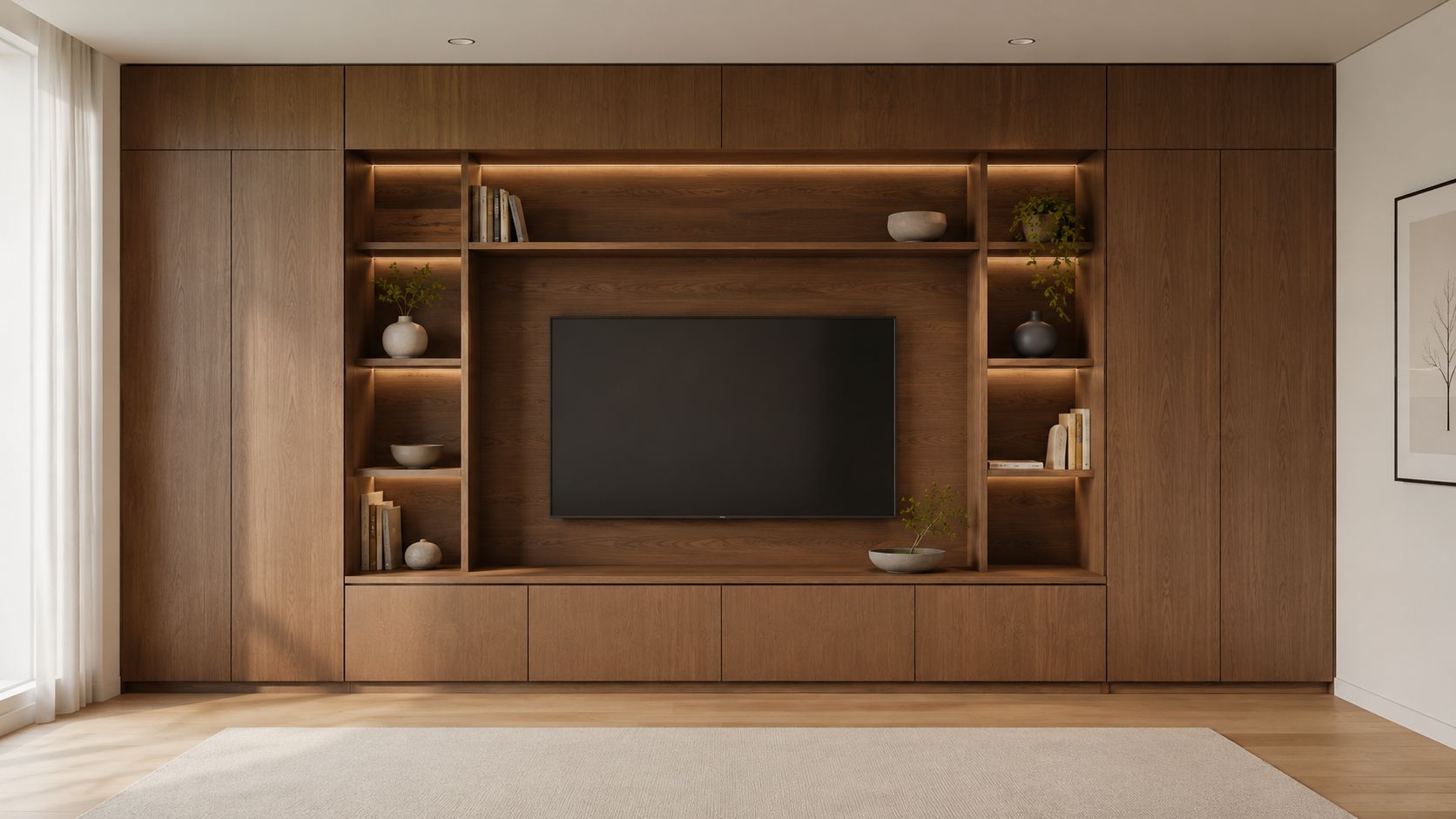
In a Longwood, Winter Park, or Lake Mary home, custom millwork can solve problems that off-the-floor furniture often cannot. It can fit an exact wall width, work around baseboards and crown molding, and create a proper visual frame for the television instead of leaving it floating on a blank wall. The result feels settled. In open-concept homes, that difference is easy to see from the kitchen and dining area.
The material choice does much of the heavy lifting. Solid hardwood has depth, grain variation, and a weight that manufactured surfaces rarely match. It also tends to age in a way homeowners appreciate, especially when the piece is intended to stay in place for many years. In Central Florida, that long-term view matters because heat, humidity, and strong daylight ask more from finishes and construction methods.
A built-in works like custom-fit clothing. The proportions are made for the room, not borrowed from a standard size.
That is why details such as wood movement, joinery, and finish selection deserve attention early. Cherry, walnut, and maple each respond differently to light and daily use. A stain sample that looks balanced under showroom lighting can shift fast beside a bright Orlando window, so reviewing samples in the home is often the smarter step.
A few design choices usually separate lasting millwork from cabinetry that looks dated or strained after a few years:
- Choose hardwoods with good stability: Dense species generally handle everyday wear better than softer woods in humid conditions.
- Include adjustable shelving: Book collections, framed art, baskets, and media components rarely stay the same size for long.
- Match storage to real use: Closed cabinets hide routers, remotes, and accessories. Open shelves give display pieces room to breathe.
- Check finish samples in daylight: Florida sun reveals undertones quickly and can change how warm or cool a stain appears.
- Size the wall around viewing comfort: Screen height, seating distance, and shelf depth should support how the room is used. Slone Brothers shares practical guidance in this guide to optimal TV positioning for comfortable viewing.
For homeowners weighing built-in millwork against freestanding storage, Slone Brothers also offers accent storage cabinets for layered living room storage.
Why airflow still matters
Custom millwork should never trap heat around electronics. Receivers, gaming systems, and streaming components all produce warmth, and enclosed cabinetry needs planned ventilation through rear clearance, vented panels, or equipment compartments designed for airflow. That point is easy to miss because the cabinetry looks like furniture, but it functions more like a housing system for sensitive equipment.
In Central Florida, that planning matters even more. A room that already runs warm in the afternoon can add extra stress to enclosed media components if the cabinet is packed too tightly. Good millwork balances beauty with performance, which is exactly what heirloom-quality design should do.
2. Premium Media Console with Integrated Charging and Cable Management
Not every room needs millwork. A premium media console often delivers the right balance of flexibility, craftsmanship, and cleaner visual lines. For many Orlando and Lake Mary homeowners, this is the most practical upgrade because it improves the room immediately without requiring renovation.
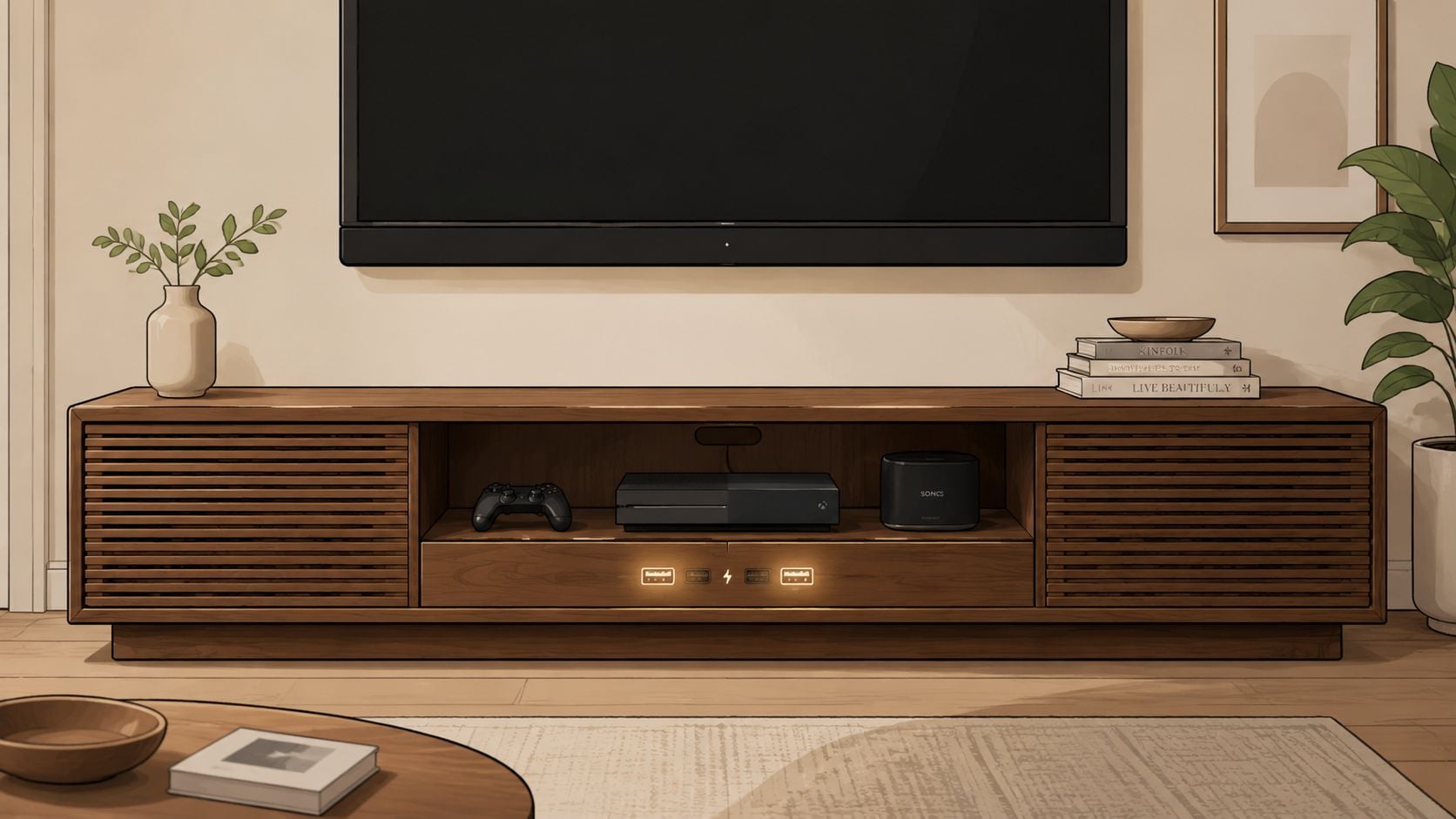
A well-made console from brands such as Canadel, Bassett, or Craftmaster can house a receiver, streaming devices, a soundbar, and decorative storage while still feeling refined. Better models include thoughtful rear access, vented compartments, and discreet places to route cords instead of forcing everything into one crowded cavity.
Why cable planning deserves attention
Cable clutter isn't a minor annoyance. It changes how the whole room reads. Built-in raceways, cable boxes, and labeled organization systems can reduce visible clutter by up to 75%, according to design benchmarks cited by Branch and Stone's entertainment center decorating article.
That kind of reduction changes the feel of a room immediately. The eye stops landing on wires and starts landing on the furniture, the artwork, and the overall composition.
A premium console should be sized around real equipment, not guesses. A Sanford homeowner with a receiver, game console, and center speaker needs more depth and breathing room than a homeowner who streams through one compact device.
- Measure every component first: Shelf depth needs to account for equipment size and rear cable access.
- Ask for a finished back panel: Even against a wall, that detail improves the piece and protects surfaces from dust and abrasion.
- Coordinate outlet placement early: Better planning leads to fewer visible extension cords later.
The best media console doesn't only hold technology. It makes technology disappear.
For homeowners refining wall placement and screen height before choosing a cabinet, Slone Brothers shares useful guidance in this complete guide to finding optimal TV positioning.
A local example that works
In many Altamonte Springs homes, the right answer isn't the largest possible cabinet. It's a long, lower-profile console in solid wood with room for ventilation and hidden charging, paired with a carefully placed lamp and one or two substantial accessories. That keeps the wall grounded without repeating the heavy, wall-dominating furniture that many homeowners are moving away from.
3. Modular Sectional with Reclining Components and Premium Upholstery
A family in Windermere settles in for a movie night. The screen is centered, the cabinet is well made, and the room still feels off because one seat faces the wrong angle, another gets blasted by afternoon sun, and nobody agrees on what feels comfortable after an hour. The lesson is simple. An entertainment center works as a full viewing zone, and the sectional is a major part of that experience.
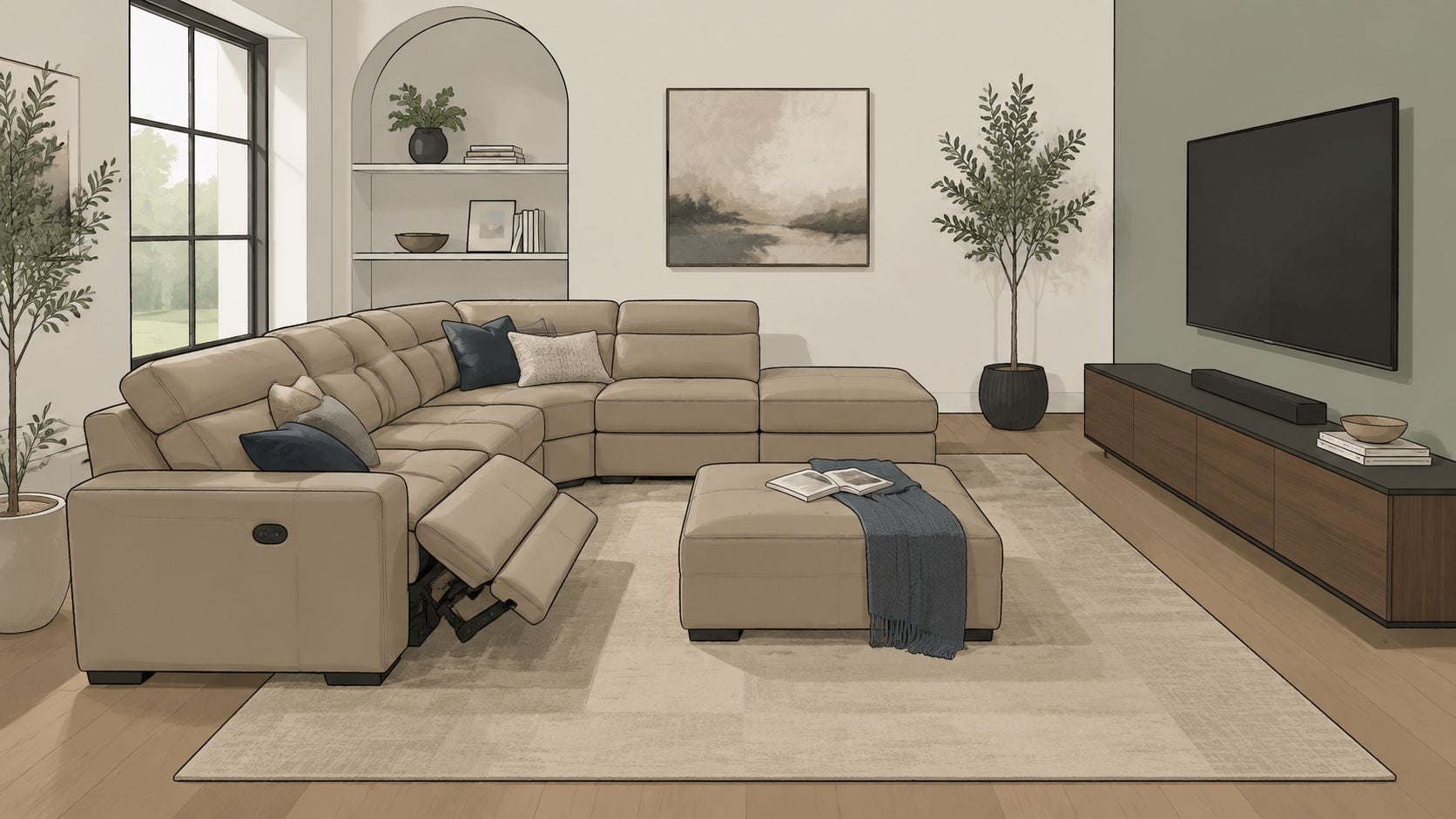
Modular sectionals solve several layout problems at once. They define the TV area in open plans, give each seat a clearer sightline, and let homeowners adjust the arrangement as family routines change. In Winter Park, Lake Mary, and other Central Florida homes with large great rooms, that flexibility matters because one room often has to handle conversation, streaming, reading, and weekend guests without feeling crowded.
Reclining components add comfort, but the engineering underneath matters as much as the motion itself. A quality sectional should stay supportive whether the footrest is up or down, and each module should connect securely so the whole piece feels unified instead of pieced together. Good construction works like a well-built porch in Florida. You may first notice the finish, but the long-term value comes from the frame, joinery, and materials that hold steady through years of daily use.
Comfort starts with construction
Shoppers often focus on color first. Start with the build instead.
Look for kiln-dried hardwood or other stable frame construction, high-resilience seat cushions, and reclining mechanisms that operate smoothly and return to position cleanly. Those details affect posture, durability, and how the sectional ages in a busy household. A beautiful profile loses its appeal quickly if the seat pitch is awkward or the corners begin to shift after regular use.
Modularity also helps the room fit real life. One homeowner may need a chaise for after-dinner lounging, while another needs two recliners and a wedge that keeps conversation easy when the television is off. The best arrangement depends on traffic paths, screen height, and where natural light lands during the day.
Upholstery choices for Florida homes
Central Florida conditions deserve special attention. Strong sun, frequent air conditioning, humidity shifts, and everyday family use all affect how upholstery performs over time.
- Test the sit, not just the silhouette: Seat depth, head support, and recline position should feel right for the people who use the room most.
- Review samples at home: A fabric or leather that looks warm in a showroom can read cooler or flatter near large windows in an Orlando-area home.
- Choose materials by lifestyle: Leather can wear beautifully in primary seating areas, while performance fabrics often make sense for homes with children, pets, or heavy daily use.
- Ask how the material is finished: Protective treatments, cleanability, and resistance to fading matter more in bright Florida interiors.
For homeowners weighing those options, Slone Brothers offers a helpful guide to upholstery materials and how they perform and practical advice on how to put your living room in the best light before selecting color and texture.
An heirloom-quality sectional should do more than fill space. It should support the body well, respect the room's layout, and hold its character through years of Central Florida living.
4. Statement Accent Lighting with Integrated Ambient Control
A Winter Park family settles in for a movie after sunset. The television is on, but the room still feels harsh because the only light source is a ring of overhead cans. Faces look washed out, wood tones turn flat, and every reflective surface competes with the screen. Good lighting design solves that problem by giving the room layers, not just brightness.
In a well-made entertainment center, light works like trim carpentry. It frames what matters, softens transitions, and brings out texture that would otherwise disappear at night. That matters in Central Florida homes, where open plans, high ceilings, and strong daylight often create a room that feels bright by day but visually unbalanced after dark.
Layered lighting usually performs better than a single overhead source because each layer has a different job. Ambient light gives the room a calm base level. Accent light draws attention to shelving, art, or the grain of a custom wood finish. Low backlighting near the television reduces the stark contrast between a bright screen and a dark wall, which can make evening viewing more comfortable.
Warm finishes respond especially well to this approach. White oak, walnut, painted millwork in soft greens or sandy neutrals, and hand-finished hardware all gain depth under controlled, low-glare lighting. In Florida, that softer effect also helps a room feel less clinical after a day of strong sun and cool air conditioning.
A comfortable media room needs light that can change character with the hour, the activity, and the season.
A few decisions make the biggest difference:
- Use more than one layer: Combine ambient, accent, and decorative lighting so the room can shift from conversation to viewing without feeling overlit.
- Keep color temperature warm: Softer light usually flatters wood cabinetry, textiles, and skin tones better than cooler blue-white bulbs.
- Add dimming control: Fine adjustments matter in multipurpose family rooms, especially when glare changes from late afternoon to evening.
- Hide light sources where possible: LED tape tucked into shelf lips, cabinet interiors, or vertical reveals gives a cleaner effect than exposed fixtures.
- Plan around Florida daylight: A room that gets intense western sun often needs a different evening lighting balance than one shaded by trees or a covered lanai.
Homeowners sorting through lamp placement, fixture scale, and glare control can get more practical guidance in this Slone Brothers article on how to put your living room in the best light.
One local example helps. A Longwood home with custom built-ins on each side of the television may benefit from concealed shelf lighting at the top of each bay, paired with a pair of shaded lamps placed outside the primary viewing angle. The shelves stay visible, collectibles read with more depth, and the screen remains the focal point. The result feels crafted and relaxed, which is exactly what an heirloom-quality entertainment center should deliver in a Central Florida living room.
5. Acoustic Design and Sound-Absorbing Materials Integration
The movie starts, the picture looks sharp, and then the dialogue disappears into the room. That happens often in Central Florida living rooms with tile floors, taller ceilings, wide sliders, and large windows facing bright outdoor spaces. An entertainment center should help the room sound better, not just look finished.
Acoustics shape comfort in the same way upholstery shapes seating comfort. You may not notice the material choice at first glance, but you feel the result right away. In a room filled with hard surfaces, sound keeps bouncing after it leaves the speaker. Those extra reflections can smear voices, make music feel flat, and force everyone to turn the volume higher than they want.
Why the room matters as much as the equipment
Homeowners often assume poor sound starts with the television or speakers. In many cases, the room is the primary factor. Glass, stone, painted drywall, and wood panel fronts all reflect sound, while rugs, fabric, and cushioned seating absorb part of it and calm the echo.
That is why speaker placement and cabinet construction need to be discussed together. A solid-wood entertainment center built with heirloom standards should still leave proper breathing room for audio components and speakers. If a speaker is pushed deep into a decorative cavity or blocked by heavy trim, the cabinet can color the sound the same way a poor lampshade can distort light.
Quiet design choices that make a clear difference
In a Winter Park or Lake Mary home, better acoustics usually come from layering the room correctly.
- Use a properly sized rug: A generous rug does more than soften the look of tile. It also catches sound reflections between the seating area and the media wall.
- Choose upholstery with substance: Sectionals, lounge chairs, and even upholstered ottomans help reduce harsh bounce, especially in open-concept plans.
- Give speakers space to perform: Avoid closing them into tight decorative niches. Audio needs open paths, appropriate depth, and ventilation.
- Balance hard and soft surfaces: If the room has stone, glass, or wood in several directions, bring in fabric through window treatments, pillows, and nearby seating.
- Treat shelves with restraint: Books, baskets, and select objects can break up reflection patterns more effectively than a wall of bare, glossy decor. Homeowners planning those finishing touches can use this guide on how to decorate shelves in any room to keep the display attractive without making it acoustically harsher.
A local example makes this easier to picture. In a Longwood family room with porcelain plank flooring and a broad bank of windows, a custom entertainment center might perform best with open speaker zones, upholstered seating facing the screen, and a wool rug large enough to extend under the front legs of the sectional. The cabinetry still reads as refined and furniture-grade, but the room sounds calmer and speech becomes easier to follow.
Good acoustic planning is quiet craftsmanship. It respects the materials, the layout, and the way Central Florida families live, gather, and watch together.
6. Custom-Finished Wood Media Display Shelving with Curated Collections
Open shelving can either enhance an entertainment center or make it feel crowded. The difference usually comes down to restraint, proportion, and the quality of the wood itself. In a well-composed living room, shelving isn't just storage. It's part gallery, part storytelling surface.
This idea works especially well for homeowners in Winter Park, Longwood, and Sanford who want the room to reflect more than technology. Shelves can hold books, ceramics, framed family photography, travel objects, and art glass without feeling busy, provided the arrangement has rhythm and breathing room.
The shelf should be as beautiful as what it holds
Custom-finished shelving in walnut, cherry, maple, or oak creates warmth that painted laminate rarely matches. Stickley, Amish, and Mavin all speak to buyers who care about visible grain, authentic joinery, and the quiet authority of solid wood.
For buyers considering Amish-crafted pieces, construction details matter. Authentic Amish furniture should be built from solid hardwood with no veneer, MDF, or engineered wood, and shoppers should verify named workshop information and inspect drawer construction, including hardwood sides and dovetail joinery, according to Amish Country Finder's 2026 buying guide.
That kind of construction doesn't only matter in dining rooms and bedrooms. It matters here too, where media storage often gets frequent daily use.
Styling with intention
A curated shelf shouldn't be packed edge to edge. It should feel considered.
- Vary height and shape: Mix upright books, low bowls, framed photos, and sculptural objects.
- Leave negative space: Empty space keeps shelves from looking overfilled.
- Group by tone: Warm woods often pair beautifully with ceramics, books, and framed art in similar color families.
For homeowners who want help composing shelves that feel personal instead of staged, Slone Brothers shares practical ideas in this guide on how to decorate shelves in any room.
A well-finished shelf can make even everyday objects feel collected and intentional.
7. Integrated Seating Vignettes with Layered Comfort Zones
The best entertainment rooms don't rely on one oversized sofa and hope for the best. They create several comfort zones within the same space. That approach works especially well in larger Central Florida homes where living rooms often need to support movie nights, family visits, conversation, and quiet solo downtime.
A layered seating plan might include a Stressless recliner as the primary comfort seat, a Smith Brothers sectional for group seating, a pair of Craftmaster accent chairs for conversation, and an ottoman that can move where needed. This feels more personalized than a single monolithic arrangement, and it serves multi-generational households far better.
Comfort should be shared across the room
Different people sit differently. Some want upright support for reading or conversation. Others want a deep, relaxed seat for an evening film. Older family members may need easier entry and exit, while children naturally gravitate toward ottomans and softer casual perches.
In open-concept homes, seating can also define zones without adding visual heaviness. Guidance on current small-space and open-plan entertainment layouts notes a growing role for low consoles with shelving on both sides as visual dividers between living and dining areas in newer Central Florida-style layouts, an idea explored in Chic Living Club's discussion of multifunctional room-divider solutions.
That same zoning logic applies to seating. A room feels calmer when furniture placement clarifies where each activity belongs.
A polished arrangement often includes
- One ergonomic hero seat: A Stressless recliner often fills this role beautifully.
- A softer group anchor: A sectional or sofa provides the shared viewing base.
- Flexible support pieces: Ottomans and smaller chairs help the layout adapt.
A well-layered seating vignette is one of the easiest ways to make a living room feel finished, especially in homes where guests and family members use the room differently from day to day.
8. Technology Integration with Heritage Aesthetics and Concealed Media Solutions
A Winter Park family might want the room to look collected and calm at noon, then function like a media room by evening. That is a significant design challenge. The television, speakers, and charging gear need to work well without taking over the architecture.
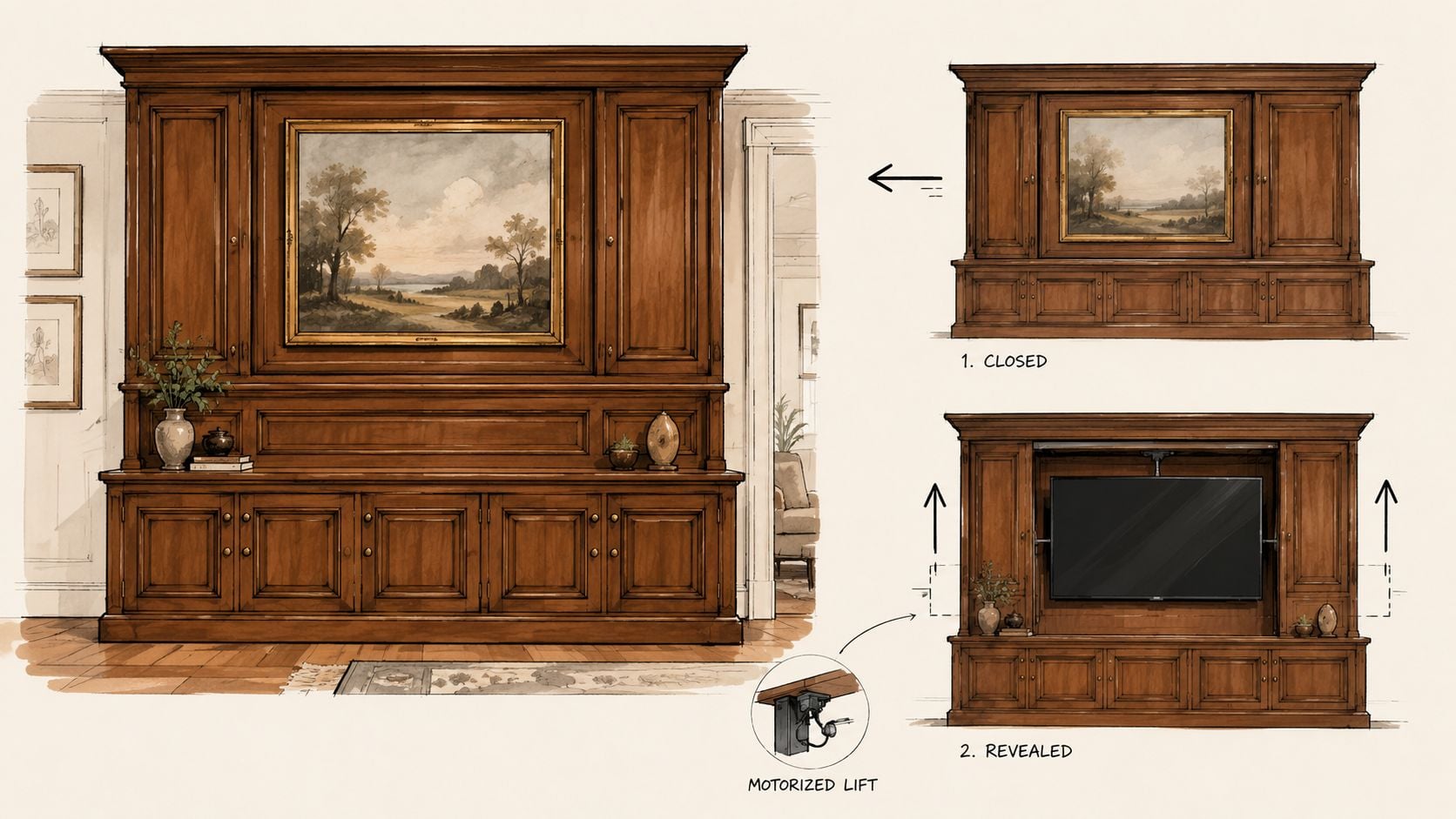
Concealed technology solves that problem when the cabinet is designed like fine furniture first. A lift cabinet, pocketing doors, or a paneled enclosure can keep the screen out of sight during the day. Once closed, the room returns to what many Central Florida homeowners want most: warm wood, balanced proportions, and a living area that still feels welcoming in natural light.
That balance matters even more in our climate. Central Florida homes often get strong sun, long cooling seasons, and open-plan layouts that carry sightlines from one room into the next. A concealed media piece should do more than hide electronics. It should protect finishes from heat buildup, allow airflow around components, and hold up well in humidity changes. Good millwork handles those demands through vented backs, stable joinery, and finish schedules chosen for local conditions.
Heritage styling works best when the technology disappears, not the craftsmanship
Older entertainment centers often looked heavy because the cabinet had to announce every device it held. Better modern pieces reverse that logic. The woodworking carries the visual weight, while the technology recedes.
In practice, that can mean framed doors with subtle bead detail, softly rounded corners that feel easier in a family room, or lightly fluted panels that add texture without making the piece feel trendy. Inside, the cabinet still needs practical discipline. Wire paths should be planned before fabrication. Remotes and smart controls should work through the doors or from a discreet receiver. Access panels should let a technician reach components without dismantling half the unit.
Hidden technology feels luxurious only when the cabinet still looks complete and intentional with the screen off.
Homeowners are often surprised by which details matter most:
- Start with the viewing plan: Screen height, seating distance, and glare control should be resolved before choosing the concealment method.
- Build ventilation into the cabinet: Media boxes, receivers, and gaming systems produce heat, especially in enclosed furniture.
- Choose stable materials: Veneers, hardwoods, and engineered panels each behave differently in Florida humidity, so construction method matters as much as appearance.
- Keep service access simple: A beautiful cabinet becomes frustrating fast if a power reset or equipment swap requires removing shelves and trim.
A realistic Central Florida application
In a Longwood home where the living room opens directly to the dining area, a custom cabinet with paneled doors and a concealed lift can preserve a more traditional daytime look. The room reads as a furnished interior instead of a screen wall. At movie time, the television rises into place, components stay hidden below, and the cabinet still feels proportionate to the surrounding millwork.
That is the goal. Technology should support the room's daily life without stripping away the sense of heritage, craftsmanship, and permanence that makes a well-made entertainment center worth keeping for years.
8-Point Comparison: Living Room Entertainment Centers
| Item | Implementation Complexity | Resource Requirements | Expected Outcomes | Ideal Use Cases | Key Advantages |
|---|---|---|---|---|---|
| Built-In Wall Units with Custom Millwork | High, full design and professional installation; permanent installation | Skilled millwork, solid hardwood, electrical/ventilation planning; 8–12 week lead time | Permanent architectural focal point; maximized storage; increased home value | New construction or major renovations; homeowners seeking permanence and luxury | Seamless integration; custom fit for wall dimensions; humidity-engineered wood; hidden cable management |
| Premium Media Console with Integrated Charging and Cable Management | Medium, professional install recommended for electrical integration | Solid wood construction, concealed cable channels, integrated power/USB, finished back panel; 6–8 week lead time | Clean, organized media area; safer cable routing; durable furniture | Upgrading living room without structural changes; tech-heavy households | Integrated charging and cable management; adjustable shelving; thermal ventilation |
| Modular Sectional with Reclining Components and Premium Upholstery | Medium, precise measuring and delivery; electrical access for powered recline | Kiln-dried hardwood frames, high-density foam, reclining mechanisms, performance upholstery; 10–14 week lead time | Flexible seating layouts; long-term comfort and structural integrity | Family rooms, movie nights, large living spaces | Reconfigurable modules; performance fabrics for sun/humidity; ergonomic recline |
| Statement Accent Lighting with Integrated Ambient Control | High, electrical planning and licensed electrician required | Dimmable LED systems, smart controls, sculptural fixtures, professional installation; $2k–$6k+ | Layered lighting, cinematic ambiance, reduced eye strain | Enhancing mood, highlighting architecture/art, home theater atmospheres | Energy-efficient dimmable control; accurate color rendering (CRI 90+); scene presets |
| Acoustic Design and Sound-Absorbing Materials Integration | Medium, requires professional acoustic assessment and precise placement | Fabric-wrapped panels, bass traps, diffusers, rugs, professional consultation ($300–$800) | Improved audio clarity, reduced echo and ambient noise, better speaker performance | High-fidelity audio setups, serious home theaters, large hard-surface rooms | Optimizes sound without studio aesthetic; improves speech and music clarity |
| Custom-Finished Wood Media Display Shelving with Curated Collections | Medium, custom sizing and finish work; installation and styling guidance | Hand-stained woods, adjustable deep shelving, integrated accent lighting | Gallery-like presentation of collections; warm tactile finishes | Displaying art, books, heirlooms; homeowners focused on curated interiors | Warm hand-stained finishes; adjustable display depth; integrated lighting to elevate objects |
| Integrated Seating Vignettes with Layered Comfort Zones | Medium, requires layout planning for sightlines and traffic flow | Multiple coordinated seating pieces, ottomans, throw textiles, professional placement; larger square footage | Multiple comfort zones accommodating varied preferences; flexible reconfiguration | Multi-generational households, entertaining, large living rooms | Ergonomic recliners and varied firmness options; encourages social interaction; layered aesthetics |
| Technology Integration with Heritage Aesthetics, Concealed Media Solutions | High, early design integration with electrical, cabinetry and automation specialists | Motorized lifts, sliding panels, wireless power/signal, smart-home integration; 12–16 week lead time | Hidden technology that preserves traditional aesthetics; reduced visual clutter | Homes valuing traditional design but requiring modern tech concealment | Conceals screens and tech from view; protects displays from UV; creates seamless heritage look |
Bring Your Vision to Life at Slone Brothers
On a bright Central Florida afternoon, a living room can look very different than it did in the showroom. Sun pours through large windows, humidity rises and falls with the season, and the space has to serve more than one purpose at once. It may be the room where you watch a movie at night, host family on the weekend, and display pieces that carry family history every day. Good entertainment center planning starts there, with real life in this climate and this region.
The strongest choices come from fitting the room's architecture, the household's routines, and the materials to the way the home is used. An entertainment center is less like a single purchase and more like a system. Cabinetry, seating, lighting, storage, and media placement all need to work together if the room is going to feel calm, functional, and built to last.
For homeowners in Longwood, Lake Mary, Winter Park, Sanford, and across the Orlando area, that usually means asking sharper questions before ordering anything. How will a wood finish read in strong Florida light at midday? Which materials hold their shape and appearance through years of cooling cycles and daily use? Will the seating still support the back and neck during a long film or a full football Saturday? Can the layout handle conversation and traffic flow without turning the room into a maze of cords, screens, and oversized furniture?
Those questions tend to lead away from impulse buying and toward craftsmanship you can inspect. A screen can show color, but it cannot show the depth of walnut grain, the weight of a drawer, the feel of a fabric, or the difference between solid wood, veneer, and engineered construction. In person, those distinctions become obvious. So does the value of details such as joinery, finish consistency, cushion support, and cabinet interiors designed for real media components.
That local, hands-on review matters even more in open-plan Florida homes, where the entertainment center is often visible from the kitchen, foyer, or dining area. The piece cannot fight the architecture. It has to belong to it. A well-designed solution creates a cohesive heritage look while still making room for hidden charging, modern media equipment, and the practical storage a busy household needs.
Slone Brothers Furniture gives homeowners a place to compare those details side by side and talk through custom-order options with experienced design consultants. The process is consultative, not rushed. Whether you are furnishing one room or shaping a whole-house look, the goal is to translate inspiration into choices that fit your dimensions, your light conditions, and your daily habits.
If you want furniture with lasting value, visit the Slone Brothers Furniture showroom in Longwood, FL and review the materials, construction, and comfort in person. A face-to-face design conversation often clears up the questions that online browsing cannot answer.