
How to Arrange Patio Furniture for Florida Living


A lot of Central Florida patios look finished because the pavers are down, the screen enclosure is up, and the grill is in place. Yet the space still doesn't feel inviting. The chairs sit too far apart, the dining set crowds the slider, or the best seat gets blasted by afternoon sun.
That's usually the moment homeowners start asking how to arrange patio furniture in a way that feels as polished and intentional as the rooms inside the house. In Longwood, Lake Mary, Winter Park, and across the Orlando area, the patio isn't extra square footage. It's where coffee happens in January, where friends gather after dinner, and where a good layout turns a blank slab into an outdoor living room.
The strongest patios don't start with furniture shopping. They start with a clear sense of how the space will be used, how Florida weather moves across it, and how circulation needs to work when guests are coming in and out of the house. For homeowners looking for inspiration before committing to a layout, it can also help to explore patio decking ideas and compare how different surfaces and built-ins shape furniture placement. A thoughtful look at backyard furniture ideas can also sharpen the vision before a single chair is moved.
Transforming Your Patio from Blank Space to Outdoor Oasis
A patio starts to work when it stops being treated like leftover space.
In Central Florida, that shift matters. A covered lanai in Sanford may need to handle quiet mornings, weekend lunches, and evening conversation in the same footprint. A pool patio in Altamonte Springs might need to feel elegant enough for entertaining but durable enough for wet feet, bright sun, and regular use.
What an outdoor room should do
A well-arranged patio usually serves at least one primary purpose and supports a second one without strain. That might mean dining first and lounging second. It might mean conversation first, with a small drink table nearby instead of a full dining setup.
The mistake is trying to force every possible activity into one area.
A patio feels luxurious when there's space to move, sit, and settle in without adjusting furniture every time someone arrives.
That's why strong layouts feel edited. They create a destination. A pair of deep lounge chairs facing the garden can do more for daily enjoyment than a crowded assortment of mismatched seating.
The Florida lifestyle changes the brief
A patio in Orlando isn't arranged the same way as one in a milder, drier climate. The sun angle is harsher, humidity is constant, and summer storms don't give furniture much grace. That changes where seating should go, how much breathing room is needed, and what pieces deserve the investment.
A few priorities usually rise to the top:
- Comfort in real conditions means planning for heat, glare, and damp air, not just a pretty catalog view.
- Flexible entertaining calls for seating that can hold a conversation group without blocking traffic from the house to the yard.
- Long-term value comes from choosing fewer, better pieces that still look composed after seasons of use.
An outdoor oasis doesn't come from filling the patio. It comes from giving each piece a job and letting the space feel calm, open, and usable.
Why Precise Measurement Is the Foundation of Great Design
Good patio layouts are measured first, styled second. That's true on a compact Winter Park courtyard and on a broad lanai in Lake Mary.
Start with fixed elements
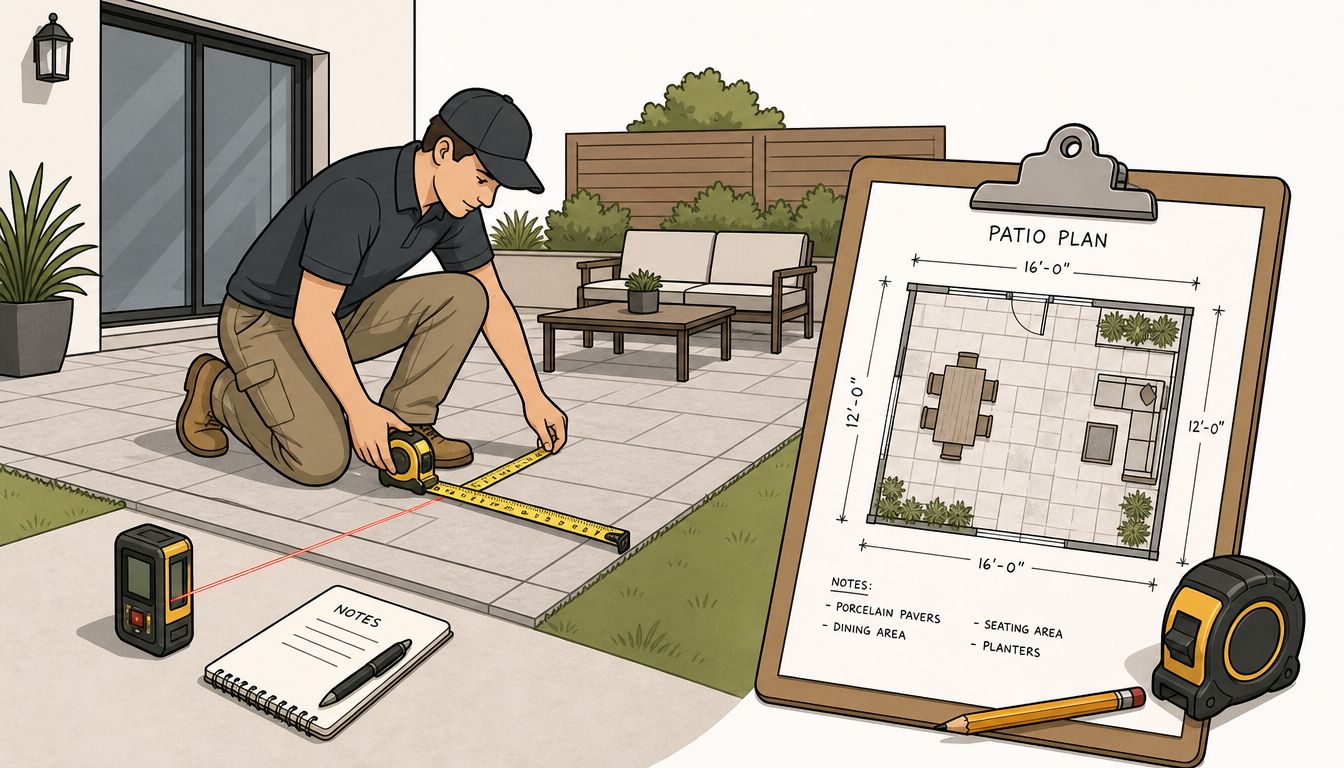
Before choosing a sofa, sectional, or dining table, measure everything that cannot move. That includes door swings, steps, support posts, built-in grills, pool edges, planters, and the width of any path guests naturally take.
Professional designers recommend maintaining a minimum pathway width of 30 inches between furniture, walls, and other obstacles, and they also state that at least three feet of clearance for main pathways is essential for comfort and accessibility, according to this patio furniture layout guide.
That single discipline prevents the most common layout problems. A patio can look balanced on paper and still fail the moment someone has to squeeze past a chair to reach the grill.
Sketch before buying
A simple scaled sketch saves expensive mistakes. Graph paper works well, and so does a digital planner if the dimensions are entered carefully. For homeowners who want a simple starting point, a review of the best free patio design app can help compare planning options before furniture is ordered.
A useful sketch should include:
- The full perimeter with all angles and transitions
- Obstructions and openings such as columns, sliders, and stairs
- Traffic routes from the house to the yard, pool, or outdoor kitchen
- Furniture footprints cut to scale so pieces can be tested before delivery
The same planning mindset applies when checking patio table dimensions, especially if the space needs to support both dining and circulation.
Practical rule: If the layout only works when chairs stay perfectly pushed in, it doesn't work.
Measure for the way people live
Patios aren't showrooms. Chairs get pulled back. Guests stand and talk. Someone carries a tray through the space. In Florida, people also migrate toward shade, away from glare, and under cover when a quick shower moves through.
That's why precise measurement is less about technical perfection and more about daily ease. A patio that feels generous almost always began with a disciplined tape measure and a realistic floor plan.
How Do You Define Your Outdoor Living Zones
The best patios use furniture to assign purpose. Even a modest outdoor area can feel polished when dining, lounging, and circulation each have a clear place.
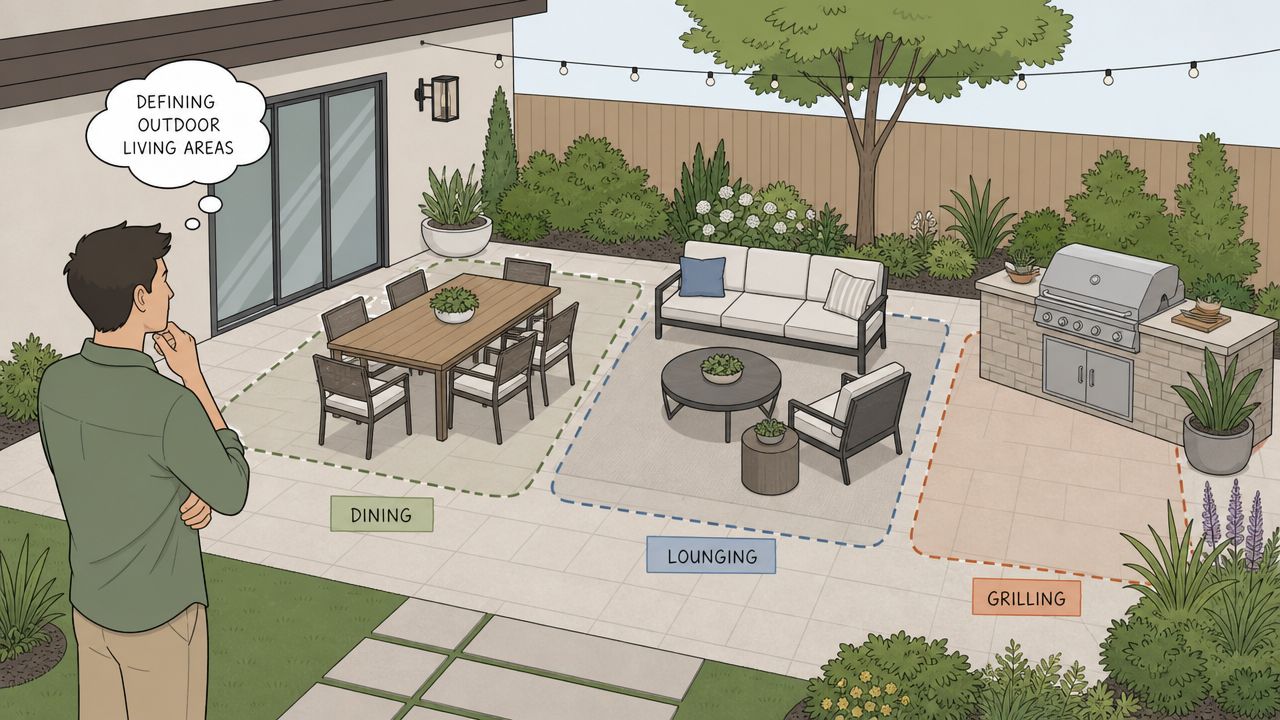
A dining zone needs enough room to function comfortably. To accommodate a standard 48-inch dining table and four chairs, designers advise a minimum area of 10.6 feet in diameter, plus another 2 to 3 feet of clearance around the perimeter so people can move freely, as noted in this design reference video.
Begin with the highest-value activity
Most homeowners don't need every patio function to carry equal weight. One zone usually matters most.
In a family home in Central Florida, that might be outdoor dining near the kitchen door. In another setting, the priority may be a shaded lounge area for reading and evening conversation.
The strongest way to define zones is to answer one question first. What should this patio do exceptionally well?
Give each zone a visual anchor
A zone feels intentional when it has something that grounds it. For dining, that's usually the table. For lounging, it may be a sofa, a pair of chairs around a cocktail table, or an outdoor rug that visually collects the seating group.
A well-chosen outdoor rug can separate lounging from circulation without adding visual bulk. That's especially helpful on screened lanais where the footprint is open and furniture needs help establishing boundaries.
Consider this simple approach:
- Dining near the house: Best for serving, cleanup, and evening meals.
- Lounge near the view: Best where there's a garden, pool, or quieter corner.
- Service and cooking at the edge: Keeps prep close at hand without dominating the social area.
Distinct zones make a patio feel larger because the space reads as organized rather than crowded.
Keep the zones related, not identical
A common mistake is matching every piece too closely and placing everything at the same scale. The result can feel flat.
A more timeless layout uses related materials and silhouettes, then adjusts the proportions by function. A dining set should feel stable and composed. A lounge grouping should feel softer and more relaxed. That contrast gives the patio rhythm, which is often what makes a well-designed outdoor space in Orlando or Winter Park feel finished.
Arranging Furniture for Effortless Conversation and Flow
Conversation areas succeed when people can see each other easily, reach a table without stretching, and move in and out without disturbing everyone else.
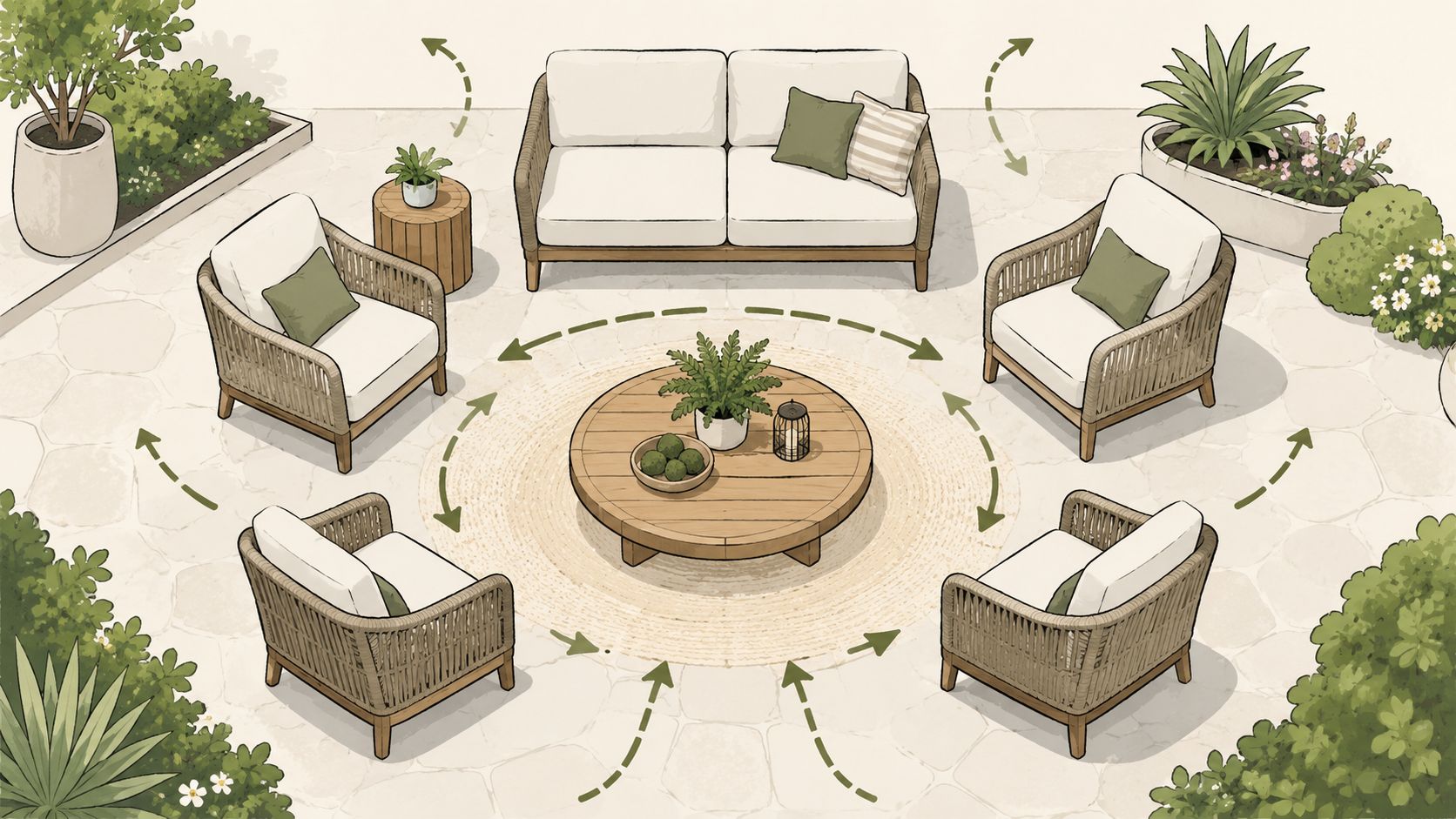
For comfortable movement, maintain a minimum walking clearance of 24 inches between furniture pieces. On smaller decks, angling primary furniture at 45 degrees relative to the house can soften a boxy layout, and transparent materials like glass-top tables can reduce visual clutter by 35%, according to this small deck arrangement guide.
Start with a focal point
Every seating group needs something to orient around. It may be a pool, a fireplace, a garden view, or a central table that gives the arrangement purpose.
Without that anchor, chairs tend to drift to the perimeter. That weakens conversation and leaves the center of the patio feeling unresolved.
A strong grouping usually includes:
- A largest piece with presence such as a sofa or sectional
- Facing or slightly angled companion seats so people don't have to turn awkwardly to talk
- A reachable center surface for drinks, books, or serving
- Open approach paths so guests can join the group naturally
For homeowners exploring elegant gathering layouts beyond residential examples, this guide for stylish outdoor spaces offers useful visual ideas about spacing and social comfort.
Don't push everything against the walls
That's one of the fastest ways to make a patio feel less inviting. Perimeter-only placement leaves a void in the middle and turns conversation into a series of disconnected seats.
Pulling key pieces inward creates intimacy. Even on a narrower patio, a compact grouping with a properly scaled central table will feel more natural than scattered chairs with no shared center.
An outdoor wicker resin sectional can work well when the patio needs to hold several people while maintaining one unified conversation zone, especially if side tables are used to keep access easy.
Seating should invite interaction, not force people to lean forward and speak across open space.
Handle fire features with discipline
Fire pits are attractive focal points, but they can be arranged carelessly. Industry safety standards call for 5 to 6 feet of clearance around fire pits for chair movement and 3 feet minimum from pool edges for traffic flow, according to this outdoor social layout article.
That's why a looser, more appropriate arrangement often works better than a tight circle. Around a rectangular fire feature, an L-shaped seating cluster can preserve comfort while keeping egress clear. On a pool patio, it's equally important to let wet-foot traffic pass without cutting through the main conversation area.
Selecting Weather-Ready Furniture for the Florida Climate
In Central Florida, layout and material selection are inseparable. A perfect arrangement fails quickly if the furniture can't handle sun, humidity, and storm season.

Data shows that 68% of homeowners in hot climates like Florida prioritize shade coverage over conversation layout, and 45% of professional outdoor designers plan layouts around the sun's path, according to this shade-focused patio design article. That aligns with what works on patios from Longwood to Sanford. The right seat in the wrong sun exposure is still the wrong seat.
Prioritize materials that earn their keep
Florida weather is hard on disposable furniture. Finishes chalk. Cushions fade. Frames loosen. Resin cracks when quality is poor, and low-grade metal doesn't forgive constant humidity.
Investment-grade outdoor furniture should be chosen with the same seriousness as indoor upholstery or solid wood dining furniture. Materials matter because they determine whether the layout still looks refined after repeated exposure.
A practical material hierarchy usually looks like this:
- Powder-coated aluminum stays lighter, resists corrosion well, and is easier to reposition before storms.
- Quality teak ages with dignity and holds visual weight without feeling bulky.
- Performance fabrics are worth insisting on because cushions are where comfort either holds up or doesn't.
- Well-made woven outdoor materials can add softness visually, but they should be tightly constructed and supported by strong frames.
Homeowners comparing options often benefit from looking through essential outdoor furniture pieces with an eye toward longevity, not just immediate appearance.
Shade should drive placement
A patio arranged for photos often ignores the sun path. A patio arranged for living respects it.
That matters in Florida because a beautiful conversation area can become unusable by midday if the layout doesn't account for seasonal light and heat. Seating should be tested at the hours the household will use it. Morning coffee and late-day entertaining don't land in the same place.
The most comfortable chair on the patio is the one that stays usable when the sun shifts.
Hurricane season changes good decisions
Storm preparation should influence furniture selection from the start. Heavier isn't always better if pieces can't be secured, covered, or moved under shelter when weather turns. At the same time, overly flimsy furniture rarely delivers the stability and finish expected in a premium outdoor room.
That trade-off is why enduring quality matters. The goal goes beyond owning outdoor furniture. It's to own pieces that justify the footprint, support the way the patio is used, and maintain their composure in a demanding climate. The same value mindset that leads homeowners toward Stickley, Stressless, Smith Brothers, Palasar, Bassett, Craftmaster, Simply Amish, Canadel, Amisco, American Leather, and Mavin indoors also applies outside. Engineering, craftsmanship, and honest construction always age better than shortcuts.
Your Beautifully Arranged Patio Awaits
A well-arranged patio doesn't happen by accident. It comes from clear priorities, disciplined measurement, zoning by function, and furniture placement that supports real movement and real conversation.
In Central Florida, there's one more layer. The layout has to respect the climate. Sun, humidity, and storm season shape the way an outdoor room should be planned just as much as style does. That's why the strongest patios feel effortless once they're finished. Someone thought carefully about how the space would be used.
What lasting patio design gets right
Timeless outdoor layouts tend to share a few qualities:
- They feel open, not sparse. There's enough furniture to support living, but not so much that circulation suffers.
- They reflect habits, not trends. Morning coffee, family dinners, quiet reading, and entertaining each need different support.
- They reward better materials. Investment pieces hold their shape, finish, and comfort far longer in a Florida setting.
- They connect to the home. The patio should feel like a natural continuation of the interior, not a separate afterthought.
That's where thoughtful planning pays off. A patio doesn't need more pieces. It needs the right pieces in the right places.
Why human guidance still matters
Patio furniture is difficult to judge from a screen. Scale can look misleading, finishes read differently outdoors, and comfort is never something a product description can fully convey. That's especially true when homeowners are trying to coordinate outdoor living with the level of craftsmanship they already expect indoors from brands like Stickley, Stressless, Smith Brothers, Bassett, Craftmaster, American Leather, Simply Amish, Canadel, Amisco, Palasar, and Mavin.
A carefully arranged patio adds daily value to the home. It also adds calm. The space becomes somewhere people naturally go, rather than somewhere they mean to finish later.
Ready to invest in furniture that lasts a lifetime? Skip the online guesswork and automated digital chatbots. Visit the Slone Brothers Furniture showroom in Longwood, FL today. Connect face-to-face with experienced design consultants and get help creating an outdoor living space that fits the way Central Florida homeowners live. Since 1980, this family-owned showroom has served the Greater Orlando area with premium craftsmanship, complimentary in-home design guidance, white-glove delivery, and a carefully curated selection that includes Stickley, Stressless, Smith Brothers, Palasar, Bassett, Craftmaster, Simply Amish, Canadel, Amisco, American Leather, and Mavin. Want to experience the unmatched heritage of Stickley or explore complimentary in-home interior design services? Stop by the Longwood showroom today and collaborate with a real design expert who understands timeless furniture, Florida living, and lasting value.