

Your Guide to Biophilic Design Elements in Central Florida


After a long Central Florida afternoon, many homes need to do two jobs at once. They need to cool down physically, and they need to feel calming after traffic, errands, school pickups, and a steady stream of humidity outside. That's where biophilic design elements start to make sense. They help a home feel grounded, breathable, and connected to the outdoors without giving up comfort.
Biophilic design sounds technical, but the idea is simple. It means shaping interiors so people feel a stronger connection to nature through light, materials, views, texture, airflow, and living elements. A few plants can help, but a true biophilic room goes further. It considers how the whole space feels from morning to evening.
For Florida homeowners, that matters. Strong sunlight, lush surroundings, screened porches, storms, and year-round greenery already influence daily life. The smartest interiors don't fight that reality. They work with it. Homeowners looking for easy plant styling can also borrow ideas from how to style your home with cacti, especially for bright rooms that need low-fuss greenery.
Readers who want a few simple plant-and-furniture pairings can also explore houseplants that complement new furniture, which fits especially well in sunlit Longwood, Lake Mary, and Sanford homes where indoor and outdoor living often overlap.
Table of Contents
- Bringing Nature Indoors in Your Florida Home
- The Core Biophilic Design Elements Explained
- Why This Design Style Improves Your Well-Being
- Biophilic Design Ideas for Every Room
- Achieving Biophilic Style with Slone Brothers
- Begin Your Design Journey at Our Longwood Showroom
Bringing Nature Indoors in Your Florida Home
Florida homes already come with a strong relationship to nature. Sun pours through the windows, palms sway outside, summer storms change the mood of a room, and even a short walk to the mailbox reminds people how much climate affects comfort. Biophilic design elements take those everyday conditions and turn them into a design advantage.
The core idea is that people tend to feel better in spaces that echo nature. That can mean daylight, organic materials, a view of trees, natural airflow, or shapes that feel softer and less rigid than a boxy room full of hard edges. In practice, it often means a home feels more restful without feeling overly styled.
Many readers get stuck on one common point of confusion. They think biophilic design equals houseplants. Plants are helpful, but they're only one piece of the puzzle. A room with a single fiddle leaf fig and harsh lighting can still feel tense. A room with real wood, filtered sunlight, breathable fabrics, and a view into the backyard may feel more natural even with fewer plants.
Practical rule: If a room feels calmer at 2 p.m. with the blinds open than it does with lamps and blackout curtains, the room is already pointing toward a biophilic solution.
A Florida-friendly approach usually starts with a few grounded choices:
- Use daylight well: Let natural light reach the main seating areas without creating glare or heat buildup.
- Bring in real materials: Wood, stone, leather, linen, cotton, and woven textures tend to feel more settled than glossy synthetics.
- Protect visual breathing room: Leave enough open space around major furniture pieces so the room can feel airy.
- Repeat nature softly: Curved silhouettes, botanical patterns, and earth-toned finishes help without turning the room into a theme.
That's often the difference between a home that only looks decorated and one that feels restorative.
The Core Biophilic Design Elements Explained
Some design ideas are easy to admire and hard to apply. Biophilic design becomes much easier when each element is broken into practical parts. A homeowner doesn't need a full renovation to start. One well-chosen change in each category can shift the mood of a room.
Natural light
Florida gives homeowners plenty of daylight. The challenge isn't finding it. The challenge is managing it. Good biophilic rooms guide sunlight into the space while controlling heat and glare with the right window treatments, furniture placement, and layered lighting for evening hours.
A simple move is to place reading chairs, sofas, or breakfast seating where daylight reaches them indirectly. That lets the room feel open instead of washed out.
Vegetation
Plants soften edges and make interiors feel alive. They also help connect indoor routines to the natural surroundings. In a Central Florida home, that might mean a potted plant near a lanai door, a line of herbs by a bright kitchen window, or a taller plant helping anchor an empty corner.
The key is scale. One small plant on a distant shelf won't change much. Groupings with varied height, leaf shape, and texture usually feel more intentional.
Natural materials
Natural materials offer many homes the biggest payoff. Real wood, stone, leather, rattan, and natural fibers give a room visual warmth and tactile variety. They also age in a more graceful way than many synthetic finishes.
Research on material connection with nature found that rooms with 45% wood coverage significantly decreased diastolic blood pressure, while 90% coverage may decrease brain activity, according to Terrapin Bright Green's 14 Patterns of Biophilic Design. That's a useful reminder for Florida interiors. Wood should be present, but not everywhere.
Presence of water
Water is one of the most overlooked biophilic design elements. The presence of water means seeing, hearing, or touching water in a way that improves the feel of a place. Research summarized by UWE Bristol on examples of biophilia in the built environment notes that water features can decrease stress and increase relaxation, especially in noisy urban settings.
In a home, this doesn't have to mean a dramatic fountain. It can be as simple as a courtyard view with a water feature, a small tabletop piece in a quiet room, or arranging seating to face a pool, pond, or rain garden.
Views to nature
A real view matters. Looking out to mature trees, planting beds, a lake, or even a small shaded patio can make a room feel larger and less confined. Homes in Orlando-area neighborhoods often have more outdoor greenery than owners realize. The interior just needs to acknowledge it.
One effective trick is to avoid blocking windows with tall, heavy furniture. Lower-profile pieces often improve the room more than additional decor.
Biomorphic patterns and forms
This term sounds academic, but the idea is familiar. Nature rarely works in perfect rectangles. Curves, arches, leaf-like motifs, branching lines, and irregular textures all help a room feel softer.
A rounded cocktail table, an organically shaped mirror, a rug with a flowing pattern, or dining chairs with a gentle curve can all contribute. Readers exploring layered finishes and texture can find related inspiration in natural home decor ideas.
Biophilic Elements at a Glance
| Element | Simple Implementation Idea |
|---|---|
| Natural light | Float seating near windows instead of pushing everything against dark walls |
| Vegetation | Group plants in threes with varied heights near the brightest part of the room |
| Natural materials | Mix wood, woven texture, and soft natural fabric instead of using one finish everywhere |
| Presence of water | Orient a chair or bench toward a pool, fountain, or garden water feature |
| Views to nature | Keep window sightlines open by choosing lower-profile storage and seating |
| Biomorphic patterns and forms | Add one curved table, mirror, or rug pattern inspired by leaves or waves |
A balanced room usually works better than a literal one. Nature-inspired doesn't mean covering every surface in green.
Why This Design Style Improves Your Well-Being
A lot of design trends are mainly visual. This one isn't. The strongest argument for biophilic interiors is that they support how people feel and function inside the home.

A home can support recovery
Workers in office environments enhanced with biophilic design elements report 15% higher overall well-being and 6% greater creative performance compared to conventional settings, according to this overview of biophilic design benefits. Even though that finding comes from offices, the lesson applies easily at home. If nature-connected spaces help people feel and think better during the workday, it makes sense that homes can use the same principles to support rest and focus.
That's especially relevant in Central Florida. Many households need one room to serve as a family room, work zone, reading corner, and evening retreat. When that room includes natural light, organic texture, and a calmer visual rhythm, it often feels less draining by the end of the day.
For families trying to spend more restorative time outdoors too, LuminAID's guide to outdoor fun offers easy ideas that pair well with an indoor design approach centered on nature.
Feeling natural and functioning naturally aren't the same
A room can look earthy and still miss the point. The healthiest spaces usually combine visual nature with things people experience in daily life, such as better light patterns, cleaner airflow, more comfortable materials, and less visual noise.
That's why the room's function matters. A bedroom may need soft texture and lower stimulation. A home office may need daylight, a view outside, and enough material contrast to stay alert. A family room may need a little of both.
Homes don't just store furniture. They shape attention, mood, and the ability to settle down.
Readers thinking about stress relief at home can build on that idea with design choices that help reduce stress, especially in busy households around Orlando and Longwood where the home often has to act as a reset button.
Biophilic Design Ideas for Every Room
The easiest way to use biophilic design is to stop thinking about it as one big style. It works better as a room-by-room set of decisions. Each space has its own job. The furniture, finishes, and layout should support that job while keeping a connection to nature.
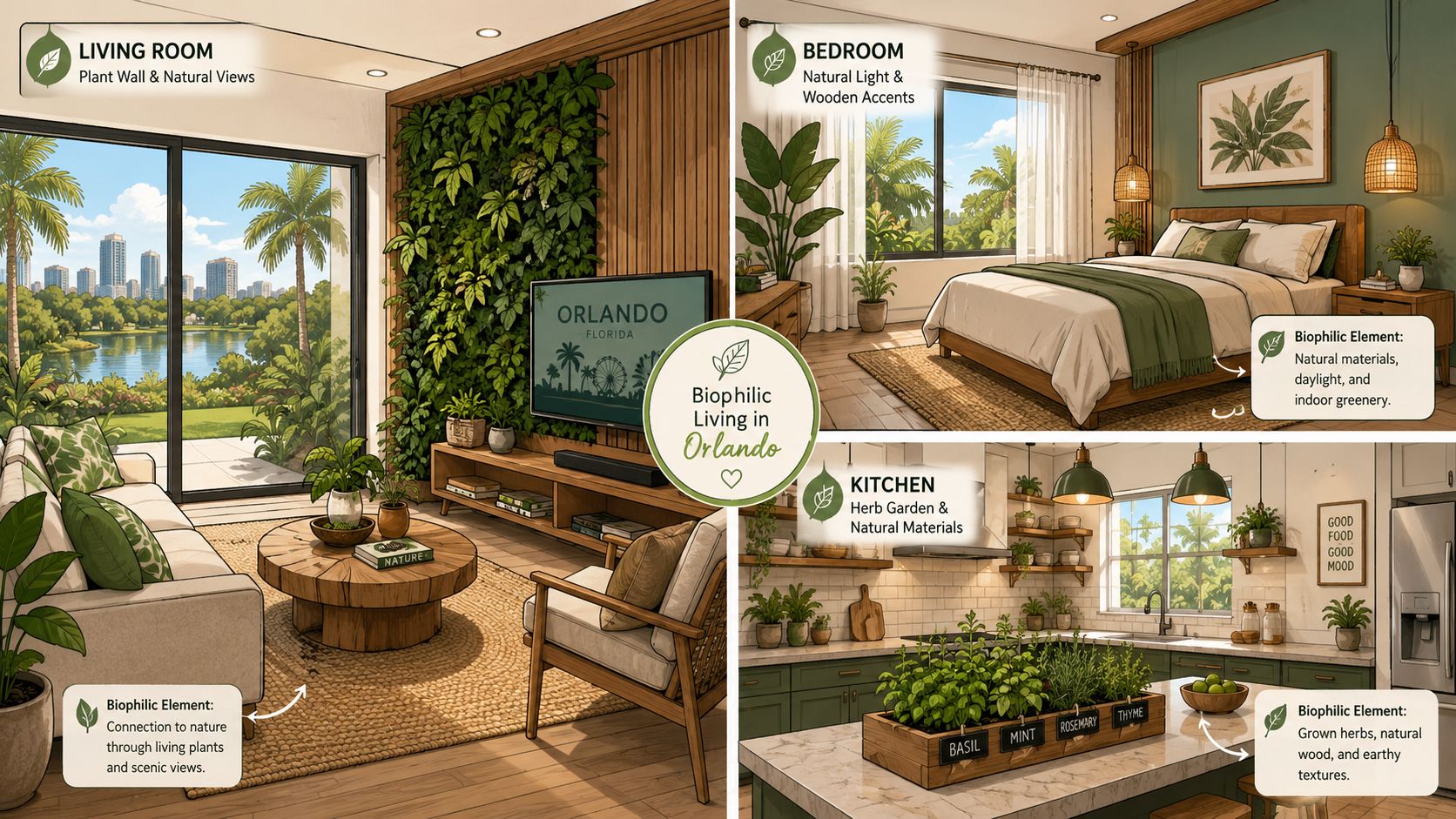
Living room
In many Central Florida homes, the living room gets the best daylight. It may also have the strongest connection to the backyard, lanai, or pool. That makes it the ideal place to start.
A comfortable sectional in a natural fabric can become the anchor. A piece from Smith Brothers works well when the room needs custom comfort and a layout designed for how the family lives. Pair that with a wood coffee table, a woven rug, and side tables with rounded corners so the room feels less rigid.
A few details help this room work harder:
- Face the view: Angle the main seating toward windows, garden doors, or a shady outdoor focal point.
- Keep the palette breathable: Sand, leaf, clay, warm white, and weathered wood tones usually hold up well in Florida light.
- Mix textures carefully: A leather accent chair, linen-like upholstery, and wood grain create interest without clutter.
Dining room
Biophilic dining rooms benefit from honesty. Real wood grain, visible craftsmanship, and a strong sense of material usually matter more than a lot of accessories. Simply Amish, Canadel, and Mavin naturally fit into this conversation. Their focus on wood, finish options, and enduring construction suits the spirit of biophilic design.
A dining table should feel substantial, but not heavy in the visual sense. In a Longwood or Lake Mary home, lighter wood tones often reflect sunlight more gently. Upholstered dining chairs in breathable fabrics can soften the look and make the room feel inviting for everyday meals, not just holidays.
The dining room often becomes more relaxing when the tabletop itself is the main visual feature.
Bedroom
A biophilic bedroom should quiet the senses. That doesn't require a full nature theme. It requires restraint. Too many colors, sharp contrasts, and glossy surfaces can make the room feel busy.
An ergonomic Stressless recliner near a window can create a strong reading nook. Add a small wood table, a soft lamp, and simple bedding in natural tones. The room starts to feel like a retreat instead of a storage area for clothing and electronics.
For the bed itself, many homeowners lean toward upholstered or wood-framed options with softer lines. Bassett and American Leather can support that look, especially when the room needs custom scale or fabric choices.
Kitchen and breakfast area
Kitchens often get overlooked in biophilic conversations because people focus on cabinets and appliances first. But this room can carry a strong nature connection through texture, light, and small moments of contrast.
Bar stools from Amisco or a breakfast set with wood character can help soften a kitchen that already has hard surfaces. A bowl of citrus, a potted herb grouping, and window treatments that let in filtered light often do more than extra decorative objects. Readers looking for more nature-focused kitchen inspiration may enjoy outdoor elements for indoor kitchens, which complements this approach nicely.
Home office
A Florida home office has one main challenge. It needs enough stimulation to support focus, but not so much visual activity that it becomes distracting.
That's where selective material use matters. A desk in real wood, a supportive chair, one view to greenery, and controlled daylight can create a room that feels alert and calm at the same time. Stickley pieces often shine in this setting because they bring craftsmanship and material depth without feeling flashy.
For households furnishing more than one room, keeping one repeating thread can help. It might be the same wood tone, the same soft green accent, or the same family of woven textures used from room to room.
Achieving Biophilic Style with Slone Brothers
A biophilic home works best when the materials are real, the scale feels right, and the furnishings have enough quality to age gracefully. That's one reason this style pairs so well with long-lasting pieces rather than disposable decor.
Choose materials that age well
Slone Brothers has served Central Florida since 1980, and that local, family-owned history matters here. Biophilic rooms benefit from furniture that develops character over time instead of looking worn out too quickly. American-made and Amish-crafted collections from Stickley, Simply Amish, Mavin, and Smith Brothers align with that approach because the materials are meant to last.
The idea is sometimes called the Patina of Time. The biophilic concept of embracing aging and wear in natural materials triggers a 22% higher sense of authentic connection and reduces anxiety compared to sterile surfaces, according to the biophilic design overview on Wikipedia. In practical terms, a well-made wood table or leather chair can become more appealing as it matures.
Use customization to keep the room balanced
Biophilic design doesn't mean every home should look the same. Some Orlando-area homes need lighter woods and slimmer silhouettes because daylight is strong. Others need more texture and grounded upholstery because the architecture feels open and airy.
That's where Slone Brothers' custom-order program becomes useful. A homeowner can choose a nature-inspired fabric for an American Leather sofa, a customized comfort level from Smith Brothers, or a finish and scale that suits a dining room from Canadel or Amisco. Custom options also help maintain balance, which is important in biophilic spaces. Too much of one material can feel heavy, while thoughtful variation usually feels more natural.
Let the layout do some of the work
Furniture selection matters, but layout often determines whether the room feels connected to nature. A beautiful chair placed in front of the only good window won't help. A gorgeous dining table that blocks circulation can make the room feel tighter than it needs to.
That's why many homeowners benefit from professional guidance before they commit. Slone Brothers offers an interior design consultation service that helps connect furniture, finishes, traffic flow, and natural light into one workable plan. For households in Longwood, Orlando, Lake Mary, and Sanford, that can make the difference between a room that looks nice for a week and one that feels good for years.
Quality matters more in biophilic design because the whole point is authenticity. Real materials, lasting construction, and thoughtful placement all reinforce the effect.
Slone Brothers also brings practical advantages beyond style alone, including a Low Price Promise, a large Clearance Outlet, home delivery, and commercial furnishings for offices that want a more welcoming, nature-connected feel.
Begin Your Design Journey at Our Longwood Showroom
Biophilic design elements don't have to be complicated. In most Central Florida homes, they begin with a better relationship to light, a few honest materials, and furniture that supports comfort without crowding the room. A small shift in layout or material choice can make a home feel calmer, cooler, and more settled.
That's easier to judge in person than on a screen. Wood tone, upholstery texture, seat comfort, and scale all need a real-world look. Shoppers comparing local options can start with one of the best furniture store experiences in the Orlando area and then narrow in on the pieces that best support a nature-inspired home.
Ready to find the perfect piece for your home? Visit the Slone Brothers Furniture showroom in Longwood, FL, and let their design experts help you get started! Want to experience the comfort of a Stressless recliner or the beauty of Stickley in person? Stop by their Longwood showroom today!