
Orlando Sectional Sofa with Storage: Organize Your Home


The living room often becomes the catchall space in a Central Florida home. Throw blankets land on the sofa, board games get tucked under a side table, chargers collect on the end table, and toys seem to multiply overnight. A sectional sofa with storage solves that problem in a way that feels intentional instead of improvised.
For households in Orlando, Longwood, Lake Mary, and Sanford, that matters. Many homes have open living areas that need to feel relaxed and organized at the same time. Since 1980, Slone Brothers has helped Greater Orlando families choose furniture that works hard without looking bulky, and storage sectionals are one of the clearest examples of that balance.
A good sectional doesn't just give a room more seating. It can hide the daily clutter that makes a beautiful room feel busy. Some modular sectionals with built-in compartments offer about 0.75 to 1.2 cubic feet per compartment, and models that integrate storage into the chaise base can increase usable living room density by 18 to 24% in urban apartments under 900 square feet, according to Belffin's modular couch with storage overview.
Table of Contents
- Your Guide to Sectional Sofas With Storage
- Decoding the Different Types of Storage Sectionals
- Measuring for Your Central Florida Home
- Quality That Lasts A Focus on Frames and Fabrics
- Customizing Your Sectional for a Perfect Fit
- Making a Smart Investment in Your Home
- Frequently Asked Questions
Your Guide to Sectional Sofas With Storage
A sectional with storage works best when it solves a real household problem. In many Central Florida homes, that problem isn't a lack of style. It's a lack of places to put the items used every day.
Blankets for a chilly movie night, kids' toys, remotes, pet accessories, and extra pillows all need a home. Without hidden storage, those things spill into baskets, piles, and overstuffed consoles. The room may still be attractive, but it won't feel calm.
Why this style makes sense
Storage sectionals combine two jobs in one piece of furniture. They provide the seating a family wants, while also adding hidden compartments under a chaise, inside an armrest, or within a center section.
That's especially helpful in homes where the living room has to do several things at once. A room might serve as a TV space, play area, reading spot, and occasional guest zone. Furniture that hides clutter keeps the room ready for all of it.
Practical rule: A storage feature is most useful when it holds the items used in that same room. Blankets belong near the seat, not in a distant closet.
What confuses most shoppers
Many people assume all storage sectionals work the same way. They don't. One may open from the top and hold bulky bedding. Another may use drawers better suited for smaller items. A third may hide chargers and remotes in a console.
Another common issue is that buying guides often describe storage as a simple yes-or-no feature. A modular sectional guide from Honbay notes that shoppers rarely get standardized information about usable storage volume or clear dimensional details, and that 90% of consumer-facing sectional content doesn't include storage-density charts that connect compartment dimensions to real household items like pillows or blankets. That gap is outlined in Honbay's discussion of modular sectionals with storage.
A thoughtful purchase starts by asking better questions. What needs to be stored. How often it will be accessed. Whether the room needs a left-facing or right-facing layout. Whether the home can handle a larger L-shape or needs something scaled for apartment living.
Decoding the Different Types of Storage Sectionals
Some storage sectionals are built for bulky items. Others are better for neat, everyday organization. Knowing the difference makes shopping much easier.
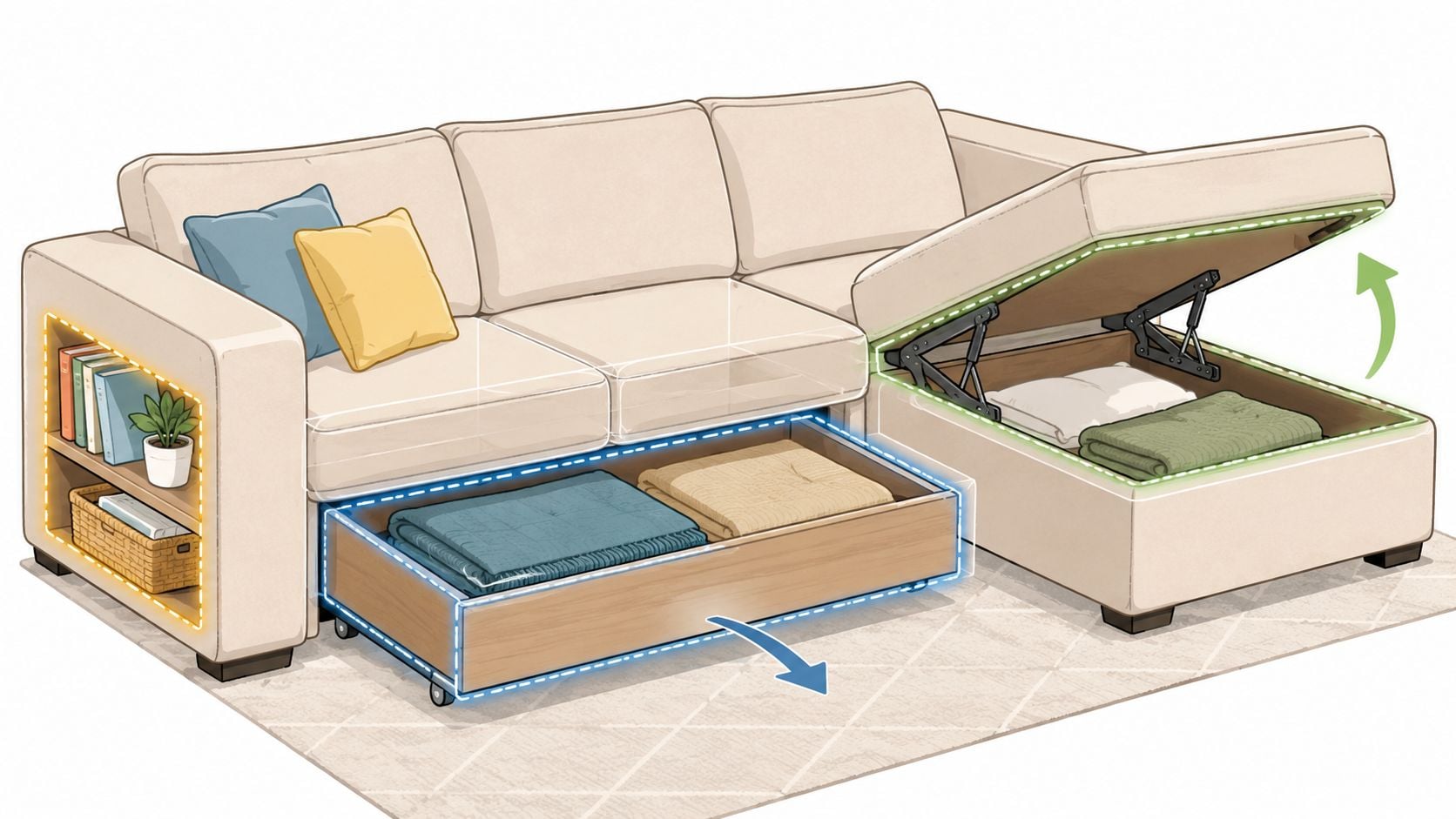
Sectional sofas with integrated storage often place concealed space inside armrests or under chaise lounges, using a lift or slide mechanism so households can stash books, toys, and clutter without giving up seating or visual appeal, as described in Remodelista's look at sectional sofas with storage.
Lift-top chaise storage
This is the version many people picture first. The chaise seat lifts upward, and the cavity underneath acts almost like a trunk.
It's usually the easiest option for larger soft goods. Extra throws, guest bedding, oversized pillows, and seasonal decor fit more naturally here than in narrower compartments.
A lift-top chaise tends to work best for households that want simple access and don't mind opening from above. It's less ideal if a coffee table or tight room layout blocks the lid from lifting comfortably.
Built-in drawers
Drawers feel more like a dresser built into the base of the sectional. They help organize smaller items that can get messy in a large open compartment.
For many families, drawers are useful for:
- Remote storage: They keep media accessories in one predictable place.
- Toy rotation: Small toys, coloring books, and game pieces stay hidden but reachable.
- Guest essentials: Spare charging cords, coasters, and lightweight throws stay nearby.
Drawers usually create better separation between items. The tradeoff is that they may not handle bulky bedding as well as a chaise compartment.
Hidden console and armrest storage
This style is the most discreet. A center console or broad armrest opens to reveal compact storage inside.
It works well for the little things that tend to clutter a room fast. Think chargers, reading glasses, headphones, and remotes. In media rooms, it often feels especially tidy because everything needed for relaxing is right where people sit.
Smaller storage areas aren't a drawback when they match the way the room gets used every day.
For homes that need a bit more hidden function beyond the sectional itself, a piece like the Beckham storage ottoman can extend that organized look without crowding the space.
Measuring for Your Central Florida Home
The best-looking sectional is still the wrong choice if it blocks circulation or can't get through the front door. Measuring first saves time, frustration, and awkward delivery day surprises.
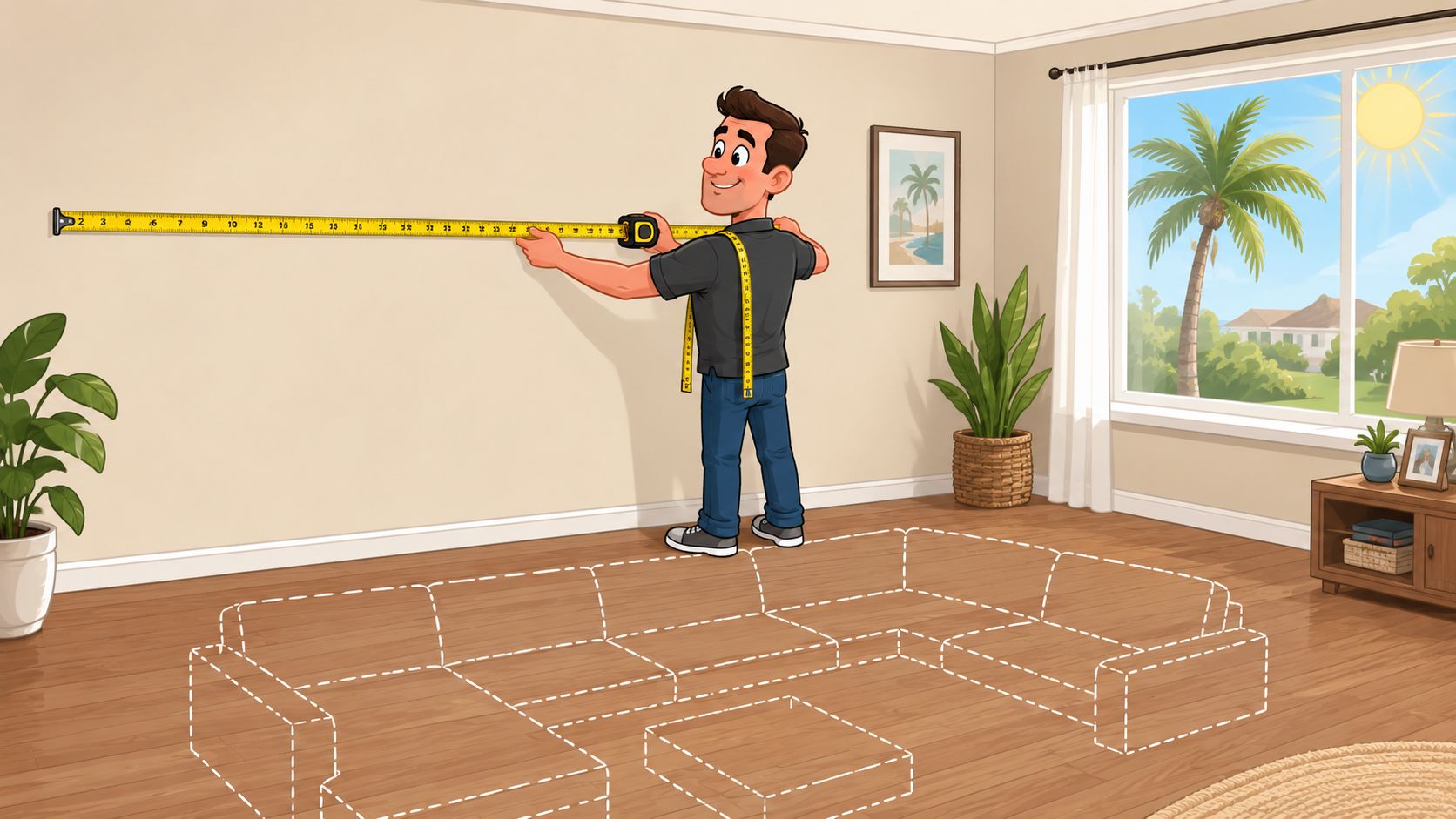
Start with the room, not the sofa
In Central Florida, floor plans vary a lot. A Longwood family room may have clear wall space for a larger sectional, while a condo near Orlando may need a tighter footprint and better traffic planning.
A reliable baseline helps. Standard L-shaped sectionals require a minimum room size of 12×12 feet, while apartment-sized sectionals can function in spaces as small as 10×12 feet. For proper traffic flow, a walkway clearance of 30–36 inches must be maintained around the entire sectional, according to Chairish's sectional couch size guide.
A practical measuring routine looks like this:
- Mark the available footprint. Use painter's tape on the floor to outline the sectional shape.
- Check traffic lanes. Make sure people can move comfortably to hallways, sliders, and adjoining rooms.
- Account for nearby pieces. Coffee tables, accent chairs, and media consoles all affect how roomy the layout feels.
- Notice room shape. Open-concept homes still need visual boundaries, even when the walls don't define them clearly.
For homeowners mapping a larger room from scratch, Flacks Flooring's guide for homeowners is a helpful companion resource because it shows a clear, practical way to think about room dimensions before furniture placement gets finalized.
Don't forget the delivery path
A sectional has to fit the house before it can fit the room. Doorways, stairwells, elevators, and entry turns all matter.
The most overlooked number is often the diagonal depth. That's the measurement from the top-back of the frame to the bottom-front of the armrest, and it's often the deciding factor for whether a piece can tilt and pivot through an entry. Belffin's measuring guide notes that this diagonal depth is critical for delivery clearance and that the sofa's diagonal depth should be less than the doorway width to avoid installation failure. That guidance appears in Belffin's sectional measuring article.
A homeowner can have enough wall space and still end up with the wrong sectional if the delivery path hasn't been measured.
For homes in Lake Mary and Sanford with tighter entries or second-floor bonus rooms, this step is especially important. A sectional that comes in multiple modular pieces can make placement much easier, but each component still needs clearance.
A design consultation can also help refine room flow before a purchase. The design services page offers a useful starting point for planning a layout around real measurements instead of guesswork.
Quality That Lasts A Focus on Frames and Fabrics
Storage adds convenience, but it also raises a fair question. Does a hidden compartment weaken the sofa.
Why construction matters more with storage
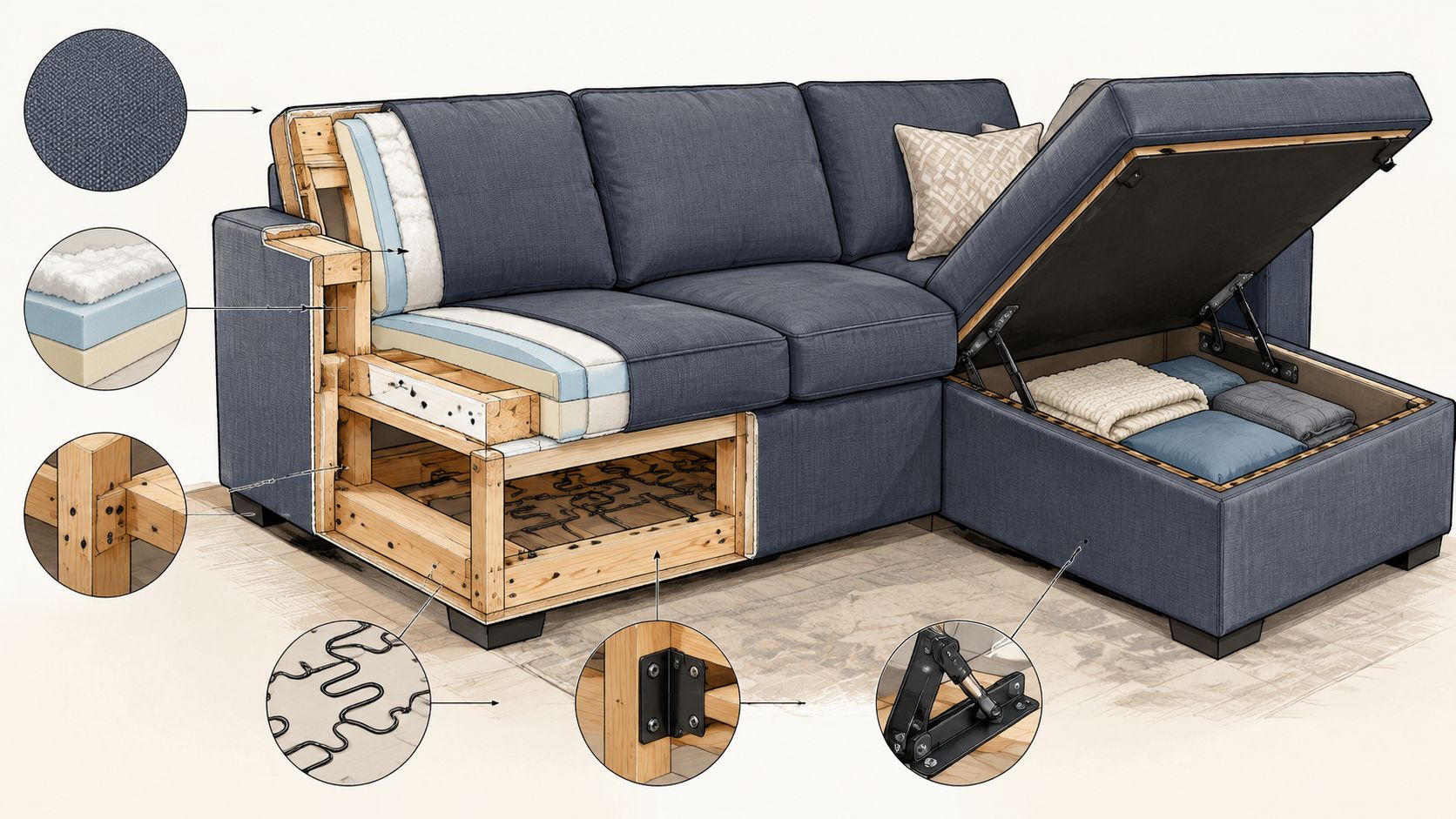
This concern comes up often because a storage seat has moving parts, access panels, and altered support areas. A consumer discussion highlighted that one of the biggest unanswered buying questions is whether integrated storage affects cushion longevity, and that independent verification of frame stress near storage compartments is often missing. It also noted that quality brands respond with reinforced frames and strong mechanisms, as summarized in this discussion of storage sectional durability concerns.
That's why build quality matters more here than in a basic stationary sofa. A well-made storage sectional should have:
- Reinforced framing: The seat base needs support around the opening, not just around the perimeter.
- Dependable hardware: Hinges and lift systems should feel steady, not wobbly or thin.
- Consistent seat support: Cushions should still feel level and secure over the storage area.
- Durable suspension: The support under the seat affects comfort over time, not just on the showroom floor.
Better-made brands demonstrate their true value. Shoppers often recognize names such as Smith Brothers, Bassett, Craftmaster, American Leather, Stickley, Stressless, Palasar, Simply Amish, Canadel, Amisco, and Mavin because these collections tend to focus on stronger construction, thoughtful comfort, and long-term livability rather than quick turnover.
Fabrics that suit Central Florida living
In Florida, fabric choice matters almost as much as frame choice. Sun from large windows, everyday humidity, pets, and frequent use all shape how a sectional ages.
Performance fabrics are often the smartest direction for active households. They're easier to maintain, more forgiving with spills, and better suited for family rooms that see constant use.
A simple checklist helps:
- For sunny rooms: Look for fabrics that hold color well in bright natural light.
- For busy households: Choose textures that don't show every wrinkle or crumb.
- For pets and kids: Tighter weaves often make day-to-day upkeep easier.
- For long-term care: Keep a practical upholstery cleaning routine. A useful reference is how to clean sofa upholstery, which walks through maintenance basics in plain language.
The smartest fabric is usually the one a family won't feel nervous about using every day.
Customizing Your Sectional for a Perfect Fit
A sectional often works best when it isn't treated like a one-size-fits-all purchase. Room shape, household habits, and preferred comfort all influence the right final design.
Configuration comes first
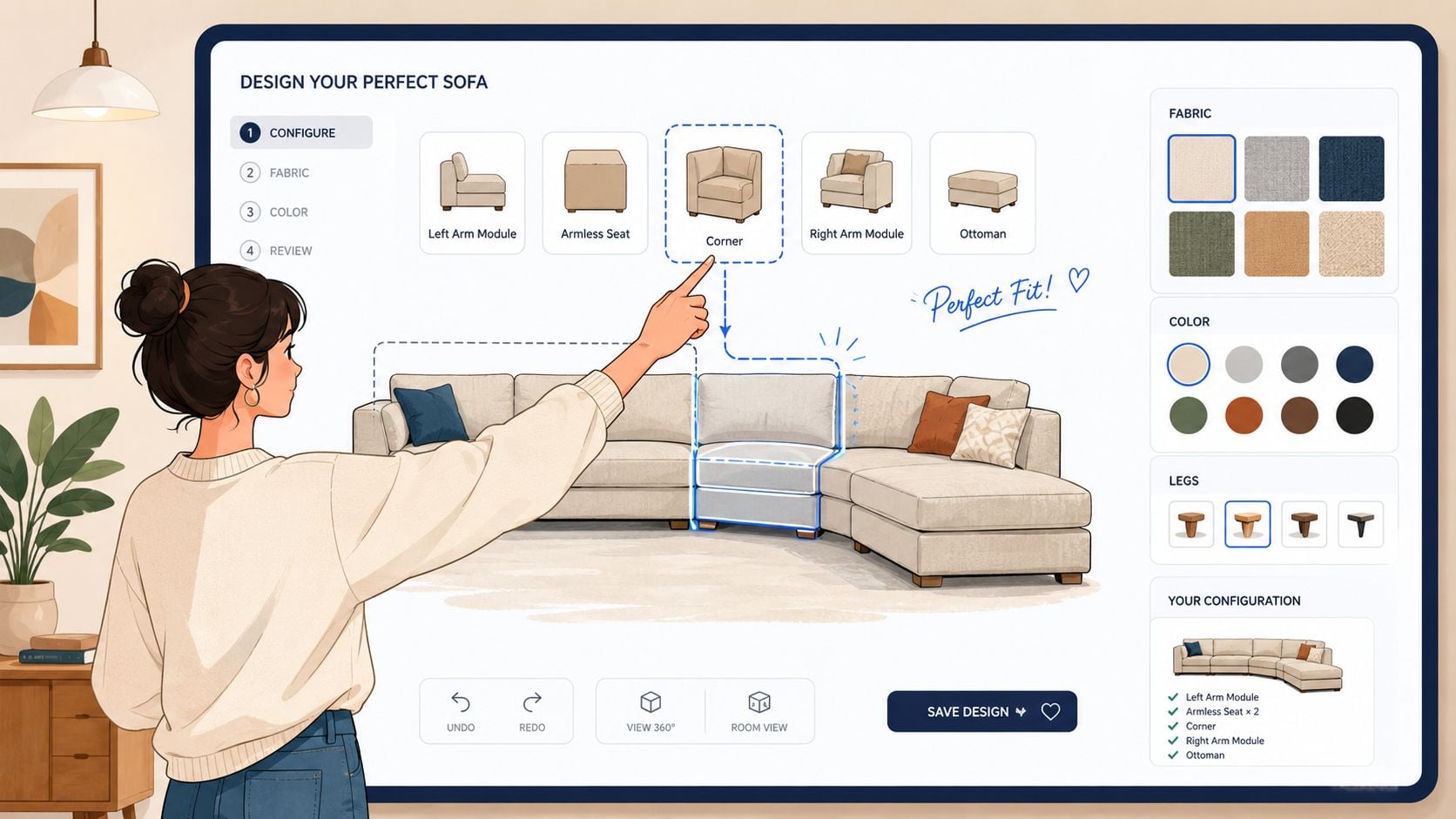
The smartest customization usually begins with layout. A family that entertains frequently may want a broad conversational shape. A townhouse living room may need a compact chaise sectional that keeps walkways open. A media room may call for deeper lounging seats and a console in the center.
Then come the personal choices:
- Arm style: Slim arms can make a sectional feel lighter in a smaller room.
- Seat feel: Some households want upright support, while others prefer a sink-in cushion.
- Fabric and color: Lighter neutrals can brighten a room, while textured mid-tones often hide daily wear better.
- Orientation: Left-facing and right-facing configurations need to match the actual traffic pattern of the room.
Custom-order programs are especially helpful here. Collections from American Leather, Craftmaster, Bassett, Smith Brothers, and other quality makers often allow choices that make the piece fit the room instead of forcing the room to fit the piece. The custom-order furniture options page shows how customized configurations, materials, and finishes can shape a more precise result.
Modern features worth considering
Storage sectionals have also become more useful in subtle ways. Some advanced models now include embedded USB-C charging ports and wireless Qi phone chargers inside armrests or center consoles, meeting smart home interoperability standards, according to Gardner White's overview of sectional couch features.
Those features work best when they support the room instead of distracting from it. A charging port in a console can reduce cord clutter on side tables. Hidden tech also helps the seating area feel more complete, especially in households where devices are always close at hand.
Some shoppers also appreciate modular flexibility. A sectional with rearrangeable components gives a room more future-proofing if the household moves, remodels, or rethinks the layout later.
Making a Smart Investment in Your Home
Storage sectionals sit at the intersection of comfort, function, and long-term value. That's why price shopping alone rarely tells the whole story.
What price really means
Compact sectionals with storage typically cost around $2,000, while higher-quality storage pieces with premium materials and stronger construction cost more because they use better joinery and high-density foams designed for long-term use, according to Emily Henderson's guide to storage sofas, sectionals, and ottomans.
That doesn't mean every household needs the highest-priced model. It does mean the least expensive option may not deliver the best value if the frame, seat support, and mechanisms wear out too soon.
A smart way to think about value is to ask:
- Will this piece solve more than one problem? Seating plus hidden organization can reduce the need for extra furniture.
- Will it still fit the household in a few years? A flexible configuration tends to age better with changing routines.
- Will the materials stand up to normal life? Durable construction usually feels different right away.
- Is there a path to make quality more accessible? Financing and clearance options can matter as much as sticker price.
The financing options page is helpful for households that want to balance a strong purchase with monthly budgeting.
Plan for delivery and long-term value
Buying the right sectional also means thinking beyond the showroom floor. Delivery, placement, and even future resale can shape whether a purchase feels wise.
As covered earlier, entry clearance matters. A beautiful sectional that can't pivot through the front door becomes a logistical headache fast. Measuring carefully protects both the purchase and the home.
Thoughtful furniture choices can also support broader home appeal. For homeowners preparing a property for market, improvements that make spaces feel organized and functional often carry weight alongside cosmetic updates. A useful broader reference is increase home value before selling, which looks at practical upgrades that help a home present better. Since that article is future-dated, it's best read as general planning guidance rather than a current market claim.
Frequently Asked Questions
Buying a sectional sofa with storage usually gets easier once the practical questions are answered. These are the ones that tend to matter most.
How much can a storage sectional really hold
It depends on the compartment style. Some modular sectionals offer about 0.75 to 1.2 cubic feet per compartment, which is enough for items like blankets, remotes, and seasonal accessories, as noted earlier in the article. The better question is whether the shape of the compartment matches what the household wants to store.
Does storage make the seat less comfortable
Not automatically. Comfort depends on frame support, cushion design, and the quality of the hardware below the seat. A well-made model should still feel stable and properly supported. If a seat feels uneven or flimsy in the showroom, that usually signals a construction issue, not a problem with the storage concept itself.
Can a sectional have both storage and reclining features
Sometimes, yes. It depends on how the piece is engineered. Reclining mechanisms and storage compartments both require internal space, so one feature may limit where the other can go. In many layouts, a console or armrest is the most natural place for hidden storage when reclining seats are involved.
Where can homeowners get more buying help
A strong buying process includes room measurements, delivery-path planning, fabric selection, and realistic expectations about storage use. Homeowners who want a clearer picture of lead times, delivery, service, and common furniture questions can review the furniture buying FAQ page.
The goal isn't to chase the trendiest sectional. It's to choose one that fits the room, supports daily life, and keeps the living area feeling calmer and more usable.
Ready to find the perfect piece for your home? Visit Slone Brothers Furniture showroom in Longwood, FL, and let their design experts help you get started. Central Florida families have counted on this local, family-owned business since 1980 for quality furniture, American-made and Amish-crafted options, custom-order flexibility, a Low Price Promise, and a large clearance outlet. Want to experience the comfort of a Stressless recliner or the beauty of Stickley in person? Stop by the Longwood showroom today.