
Crib Mattress Measurements: A Central Florida Parent’s Guide

You’re standing in the nursery with a tape measure in one hand and a list on your phone in the other. The crib is assembled. The paint color is picked. Maybe the rocker is in the corner already. Then you hit the part that seems like it should be simple and somehow isn’t. Crib mattress measurements.
That confusion is normal. New parents across Orlando, Longwood, Lake Mary, and Sanford run into the same problem. A crib mattress looks close enough until you start asking the safety questions. Is there too much space at the sides? Is a mini crib mattress interchangeable? What if the crib was handed down by family?
The good news is that this doesn’t have to stay confusing. Once you understand what the measurements mean and how to check fit, the decision gets much clearer. If you’re also shopping for the rest of the sleep setup, our guide on how to choose a mattress is a helpful starting point for understanding mattress basics in plain language.
Why Crib Mattress Measurements Are a Parent’s Top Priority
A lot of nursery decisions are about style. This one isn’t.
Parents often spend time comparing wood finishes, drawer storage, or whether the crib will match the dresser. Then the mattress becomes an afterthought. That’s where trouble starts. A crib mattress isn’t just another bedding purchase. It has to fit correctly inside the crib so your baby has a secure sleep surface.
What makes this decision different
With adult beds, a little extra room around the mattress is mostly a cosmetic issue. In a crib, fit matters in a completely different way. If the mattress is too small, it can leave space at the edges. If it’s too big, it may buckle or press up where it shouldn’t.
That’s why parents tend to feel uneasy when they shop online for one. Product names can sound similar. Photos don’t always tell you enough. And a listing that says “crib mattress” doesn’t automatically mean it fits your specific crib.
Practical rule: In a nursery, “close enough” is not the standard. A crib mattress needs a deliberate, snug fit.
The real-life moment where parents get stuck
We see this kind of situation all the time in Central Florida. A family moves into a new home, sets up the nursery, and unboxes a crib from a registry or a relative. Then they realize the crib might not be a standard full-size model. Or they ordered a mattress first and the crib second, assuming all crib mattresses worked the same way.
That assumption causes most of the confusion.
The safest approach is to think of the crib and mattress as a matched pair, even if they come from different places. The mattress isn’t just supposed to look right. It’s supposed to fit right.
Why measurements matter more than appearances
A crib mattress can be beautifully made, nicely finished, and still be the wrong choice if the dimensions don’t match the crib interior. This is one of those purchases where the unseen detail matters more than the visible one.
For new parents, that can feel frustrating. It also gives you a simple priority list:
- Start with fit: Measure first or confirm the crib’s interior size before shopping.
- Check the category: Standard, mini, portable, and specialty cribs don’t use the same mattress type.
- Treat hand-me-downs carefully: Older cribs and older mattresses need extra scrutiny.
- Ignore “looks about right”: Use actual dimensions, not visual guesses.
Once you focus on fit before comfort features or cover materials, the process gets much easier.
Understanding Standard Crib Mattress Measurements
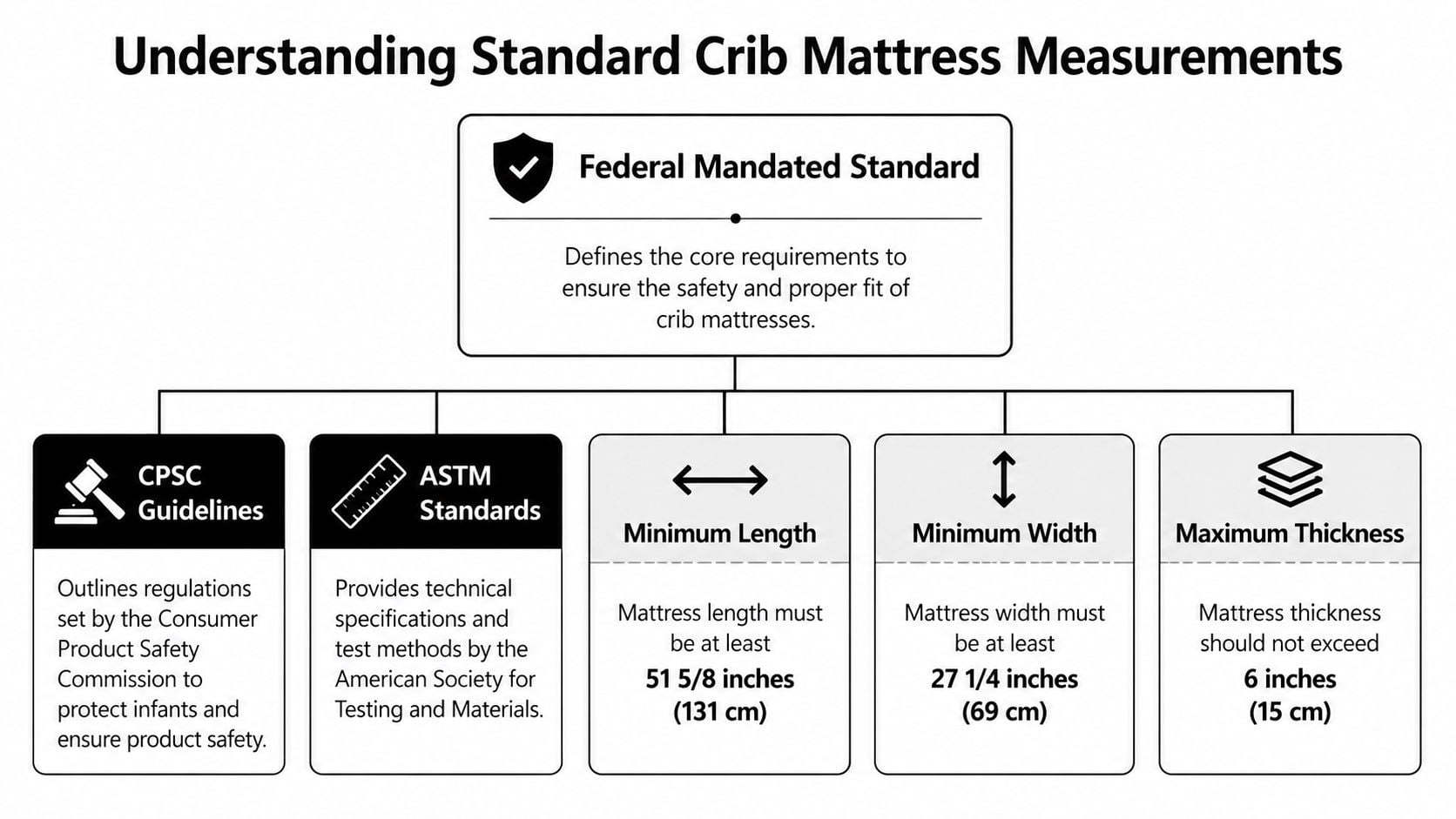
A standard crib mattress follows a very specific set of measurements. In the U.S., it must measure at least 27 1/4 inches wide by 51 5/8 inches long, with a maximum thickness of 6 inches, according to the crib mattress sizing details summarized by Sealy Baby’s explanation of crib mattress fit. Those dimensions are designed to match standard crib interiors that measure 28 inches wide by 52 3/8 inches long (plus or minus 5/8 inch), which is why a proper fit feels snug right away.
The numbers have a purpose
Those fractions can look fussy on paper, but they serve a plain safety goal. A crib mattress should sit close enough to the sides that a baby cannot slip into a dangerous gap between the mattress and the crib frame.
That is why parents often hear the two-finger check.
If you can fit more than two fingers between the mattress edge and the crib side, the fit isn’t snug enough.
It works like checking whether a lid matches a container. If there is too much space around the edge, the fit is off, even if the mattress looked fine in the box or on a product page.
Why thickness matters
Thickness affects more than appearance. A mattress that is too thick can change how high the sleep surface sits inside the crib, which affects how the crib functions as your baby grows and the mattress support gets lowered.
This is one of the details that often trips up online shoppers in Orlando and across Central Florida. A listing may say “standard crib mattress,” but the actual spec box clarifies the specifics. At Slone Brothers, we help parents read those measurements the same way we would help someone compare the size of a twin mattress. The difference is that crib sizing is tied directly to nursery safety, not just comfort or bedding fit.
A quick reference table
| Measurement | Standard requirement |
|---|---|
| Minimum width | 27 1/4 inches |
| Minimum length | 51 5/8 inches |
| Maximum thickness | 6 inches |
| Standard crib interior | 28 inches wide by 52 3/8 inches long |
| Safe side gap goal | No more than 1 inch or roughly two fingers |
What these measurements mean in a store
For parents, these numbers are less about memorizing fractions and more about knowing what to confirm before you buy. If a mattress is labeled standard, the specs should line up with the chart above. If they do not, stop and check before bringing it home.
That hands-on check matters. Nursery planning is part of creating a secure space for children, and the mattress is one place where small measurement errors can create real problems.
If you would rather not sort through conflicting listings and vague labels by yourself, come into Slone Brothers and let us walk through it with you. For many Central Florida parents, seeing the crib, checking the specs, and asking questions in person clears up more confusion in ten minutes than an hour of online searching.
Beyond the Standard Sizing for Crib Mattresses
A parent walks into our Orlando showroom with a mattress in the box, a crib picked out online, and one simple question. Will these two fit together safely?
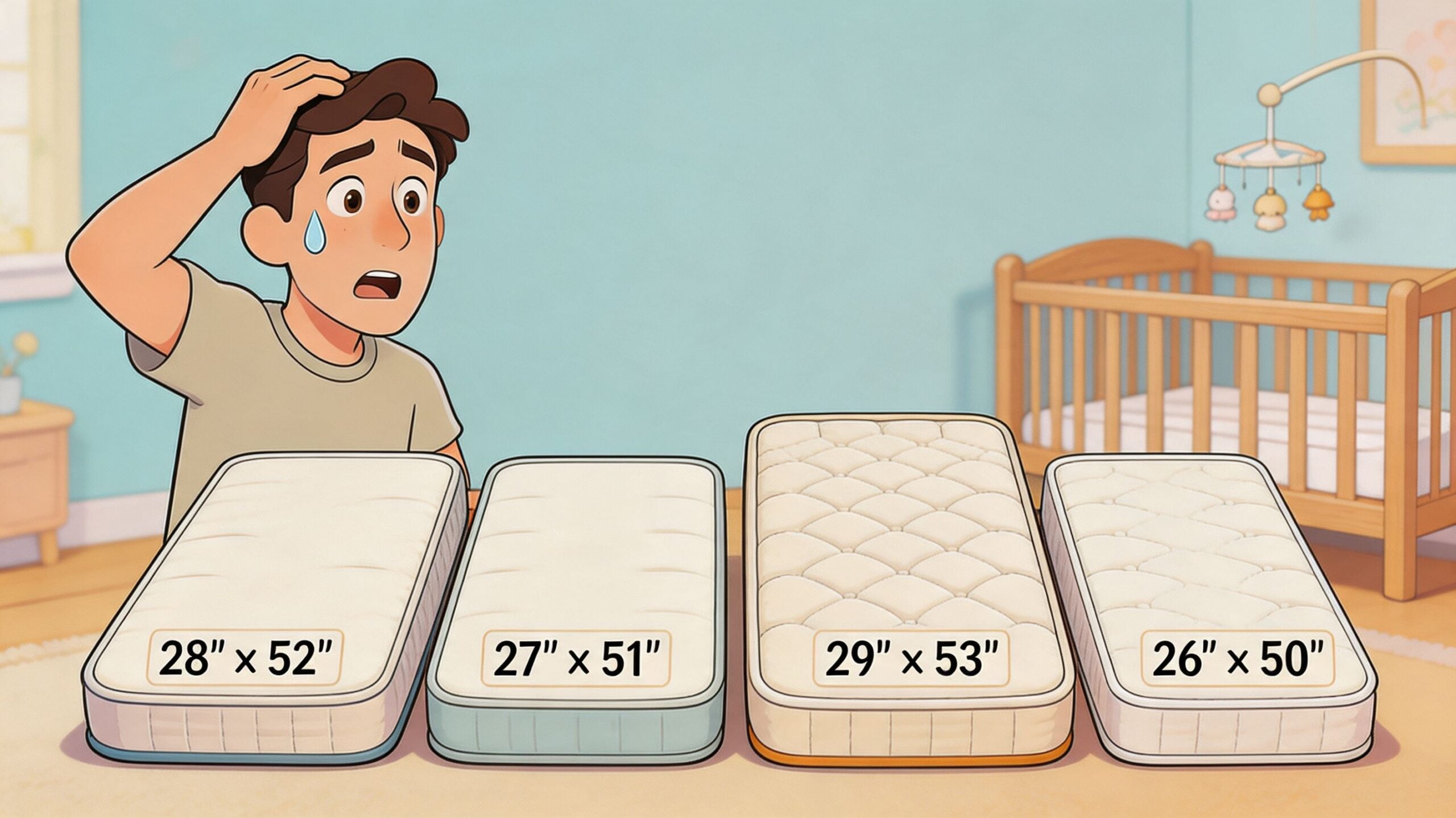
That question matters because “crib mattress” is a category name, not one universal size.
Some mattresses are built for standard full-size cribs. Others are made for mini cribs or portable models. Some convertible cribs still use a standard crib mattress, while shaped cribs often need a mattress made for that exact frame. The labels can sound close enough to fool you, especially when you are comparing product pages late at night and every listing claims to be the right choice.
Standard full-size crib mattresses
This is the size category many parents expect to buy. It matches the regulated full-size crib dimensions covered earlier and is the default choice for many new cribs from major brands.
Still, the safest habit is to confirm the crib’s category instead of trusting the product title alone. A crib can look standard from across the room and still be built for a different mattress size.
Mini and portable crib mattresses
Mini crib mattresses are a separate category. They are smaller than standard crib mattresses and are made for cribs designed around that smaller footprint.
That sounds obvious until you start shopping online.
Words like “portable,” “compact,” and “small-space” often get used loosely in listings, which leads parents to assume that any smaller crib mattress will work in any smaller crib. It will not. A mini crib mattress belongs in a mini or portable crib made for that size. A standard crib mattress does not safely substitute for it, and the reverse is true too.
For families planning around tighter bedrooms, condos, or guest rooms, NINI and LOLI's advice for small nurseries is a helpful starting point for choosing the crib itself before you match it to a mattress.
Convertible crib mattresses
Convertible cribs confuse a lot of parents because the word “convertible” sounds like it should mean a special mattress. Usually, it does not.
A convertible crib works like a dresser with an adjustable shelf. The furniture changes how it functions over time, but the core dimensions may stay the same in the crib stage. Many convertible cribs begin life as standard full-size cribs and use a standard crib mattress. Others do not. The label tells you that the crib can become something else later. It does not tell you the mattress size by itself.
That is why category comes first, marketing name second.
Specialty and shaped mattresses
Oval, round, and other shaped cribs can be beautiful. They also leave much less room for approximation.
With a standard rectangular crib, you are working within a familiar set of measurements. With a shaped crib, the mattress often needs to match that specific model the way a puzzle piece matches its own spot. A mattress that is merely close can leave unsafe gaps or fit unevenly.
If you want to compare that kind of fit the same careful way you would measure a sofa, bunk bed, or dining set in your home, our guide on how to measure furniture properly before you buy follows the same basic principle. Measure the actual usable space, not what looks right at a glance.
A quick comparison
| Crib type | Mattress note | Main caution |
|---|---|---|
| Standard full-size | Uses standard crib mattress sizing | Confirm the crib is truly standard |
| Mini or portable | Uses a smaller mattress category | Not interchangeable with standard |
| Convertible | Often uses crib sizing based on the starting crib format | Do not assume the label gives the dimensions |
| Shaped or specialty | Often needs a model-specific mattress | Avoid near matches and substitutes |
Where parents get tripped up
We hear the same misunderstandings again and again in the store:
- “It says crib mattress, so it should fit.” Product category alone does not confirm compatibility.
- “Portable means they all use the same mattress.” Portable cribs are not all built to one size.
- “The size difference looks small.” In a crib, small gaps can create safety problems.
- “We can fix the fit with padding.” Extra padding does not correct a bad fit.
If you are feeling unsure, that is normal. This part gets confusing fast online. At Slone Brothers, Central Florida parents can bring in measurements, ask questions face to face, and compare options with someone who has handled the furniture in person. That usually clears up the confusion much faster than scrolling through another five product listings.
How to Measure Your Crib for a Perfect Mattress Fit
If you’ve got a tape measure and five quiet minutes, you can answer the biggest question yourself. Does this mattress fit this crib?
This step matters most when the crib is older, inherited, imported, or missing its original paperwork. It also matters when the crib is marketed with terms that sound close to standard but don’t clearly say what category it belongs to.
What you need before you start
Keep it simple:
- A firm tape measure: A floppy cloth tape can shift and throw off your reading.
- The crib assembled: Measure the crib in its actual set-up position.
- Good lighting: You want to see the inside edges clearly.
- A notepad or phone note: Write measurements down immediately.
If you’ve measured sofas, sectionals, or bed frames before, the same principle applies. This guide on how to measure furniture follows the same common-sense approach of measuring the actual usable interior space, not what looks right from the outside.
The step-by-step method
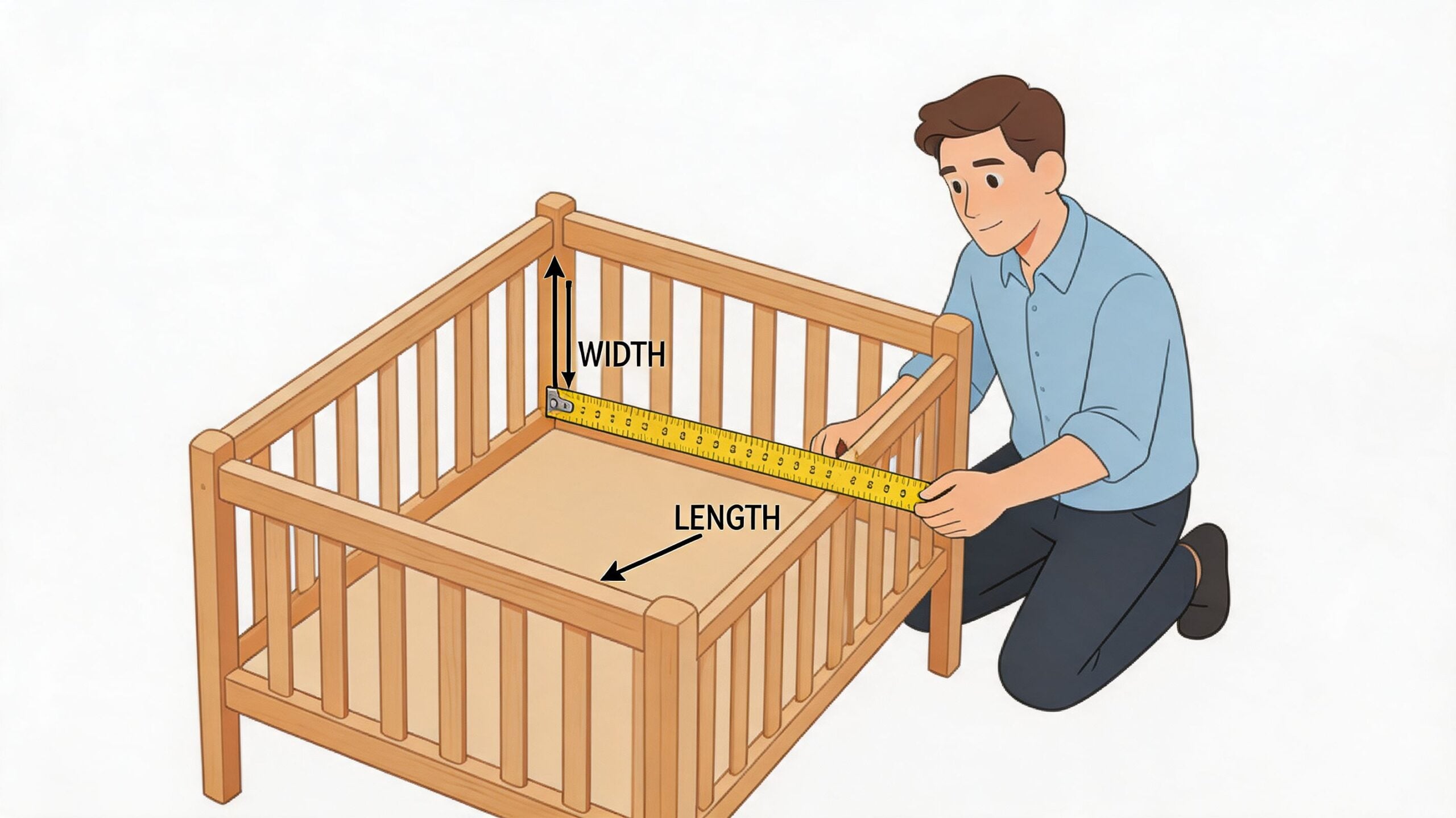
Use the inside of the crib, not the outer frame.
Measure the inside width
Place the tape measure from one interior side panel straight across to the opposite interior side panel. You want wall-to-wall measurement inside the crib.Measure the inside length
Repeat the process from the interior head end to the interior foot end.Check for square corners and straight sides
If the crib is older or handmade, look for any warping or irregular spacing. A crib can seem rectangular but still vary slightly from one side to the other.Compare your numbers to the mattress specs
The mattress should sit snugly once installed. You’re not looking for visual approximation. You’re matching actual dimensions.Do the finger-gap check after placement
Once the mattress is inside the crib, test the perimeter. If more than two fingers fit in the space, the fit isn’t right.
The part parents often miss
Many people measure after they buy the mattress. Reverse that order if you can.
The best time to measure is before purchase, especially with second-hand cribs, heirloom pieces, or international models. Those are the situations where assumptions fail most often.
Measurement note: Measure the interior where the mattress actually rests. Outside frame measurements don’t tell you what you need.
When the crib is older or unusual
An heirloom crib can have sentimental value. It can also create uncertainty. Sometimes the original manufacturer information is gone. Sometimes the crib was built before current standards became familiar to most shoppers. Sometimes an imported crib doesn’t line up neatly with U.S. mattress categories.
In those cases, don’t rush. Take the measurements carefully. Recheck them. If anything about the fit seems questionable, pause before using it.
That caution saves a lot of frustration later. It also helps you avoid buying multiple mattresses just to test which one seems closest.
Common Measurement Mistakes and Safety Risks to Avoid
You bring the crib home, slide the mattress in, and pause. There is a gap at one end. Or the mattress only fits if you push hard on the corners. That moment matters, because crib fit is not a place for guesswork.
Parents usually run into trouble for a simple reason. Product labels can sound clear until you compare them to the crib in front of you. “Standard” can create false confidence, especially with older cribs, hand-me-downs, imported models, or replacement mattresses bought online.
Mistake one using a mattress that’s too small
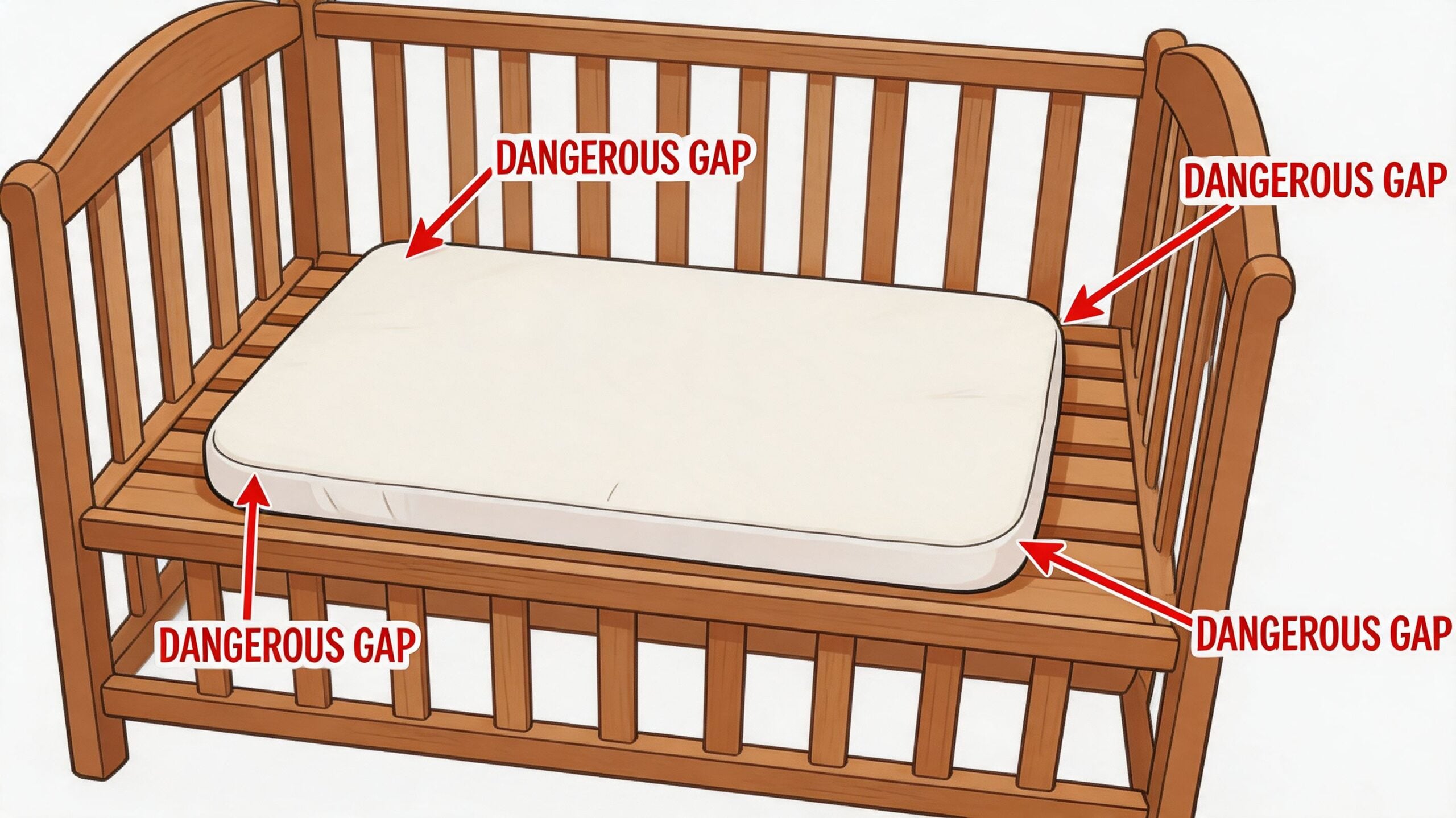
A crib mattress should fit like a lid that belongs on its container. If there is open space around the edges, the fit is off.
This often happens when a mini crib mattress is mistaken for a standard crib mattress, or when a parent shops by category name instead of exact dimensions. The gap may look minor at first glance. In practice, even a small amount of extra space is a warning sign that the mattress and crib are not matched correctly.
Mistake two forcing in a mattress that’s too large
A too-large mattress can fool people because less visible gap feels safer. The key test is whether the mattress drops in flat and even.
If you have to bend it, squeeze the corners, or press it down into place, stop. A mattress under pressure can bow, lift at the edges, or create an uneven sleep surface. That is not a proper fit. It is a mismatch.
Mistake three trusting the label more than the real-world fit
This is the trap that catches many parents with unusual cribs. A mattress may be sold as a crib mattress and still not suit the crib you have at home.
Heirloom cribs, second-hand finds, and some international models often create the most confusion. The safest approach is practical, not theoretical. Measure carefully, compare the actual dimensions, and judge the fit inside the crib itself. If anything feels questionable, get a second opinion before use.
That hands-on help is one reason Central Florida parents often prefer to visit a local store instead of trying to decode conflicting product pages by themselves. At Slone Brothers, you can bring your measurements, talk through the crib style, and get guidance from someone who works with furniture sizing every day.
Mistake four trying to correct bad fit with accessories
A poor fit cannot be fixed with extra padding, a topper, rolled blankets, or fabric tucked around the edges. Those additions do not solve the sizing problem. They create a different safety problem.
The mattress itself needs to fit correctly. No workaround can substitute for that.
If the fit is wrong, replace the mattress with one that fits the crib properly. Do not patch the gap with add-ons.
Mistake five overlooking mattress condition
Fit is not only about width and length. Condition matters too.
A used crib mattress may have softened spots, weak edges, or a shape that has changed over time. Even if the label says it is the right size, wear can affect how it sits in the crib and how evenly it supports your baby. Parents who have seen this happen with adult beds will recognize the pattern. Our guide to signs it’s time to replace your mattress explains how aging materials can change support and shape.
A quick red-flag checklist
Pause and recheck the setup if you notice any of these:
- Visible space around the perimeter: The mattress does not sit snugly against the crib sides.
- Pressure fit: You have to push, bend, or compress the mattress to get it in place.
- Uneven corners or edges: Part of the mattress sits higher, lifts up, or will not lie flat.
- Unclear crib history: You are working with an older, imported, or second-hand crib with uncertain sizing.
- Temptation to improvise: You feel the need to add padding or fill gaps to make the setup work.
A crib mattress should fit cleanly, sit flat, and leave you feeling sure about it. If you are standing in the nursery wondering whether it is “close enough,” it is worth stopping by Slone Brothers and getting an in-person answer from someone local who can help you sort out the measurements with confidence.
Your Local Guide to Crib Mattresses in Central Florida
For Central Florida families, one of the hardest parts of crib shopping isn’t finding information. It’s sorting through too much of it. You read one guide that says standard sizing solves everything. Then you read another that mentions mini cribs, portable models, or vintage furniture and suddenly the decision feels less settled.
That’s why local, in-person help matters so much with nursery pieces. A crib mattress isn’t a category where most parents want to rely only on product photos and vague dimensions. They want to compare options, ask questions, and leave feeling sure.
Why local shopping changes the experience
In the Greater Orlando area, families are often furnishing more than one room at once. Maybe it’s a first nursery in a new Longwood home. Maybe it’s a guest room and nursery combo in Lake Mary. Maybe it’s a growing family in Sanford trying to make a smaller room work well.
Seeing mattresses and furniture in person makes those decisions easier. You can check construction, feel firmness, compare scale, and talk through whether a standard, mini, or special-order solution makes sense.
What to look for in a trusted mattress resource
A good local mattress destination should offer more than inventory. It should give you guidance.
Look for:
- Clear product information: You shouldn’t have to decode sizing language.
- Knowledgeable staff: Parents need practical answers, not rehearsed sales lines.
- Quality-focused selection: Well-made mattresses and furniture tend to come with clearer specs and better consistency.
- Design help when needed: Nursery planning often overlaps with room layout, storage, and long-term use.
If you’re comparing local options, this roundup of top-rated mattress stores near me is a useful place to start.
Why Central Florida parents benefit from hands-on help
This is especially true when your situation isn’t textbook. Maybe your crib is inherited. Maybe you’re balancing nursery function with limited square footage. Maybe you want furniture that coordinates with the rest of your home instead of looking temporary.
A showroom visit lets you bring those practical concerns into the conversation. It also gives you a better sense of long-term value. That matters when you want pieces that work well now and still make sense as your child grows.
The best nursery choices usually come from asking simple questions in person, then matching the answer to your actual room and actual crib.
For families who want more help pulling the room together, design support can make the process much less stressful. It’s worth exploring complimentary design services when you’re trying to create a nursery that feels calm, functional, and well-planned.
A Safe and Sound Nursery Starts with the Right Fit
A beautiful nursery feels good. A properly fitted crib mattress does something more important. It helps create a safer sleep space.
That’s the central takeaway. Crib mattress measurements aren’t just technical details on a spec sheet. They’re the foundation of a good fit, and good fit is what turns a crib and mattress into a setup you can trust more confidently.
If the measurements felt intimidating at first, that’s understandable. Most parents aren’t used to thinking in fractions of inches and gap checks. Once you know what to watch for, though, the process becomes more manageable. Measure the crib interior, match the mattress to the crib category, and never assume “close enough” will do.
For parents who want to keep learning about sleep setup as a whole, this article with expert advice on infant sleep safety is a useful companion read.
The nursery doesn’t need to be perfect on day one. It does need the basics handled well. And among those basics, mattress fit belongs near the top of the list.
Frequently Asked Questions About Crib Mattresses
Are all mini crib mattresses the same size
No. Mini crib mattresses are a separate category, and portable crib dimensions can vary by brand. That’s why “mini” shouldn’t be treated like a universal fit label. Always compare the crib’s interior dimensions to the mattress specifications before you buy.
Is it okay to use a used crib mattress
It depends on condition, history, and fit, but many parents choose to be cautious here. A used crib mattress may have lost firmness, changed shape, or picked up wear that isn’t obvious at a glance. If it doesn’t feel consistently flat and supportive, or if you can’t confirm it still fits the crib properly, it’s better to move on from it.
What’s the difference between a crib mattress and a toddler mattress
In many convertible setups, the same mattress may continue from crib use into a toddler bed configuration. Parents also see dual-sided mattresses designed with one side for infants and another for toddler use. The key difference isn’t just the label. It’s whether the mattress is still appropriate for the furniture and stage you’re using it in.
Ready to find the perfect piece for your home? Visit Slone Brothers Furniture in Longwood, FL, and let our design experts help you get started. As a local, family-owned showroom serving Central Florida since 1980, we’re here to help you sort through the details, compare quality options in person, and furnish your home with confidence.