How to Choose a Rectangle Glass Top Table


A west-facing dining room in Winter Park can look smaller than it is once a heavy dark top covers the rug and the tile. The same thing happens in Lake Mary, where a long sofa and a solid cocktail table leave almost no floor visible. A rectangle glass top table is a level glass panel on a wood or metal base, used for dining, coffee, or an occasional table. Straight edges suit a galley dining room and a long sofa better than a round top, which wastes corner space and fights a rectangular rug.
Homes in Longwood, Sanford, and Altamonte Springs deal with strong sun, humidity, and open plans. A clear top lets the floor stay in the picture, but the base still has to carry real weight, real chairs, and real people. The decisions run in a set order. Measure seating and walkways first. Verify tempered or laminated safety glass next. Then choose the edge and the base, match the room, and learn how humidity care works in Central Florida.
Clear glass is not automatically safer, easier to live with, or a stand-in for a sturdy base. Tempered glass changes the break pattern. It does not make the top unbreakable. Measure the room and write down who sits there before a finish is chosen.
Why a Rectangle Glass Top Table Belongs in the Plan
Start with the room that already exists, not with a catalog photo. Say the dining area opens to a living room in Sanford, with a buffet on one wall and a slider to the lanai on the other. A dark wood top reads as a solid block. The rug disappears, and the path to the kitchen feels tighter than the tape measure says. Swap that block for a rectangular glass panel and the floor, the rug border, and the base all stay visible. That is a layout tool, not a trick that magically adds square footage.
The piece itself is simple to define. The top is a flat sheet cut to a rectangle, with a finished edge, set on a frame that holds it level. It might be a dining table, a coffee table in front of a sofa in Altamonte Springs, or a smaller occasional table beside a chair. The geometry matters. Long sides give each person a straight run of edge. Corners stay out of a narrow walkway better than a circle of the same seating count. A round top can be lovely in a square room. It is a poor fit when the sofa, the rug, and the dining zone are already rectangles.
What the glass does and does not do
Sun in a Longwood great room bounces off bare glass. That light can make a small room feel open, and it can also throw glare onto a face at the head of the table. Humidity does not warp a glass panel the way it can move an unsupported veneer top, but it still works on a wood base, on metal fasteners, and on the pads between glass and frame. The top shows the floor only if the base is open enough to see through. A thick apron, a low stretcher, or a wide pedestal foot can cancel the visual gain.
Practical rule: List the people who sit there on a normal week, including a guest who uses a wheelchair or a child who pulls a chair out fast, before any glass color or edge profile is picked.
Glass is also a safety system. An open horizontal surface at dining or coffee height can break under a point impact, a chipped edge, or a bad support. Families comparing tops should treat the glass type, the mark on the panel, and the way the base holds it as part of the purchase, not as fine print. Style comes after those facts.
Smaller accent pieces in the same room need the same honesty about scale. A corner or end table that crowds a chair makes the glass dining top feel larger than the path around it. The Lewis and Sheron Textiles corner table guide is a useful reminder that a side piece has its own footprint, height, and traffic role, even when the main table is the one getting replaced.
Pair the table with chairs and a sideboard that belong to one dining idea, not a stack of unrelated finds. The seven dining room styles that work in real houses are a practical way to test whether a glass rectangle belongs with Craftsman wood, a quieter traditional room, or a lighter contemporary plan. In an Orlando-area open plan, the top should agree with the sofa line and the rug, not fight both.
Finish is the last choice, not the first. A bronze tint, a beveled edge, or a wood trestle can all look right on paper and still fail if six people cannot pass, or if the glass has no safety mark. Measure length, width, door swings, and chair arms. Write the names of who sits there. Then the rest of the plan has something solid to stand on.
What Size Rectangle Glass Top Table Fits the Room
Plan about 24 inches of table edge per diner, 12 to 15 inches of depth for a place setting, and another 8 to 12 inches in the center for serving pieces. A 60-inch rectangle is commonly suited to six diners along the long sides. An 78- to 96-inch table is the workable range for eight. Those figures come from published planning dimensions, and they are planning dimensions, not guarantees, because chair width, armrests, legs, and elbow room can shrink the count, as the dining table planning guide notes.
A dining surface should sit about 28 to 34 inches high, with at least 27 inches of knee clearance and a forward-approach clear floor area of roughly 30 by 48 inches. Leave at least 36 inches between the table and walls or other furniture, and more where someone serves or uses a wheelchair. That clearance guidance is the practical test for a busy Central Florida room, not a style preference, and it is spelled out in inclusive furniture recommendations used for public seating.
| Use | Length or height | Seats or clearance | What to watch |
|---|---|---|---|
| Dining for four | About 48 inches long | 4 diners | 24 inches of edge per person |
| Dining for six | 60 inches long | 6 along the long sides | Armchairs can drop a seat |
| Dining for eight | 78 to 96 inches long | 8 diners | Needs real elbow room |
| Place setting depth | 12 to 15 inches plus 8 to 12 inches center | One setting | Shared dishes need the center zone |
| Dining height and knees | 28 to 34 inches high | 27 inches knee clearance | Base, stretcher, or pedestal must not block feet |
| Walking and approach | 36 inches around the table | 30 by 48 inches forward approach | More space if serving or using a wheelchair |
| Coffee or occasional | Height well below 44 inches | Long edge parallel to the sofa with room to pass | A pedestal or stretcher can block the knee room the open top suggests |
How to measure one real room
Take the measurements in the house, not from a floor plan that forgot the buffet.
- Record the shell. Length and width of the dining area or living zone, including the swing of every door and the slider.
- Mark fixed pieces. A buffet in a Sanford dining room or a sofa in an Altamonte Springs living room is not movable on a weeknight. Measure from those faces, not from the bare wall.
- Add the chairs. Width with arms, not the seat alone. An armchair at each end of a 60-inch top often turns a paper six into a comfortable five.
- Walk the path. A 36-inch clear route should stay open when chairs are pulled out. Serving from a sideboard needs more than that minimum.
- Check knees under the glass. A pedestal, a stretcher, or thick legs can steal the foot room the open top suggests. Sit in the actual chair position and slide both feet forward.
Leaves and armchairs change capacity in both directions. A leaf may add two place settings on paper and still leave the end chairs hitting a hutch. Pull the leaf and measure again with the chairs that will be used, not with a side chair that has no arms.
A deeper look at proportions for Central Florida dining rooms sits in the dining room table size guide. Use it to test a length against the path, then come back to the glass and the base.
Coffee and occasional rectangles
A coffee top should stay well below 44 inches so the horizontal-glass rules for low tables still apply. Keep the long edge parallel to the sofa, with enough room to pass between the sofa front and the table. A top that looks light can still block knees if a stretcher runs the full length. In a modest Longwood dining area, a 60-inch top for six works when the 36-inch path stays open on both long sides and no armchair claims an end that the walkway needs. If that path closes when the chairs are out, the room wants fewer seats or a shorter top, not a clearer glass.
How to Verify Tempered or Laminated Safety Glass
For a desk or table under 44 inches high, including dining and coffee tables, the top should be tempered or laminated safety glass that meets ANSI Z97.1, not ordinary annealed glass. ASTM F2813 covers unenclosed horizontal glass in desks and tables below that height. The U.S. Consumer Product Safety Commission points to a voluntary ASTM standard calling for tempered glass on those surfaces because breakage can cause serious cutting and piercing injuries, and it reported an estimated 20,700 emergency-department-treated injuries associated with glass tables in 2016.
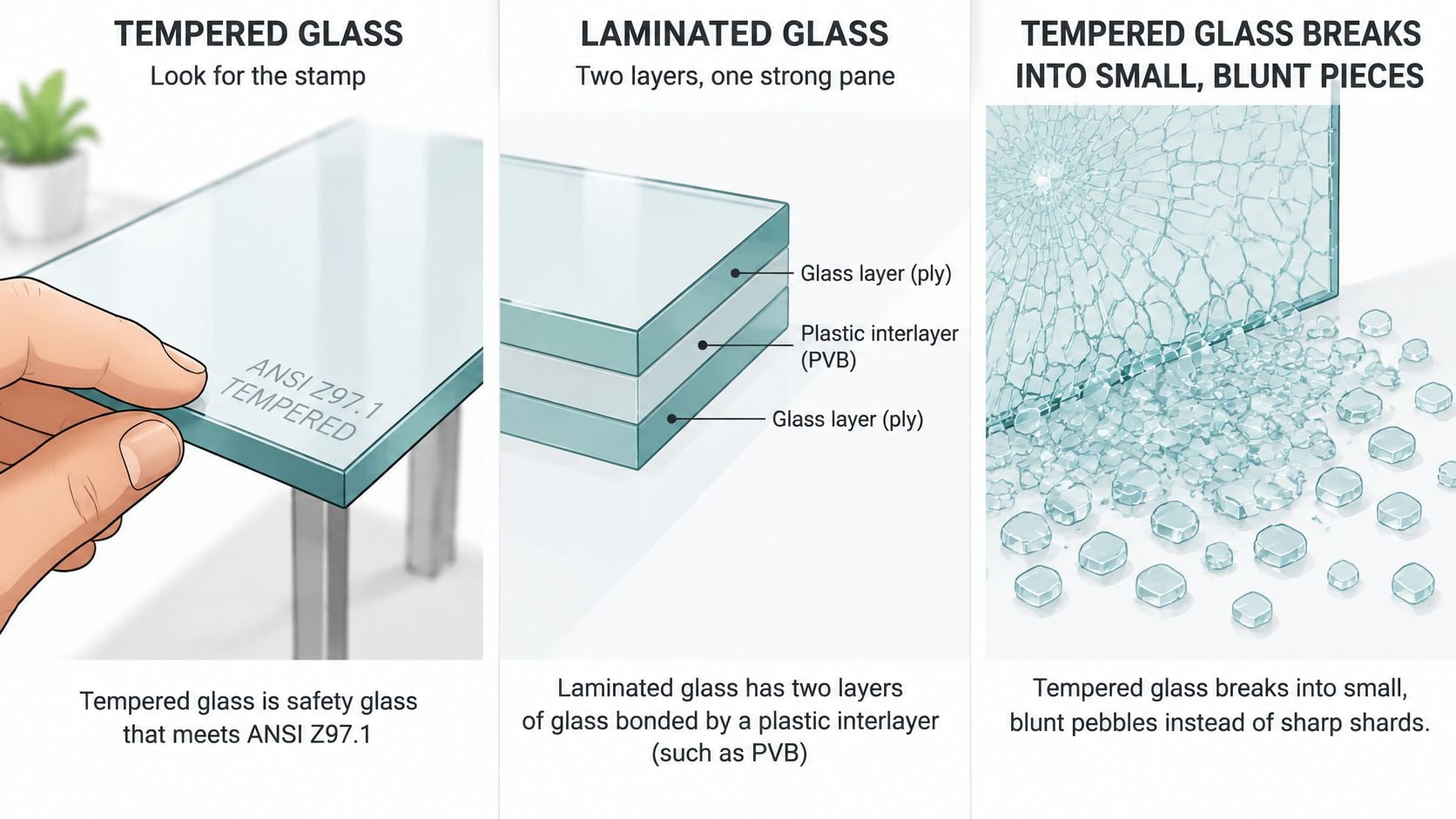
The diagram above separates stamps and break patterns so a showroom conversation can stay specific. A vague "safety glass" label is not a specification.
The inspection, in order
- Measure the height. Confirm the top falls under 44 inches. Dining and coffee tables in Greater Orlando homes almost always do.
- Name the glass. Ask whether the panel is tempered or laminated. Do not accept a generic safety-glass phrase.
- Confirm the performance standard. The panel should meet ANSI Z97.1 criteria, not an unnamed in-house test.
- Check the area. Panels of at least 9 square feet need Class A performance. Smaller panels need at least Class B.
- Find the permanent mark. It should name the glass type and the standard. A sticker that peels off in the first cleaning is not that mark.
- Reject the wrong products. Monolithic annealed glass, chemically strengthened glass, and wired glass do not belong on an open tabletop unless the glass is fully supported and bonded to a non-glass material.
The American Society of Home Inspectors explains that tempered glass, when it breaks, fractures into small cube-like fragments rather than long shards. Laminated glass holds those pieces in an interlayer, which matters with children, pets, or a high-traffic hall between the kitchen and the lanai. A short parallel sits in architectural glazing. The UK glazing options for balustrade projects walk through toughened glass versus laminated glass where people lean on a barrier, the same distinction between a safer break pattern and a sheet that stays together.
Tempered is not indestructible. A chip, a deep scratch, or a poor install can still lead to breakage.
| Glass | What to verify | If it breaks | Buyer decision |
|---|---|---|---|
| Tempered safety glass | Permanent mark and ANSI Z97.1 | Small cube-like fragments | Usual choice for dining and coffee tops |
| Laminated safety glass | Interlayer plus Class A when the panel is 9 square feet or more | Fragments stay in the sheet | Better where containment matters |
| Annealed or unlabeled glass | No furniture safety mark | Long sharp shards | Do not buy for an open tabletop |
Normal glass character versus real damage
Minor hairline scratches, small air bubbles, surface waviness, or lightly pitted areas in glass components are not considered quality defects. Separate that ordinary character from a chipped edge, a long scratch you can catch with a fingernail, or a corner already flaked. Those are damage, and they belong in the rejection pile, not in a care routine later.
Smaller rooms still need the same mark. A compact top in a Lake Mary condo is not exempt because the sheet is lighter. Sets sized for tighter dining areas are easier to compare when the glass specification is written down beside the length, which is why the small glass dining sets conversation should start with the stamp, not the metal finish. Walk away if the supplier cannot name the glass type, the class, or the marking.
Which Base Edge and Finish Suit the Room
Judge the table as a base-plus-glass system. A beautiful top still fails if the base rocks, the glass can slide, or a stretcher blocks every chair.
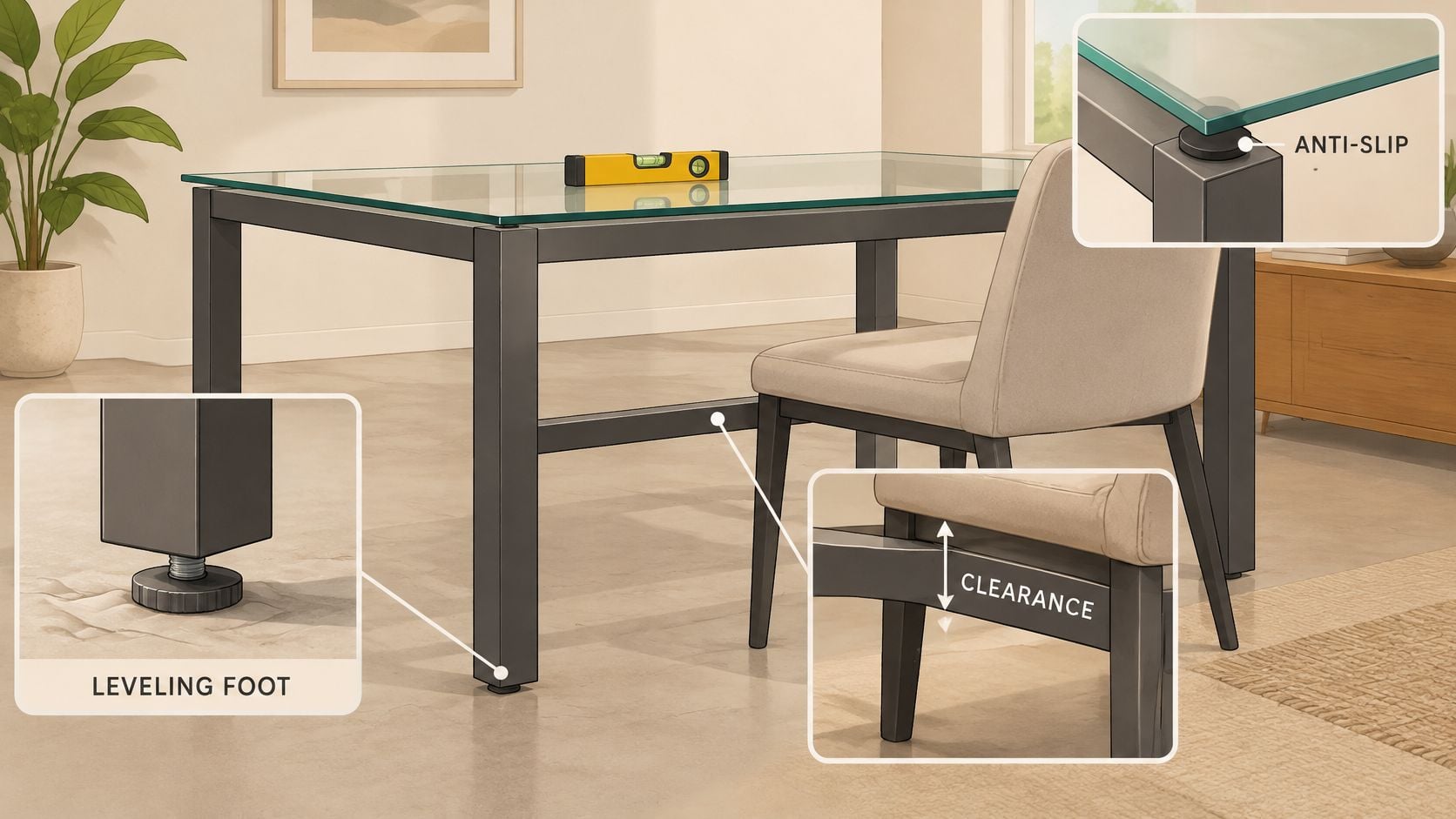
The photo shows what the hardware should look like in the room. Leveling feet and pads are part of the design, not extras added after a wobble shows up.
A sound install follows a short sequence, drawn from how ANSI/BIFMA X5.5 table testing treats the whole assembly. Confirm the base is level and does not create concentrated point loads. Use manufacturer-approved pads, retainers, or bonding components. Never let glass sit directly on metal or stone. Make sure the top cannot slide or lift in normal use. Then test the fully assembled table, including leaves. That same benchmark added a stability case using a 34 kg load on a 203 mm pad tangent to the edge, alongside a 57 kg vertical load on a 305 mm pad positioned 25 mm from the edge. It is a quality question for dining and office tables, not a residential pass-fail law.
Four bases, then the edge
Four-leg wood is the easiest read for a traditional dining room. Each person can usually find a gap, until a leg lands exactly where a corner guest needs a knee. Pads under the glass and a level floor matter more than the stain.
A trestle suits a long rectangle and a Craftsman or Amish dining look, with a solid-wood base under a clear top. The stretcher is the risk. If it crosses at knee height, the chart's seat count is fiction. Check clearance at every chair, not only at the ends.
A pedestal frees chairs to slide around a rectangle and can ease traffic in a tighter Orlando dining zone. A narrow foot can tip when someone leans on a corner. The foot should be wide, and the top should be retained, not just resting.
A metal frame fits a contemporary living room or a home office, including a slim base in a Winter Park living room. Bare metal against glass is the failure. Approved pads and no point loads are the confirmation, which is also why metal details elsewhere in the house deserve a closer look in this guide to metal accents.
| Choice | Best room | Comfort risk | What to confirm |
|---|---|---|---|
| Four-leg wood base | Traditional dining | Legs steal corner seats | Pads under glass and level floor |
| Trestle base | Long rectangular dining | Stretcher blocks knees | Clearance at every chair |
| Pedestal base | Round traffic around a rectangle | Narrow foot can tip | Wide foot and retained top |
| Metal frame | Contemporary living or office | Bare metal against glass | Approved pads, no point loads |
| Beveled or pencil edge | Low-glare dining | Sharp or invisible lip | Smooth polish and visible edge |
Edge profile is a visibility choice as much as a look. A flat polished edge is quiet and can vanish in glare. A bevel catches a line of light so older guests can see where the top ends. A pencil edge softens the lip without a wide facet. A low-contrast edge in a bright Altamonte Springs room is easy to miss, and a forearm finds it first.
A wood apron can make the glass feel quieter when the room already has enough shine. Color belongs on the seating more than on the top. Fabrics and finishes on the furniture can be customized, so chairs can carry a performance textile that stands up to afternoon sun while the glass stays clear. West-facing windows in Longwood bake nearby leather and fabric, and bare glass throws reflections across a pale rug. Stone is a different decision when a solid accent is the point. A sodalite slab table for interiors shows how a dense natural top reads as mass and color, which is useful beside a sofa when the dining surface should stay transparent instead.
Ask for assembly instructions, stability notes, and a replacement-glass procedure before the table is scheduled for delivery.
Custom length and a base drawn to the measured room belong in a design conversation, not in another size chart. Uneven tile, a thick rug pad, and a leaf that lands past the foot are the details that decide whether the system stays quiet for years.
How to Care for a Glass Top in Florida Humidity
Clean the glass often with a soft cloth and a cleaner made for glass, and keep grit, standing water, and direct sun off both the top and the base. Humidity in Central Florida leaves a film on wood and metal even when the glass still looks clear. Care is a habit, not a rescue after a chip appears.
A routine that fits the climate
- Lift, don't drag. Placemats and centerpieces pick up sand. Sliding them grinds that grit into the surface.
- Wipe spills the same day. Citrus, wine, and hard-water spots can mark glass if they sit through a humid afternoon.
- Dust before any spray. A dry microfiber cloth takes pool sand and patio grit off first, so the cleaner is not a polishing compound.
- Use coasters under hot pieces. Glass tolerates heat better than a bare wood finish, and a coaster still protects the edge and the pads from a heavy platter.
- Check pads and clips twice a year. A top that can shift is a top that can chip when a chair hits it.
- Wipe the base. On wood or metal, remove the humidity film and keep felt on anything stored underneath so a basket does not scar a stretcher.
Afternoon sun in a west-facing Orlando or Longwood room can bake leather and fabric on the chairs even while the glass stays cool to the eye by evening. Pool sand is the scratch risk, especially after a weekend when wet feet cross the dining floor. A sudden cold drink set on a sun-heated top is an unnecessary shock. Let the surface settle, or set the glass on a coaster from the start.
What cleaning cannot fix
A chip at the edge, a long crack, or glass that already shows impact damage is a replacement issue, not a polish issue. Ask whether a replacement panel is available before delivery, and keep the glass type and size written with the order. Normal wood grain is not new damage. Wood furniture may have natural variations in grain and color, and knots, mineral streaks, pitch pockets, tiger striping, and insect markings, which are not considered quality defects. A fresh dent in the base or a new flake at the glass corner is different, and it should be reported rather than rubbed with a cleaner.
The wood furniture care steps for a solid base still apply under a glass top. Wipe spills on the wood, keep standing water off the feet, and don't park a wet umbrella against a leg. Felt on chair glides protects both the floor and the glass edge when a chair is pulled in hard.
Before holiday seating for eight, recheck that leaves sit level and that no chair arm strikes the edge. A leaf that rocks will click against the glass every time someone leans on the center. That sound is a warning, not a quirk of an old house. Level the leaf, reset the pads, and only then set the table.
Order Your Table with Slone Brothers in Longwood
A rectangle glass top table should be ordered like a fitted safety system: length, knee space, glass mark, edge, base, and delivery path all have to agree before the piece is built. Bring the room measurements, the seat count, and the glass questions to the Longwood showroom. Slone Brothers Furniture is a family-owned showroom serving Greater Orlando since 1980. Dining room products include dining tables, chairs and benches, dining storage, bar furniture, transformer tables, Amish dining room furniture, and custom dining.
The custom path is plain once the room is measured.
- Confirm length and knee clearance against the buffet, sofa, and door swings.
- Choose tempered or laminated glass and an edge that stays visible in the light of that room.
- Select a wood or metal base and a finish that can be matched to the chairs and the floor.
Slone Brothers Furniture offers custom orders and custom dining furniture, and fabrics and finishes on furniture can be customized. The Design Team can plan the whole dining or living room with you in the showroom. Complimentary in-house design services are available, so the rug, the seating pattern, and the west wall light can be considered before the order is placed. Certain items can be taken home on approval for a 48-hour period to make sure they suit the customer's decor. That trial is for fit with the room, so a finish can be judged beside the floor, chairs, and everyday light.
Some households want a piece already in the building. The clearance outlet holds quality furniture on the floor. Floor samples, clearance items, and as-is merchandise are sold in their existing condition and are warranted only for manufacturer defects that develop within one year of the initial sale. Read that as a condition of the piece. A rectangle glass top table is a long-term companion to American-made and Amish-crafted seating, with the glass chosen for safety and clearance rather than swapped out when a trend changes.
The custom furniture order path is the right next conversation when the measured length, the glass mark, and the base all have to match one room. Past the order, reliable home delivery with order tracking brings the finished table into Greater Orlando homes in Lake Mary, Sanford, Winter Park, and Altamonte Springs. That tracking matters when the room has been planned around a specific footprint and the household needs to know when the piece is on its way.
Visit the Slone Brothers Furniture showroom in Longwood, FL, and review the glass, edge, base, and finish in person. A table that looks simple in a catalog becomes much easier to choose once it is measured against the chairs, the wall light, and the way the room gets used.