
Dining Room Sets with China Cabinet: A Buyer’s Guide


The dining table looks right, but the wall beside it remains unresolved. The dishes need a permanent home, the serving platters are scattered through the kitchen, and a tall cabinet might crowd the route to the patio. For Central Florida homeowners comparing dining room sets with china cabinet storage, that cabinet deserves attention before anyone chooses a finish.
The strongest starting point is its footprint: height, depth, door swing, and the space left for chairs. Then come the materials and construction that suit an air-conditioned Florida home. A coordinated dining room should feel comfortable during an ordinary dinner, not look composed when every chair is tucked in.
Which Dining Room Sets with China Cabinet Suit Your Home?
The right set starts with what the cabinet must hold and how the household uses the room. A full-height display cabinet, a low buffet, a buffet with a hutch, and separate modular pieces solve different storage problems.
Dining storage isn't automatically formal or outdated. Coverage of dining-room furniture trends from Homes & Gardens emphasizes integrated storage, extendable tables, and flexible layouts, all relevant to open-plan homes around Orlando.
Storage pieces compared for a dining room
| Storage piece | Typical height | What it stores | Visual effect | Best fit |
|---|---|---|---|---|
| Full-height china cabinet | Tall, with upper display storage | Dishes and glassware behind doors, display above | Strong vertical presence | Formal rooms with a display collection |
| Buffet or sideboard | Low, with an accessible serving surface | Linens, serving pieces, and tableware in drawers and closed cabinets | Low, open sightlines | Frequent entertaining, children, concealed storage |
| Buffet with hutch top | Base cabinet plus an upper display section | Drawers below, display shelves above | Layered storage with visible display | Mid-size rooms with mixed use |
| Modular storage combination | Selected unit by unit to fit the wall | Pieces sized to the wall and the collection | Adjustable, lighter footprint | Narrow walls and open-plan layouts |
Choose by the weekly task
A full-height china cabinet makes sense when attractive dishes leave the shelves for meals. Vertical storage can keep those pieces close to the table without requiring a long run of low cabinetry. Its presentation role remains useful, provided the collection deserves the wall space.
A buffet offers a different advantage: its top stays available for serving. For a Lake Mary household that entertains frequently, concealed storage below and a clear landing surface above may matter more than displaying stemware. Closed storage also helps separate fragile pieces from everyday family activity, although it doesn't replace appropriate furniture anchoring.
A hutch balances display with practical drawers. Modular pieces are useful when a window, doorway, or narrow wall prevents a conventional cabinet from fitting comfortably.
Practical rule: Select storage for the objects used regularly, then reserve display space for the pieces worth seeing every day.
Test the cabinet's job at home
Before comparing wood finishes, sort the proposed contents into display, everyday use, and occasional use. A cabinet filled mainly with table linens and serving tools needs more closed compartments than glass shelves.
Then stand where the cabinet would go. Picture its doors open, a chair pulled back, and someone carrying a platter past the table. If reaching for a weekly-use item interrupts that route, a shallower cabinet or lower buffet may be the more thoughtful choice.
How Much Room Does a Dining Set with China Cabinet Need?
A table may fit neatly on an empty floor plan, yet feel crowded once chairs are pulled out and cabinet doors swing open. Check the full working footprint: table, seated guests, chair movement, cabinet depth, door swing, and the route people use to pass through the room. The cabinet's height, depth, and placement are part of the storage decision, not details to leave until after choosing the table.
Room width and clearance by seating count
| Seating | Clearance behind chairs |
|---|---|
| Four seats | Allow the selected chair to pull back fully while preserving the household's walking route |
| Six seats | Test occupied end chairs and side chairs with the table fully extended |
| Eight seats | Preserve a usable passing route behind occupied chairs, including beside the cabinet |
Treat these as practical planning checks, not fixed minimums. A pedestal table with compact chairs takes up space differently from a trestle table with upholstered seating. Start with the table choice in the dining-room table size guide, then add the cabinet's depth and the full swing of its doors to the layout.
Measure the room in working condition
- Measure the usable wall. Note the space between corners, windows, door trim, and switches. Include projecting baseboards that might keep the cabinet from sitting close to the wall.
- Tape the extended table footprint. Mark the table with its leaves installed. A layout based only on the everyday arrangement can hide a bottleneck when extra seating is in use.
- Test chair pull-back. Set an actual chair at the taped edge, sit down, and stand up. Ask someone to walk behind it so you can judge the route while the chair is occupied.
- Mark cabinet depth and door swing. Include handles and projecting molding, then mark the full opening arc. Check that drawers also have an unobstructed path.
- Check environmental obstacles. Mark exterior doors, HVAC outlets, and walls exposed to strong afternoon sun before settling on the cabinet's position.
Repeated chair movement can affect hardwood flooring. For a protective surface, compare chair mats for hardwood, and choose one suited to the floor finish that does not interrupt the walking route.
Plan anchoring before delivery
The U.S. Consumer Product Safety Commission's furniture-anchoring guidance recommends securing furniture with anti-tip devices and explains that a tether increases resistance to tip-over. Treat a dining hutch as potentially top-heavy and follow its manufacturer's securing instructions.
Plan the attachment for the wall itself. Identify the studs or an appropriate masonry method, and use brackets, tethers, and fasteners suited to that wall rather than relying only on hardware supplied with the cabinet.
Store heavy serving pieces low and lighter items above. Then check the finished layout with the table extended and cabinet doors open. Guests should be able to sit, stand, reach the cabinet, and pass through without competing for the same space.
Which Styles Work Best in a Florida Dining Room?
Match the cabinet to the home's architecture, wood tones, and sightlines. Traditional, transitional, Arts and Crafts, farmhouse, and contemporary solid-wood designs can all suit a Florida dining room when the cabinet's proportions and details work with the table and surrounding rooms. Start with the cabinet's height and depth, then check that its doors can open without crowding the table or a walkway. Its size and placement shape the dining set's storage and movement, much like a structural choice rather than a finishing touch.
The history of the china cabinet traces its roots to European households displaying imported Japanese and Chinese porcelain. Over time, cabinets developed lighter construction and refined doors. Their role has always combined storage with presentation, so consider what the cabinet will hold and how it will look from nearby rooms.
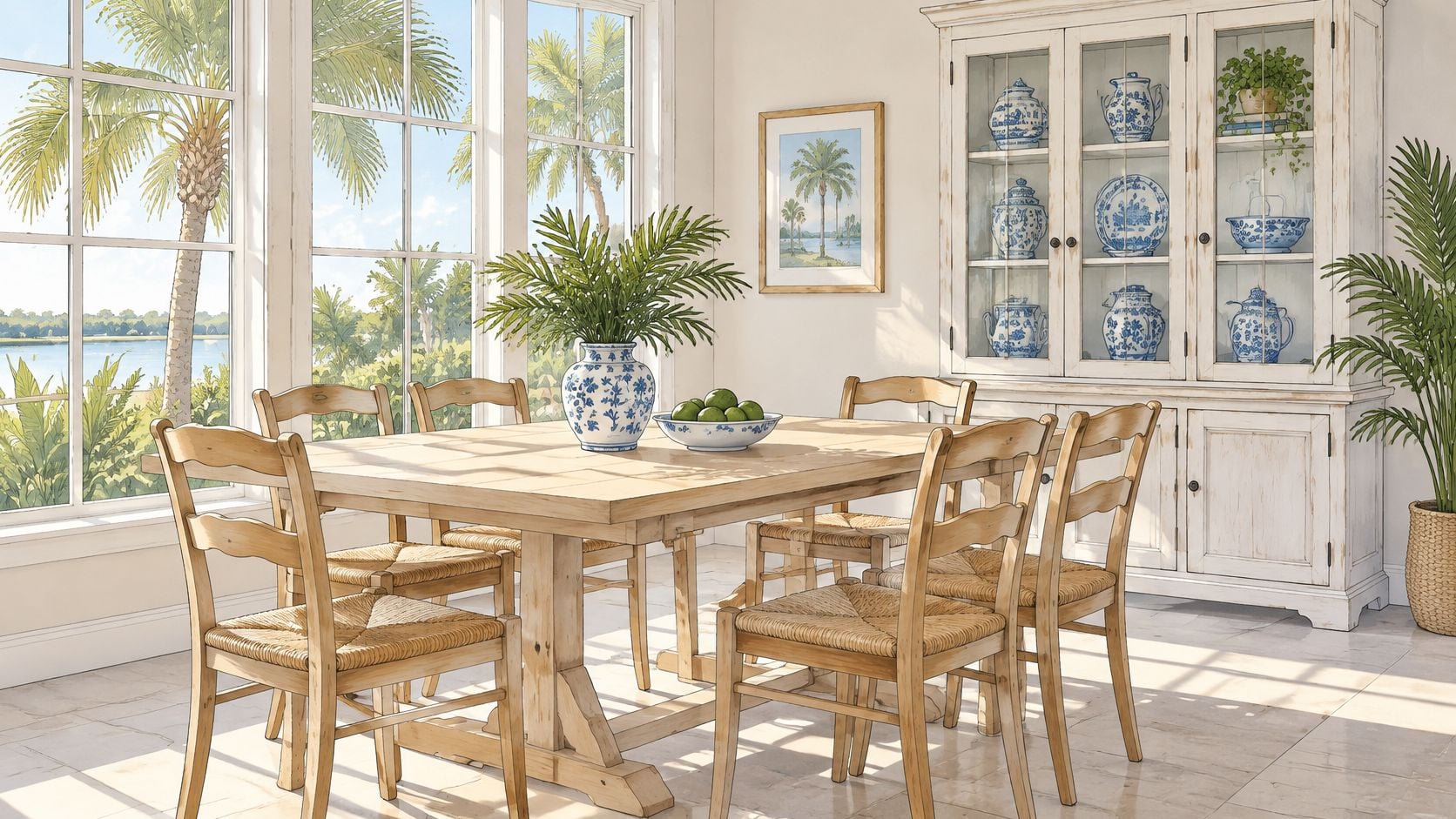
Read the details, not just the label
In a Winter Park home with detailed millwork, a traditional cabinet with raised panels and crown molding may pair naturally with a table with turned legs. A transitional cabinet keeps warm wood tones while simplifying those outlines, which can help connect the dining area to an adjoining living room.
Other styles make different commitments:
- Arts and Crafts: Visible structure and handcrafted joinery shape the style. Stickley's American heritage is associated with heirloom solid-wood furniture.
- Farmhouse: Plank-look doors and painted or distressed finishes create a relaxed appearance. Distinguish intentional distressing from actual finish damage.
- Contemporary solid wood: Flat fronts and restrained hardware keep the profile simple, a useful approach when an open-plan room already has several focal points.
Coordinate without making everything identical
MAVIN furniture is made in Ohio's Amish country, with wood selected from cherry, oak, maple, walnut, or hickory. Canadel offers hand-finished solid-birch dining furniture made to individual design specifications. These different approaches can help you compare the character and construction of a table and cabinet without requiring every piece to match exactly.
The guide to dining-room table styles can help you compare a table's base, edge profile, and overall form with the cabinet's visual weight.
A cabinet should look intentional from the adjoining room, not only from the chair directly opposite it. Use the floor color, nearby trim, and visible living-room furniture as reference points. If the cabinet will display a varied collection, a quieter profile can let the pieces inside stand out.
Which Materials Hold Up in Central Florida Humidity?
In a Sanford dining room, the china cabinet is a structural storage decision as much as a display piece. Its height and depth affect how it sits beside the table, while its shelves, doors, and joints must cope with changes in indoor moisture. Solid hardwood and quality hardwood plywood can both work well when their components are designed for those conditions.
Furniture materials compared for Central Florida homes
| Material | Humidity behavior | Weight | What to ask |
|---|---|---|---|
| Solid hardwood, including oak, cherry, maple, and walnut | Moves with humidity; floating panels and appropriate joinery accommodate movement | Substantial; species and dimensions determine weight | Was the lumber conditioned for interior service? |
| Hardwood plywood | Dimensionally stable panels; cores and exposed edges need inspection | Panel thickness and construction determine weight | What is used in the cabinet back and edges? |
| Medium-density fiberboard, or MDF | Vulnerable to swelling when wet; resin formulation deserves attention | Dense | Which resin is used, and how are edges protected? |
| Particleboard | Moisture-sensitive, particularly at exposed edges and fasteners | Density and panel thickness determine weight | Where is it used, and does it support loaded shelves? |
Weight tells you little about joinery or panel stability. A dense composite may feel heavy, while a well-built hardwood component offers different fastening and repair characteristics.
Understand what humidity does to wood
The USDA Forest Products Laboratory's guidance on wood and moisture explains that wood exchanges moisture with surrounding air according to relative humidity, temperature, and its existing moisture content. This exchange affects performance. Cabinet doors and tabletops need room to move rather than rigid restraint.
The USDA Forest Service's dimensional-change guidance states that hardwood lumber for furniture, cabinets, and millwork is commonly dried to approximately 6%–8% moisture content, with dimensional changes estimated across the broader 6%–14% moisture range. These figures describe moisture in the lumber, not indoor relative-humidity settings.
For a Central Florida home, consistency between the conditions around the furniture and the way its components were prepared matters. Thick solid-wood doors still move with moisture changes. Skilled construction allows their panels to expand and contract without forcing joints apart.
Look beyond the visible exterior
A cabinet's door does not show what is used for its back, drawer bottoms, or adjustable shelves. Inspect these hidden components, since they affect shelf support, hardware attachment, and exposure to moisture. Also check the cabinet's depth and door swing against the table and available clearance, especially when the cabinet will be fully loaded.
The EPA's formaldehyde guidance identifies urea-formaldehyde pressed-wood products as potential indoor emission sources and describes MDF as generally the highest-emitting category among those products. For an individual cabinet, ask about its resin system and whether lower-emitting materials are used.
Use this inspection checklist in the showroom:
- Lumber preparation: Was the wood conditioned for interior service?
- Adjustment: Can doors and shelves be adjusted after installation?
- Hidden construction: What materials form the backs, shelves, drawer bottoms, and interior panels?
- Joinery: How do wide fronts and panels accommodate seasonal movement?
- Shelf support: What loading guidance applies to stacks of dinnerware?
For ongoing maintenance, follow the manufacturer's finish-specific instructions alongside this wood furniture care guide.
Can You Match Finishes and Customize Every Piece?
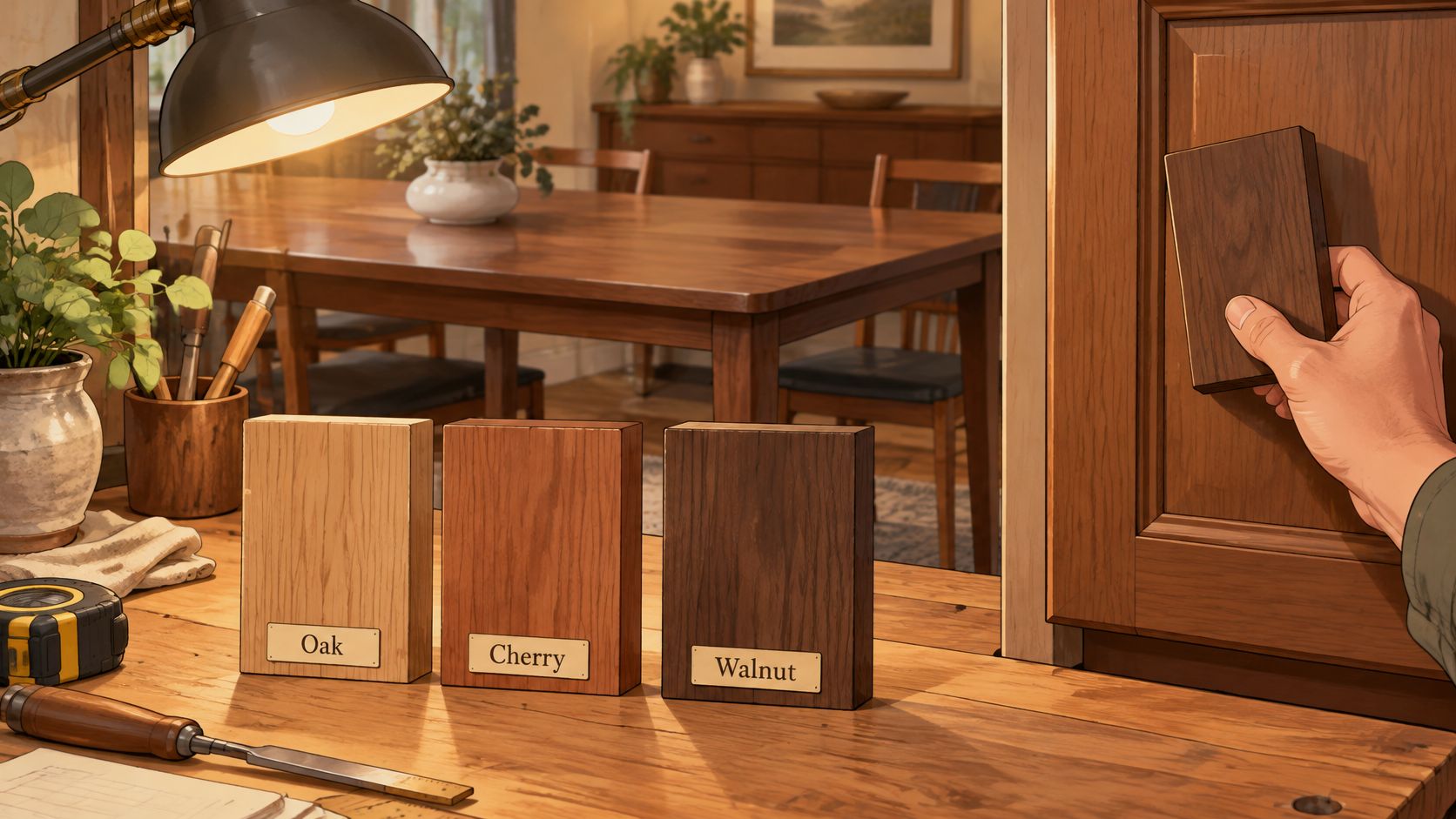
A china cabinet's finish is only one part of how it will sit in the room. Its height, depth, and door swing affect where it can go and how it works with the table, so settle those measurements before choosing a stain. Then compare wood samples with the flooring and nearby furniture under the room's daylight and evening lighting. Oak, cherry, and walnut show different grain and color, even with similar finish names.
Coordinate the room, not just the stain
A darker table can work with a lighter cabinet when their undertones and proportions feel related. For a home in Altamonte Springs, place finish samples beside the flooring, chair fabric, and a photograph of nearby woodwork. View the samples upright as well as flat, since a cabinet door and tabletop catch light differently.
Central Florida's changing indoor conditions also make placement and care part of the finish decision. Keep the cabinet away from direct afternoon sun, remove spills promptly, and follow care instructions for the specific finish. Aqua Painting wood furniture finishing advice can help inform a conversation about finishing existing wood furniture. Check the manufacturer's care and warranty terms before altering a factory finish.
Slone Brothers Furniture offers custom orders and custom dining furniture, with customizable fabrics and finishes. The custom-furniture ordering guide is a useful starting point for discussing available materials, configurations, dimensions, and upholstery choices for a selected collection.
Put custom choices in writing
Amish-crafted furniture can feature hand-selected solid hardwood and traditional joinery. Custom options vary by collection, so confirm that a requested change is available before treating it as part of the order. Changes to shelf spacing or cabinet width, for example, need confirmation for the specific piece.
A written order helps keep the details clear:
- Final dimensions: Record overall width, height, and depth, including projecting trim.
- Interior arrangement: Specify shelf count, drawer placement, usable openings, and guidance for shelf loading.
- Installation: Confirm anti-tip hardware and the manufacturer's securing requirements.
- Materials: Ask about interior panels as well as visible wood.
- Timing and care: Confirm the lead time, finish identification, and maintenance instructions.
Finish check: Choose a sample that suits the room's actual light, not just the showroom display.
Before ordering, confirm that the cabinet's doors can open fully in the intended position and that its dimensions suit the space beside the table. That practical fit matters as much as finish coordination.
Why Do Quality Dining Sets Cost More Up Front?
A china cabinet is a major part of a dining set's structure and cost. Its height and depth affect how it fits beside the table, while its materials and construction influence how it serves the household over time. In Central Florida, account for humidity when considering the cabinet's construction, then compare the full set rather than judging it by appearance alone.
Dining set tiers compared by construction
| Tier | Core construction | Moisture behavior | Best fit |
|---|---|---|---|
| Entry-level engineered | Veneers over particleboard components | Vulnerable where moisture reaches unprotected components | Lighter use with short-term expectations |
| Mid-tier | Hardwood plywood with some solid hardwood | Stable panels, with edges and connections requiring inspection | Households balancing material choices and investment |
| Solid-wood American-made or Amish-crafted | Solid hardwood with traditional joinery | Movement-tolerant design and floating panels matter | Heirloom goals and custom configurations |
These are broad construction categories, not guarantees. Veneer can be part of fine furniture, while solid wood can be poorly assembled. Look closely at shelf support, connections, finish, and the cabinet's design; the category label alone does not tell the whole story.
Put price changes in perspective
A Bureau of Labor Statistics analysis published in April 2019 reported a 4.4% increase in the price index for living room, kitchen, and dining room furniture over the covered twelve months, compared with 1.1% for bedroom furniture. Furniture categories do not always move together, so these figures are a historical comparison, not a forecast.
For an Orlando homeowner, ownership costs depend partly on whether a loose connection can be repaired and whether a damaged surface can be assessed and refinished when appropriate. Consider, too, whether the cabinet will remain useful if the room's styling changes. The guide to why furniture costs more explains how labor, materials, and service can contribute to price.
Read the complete quote
A coordinated set can simplify selection, but the quote should identify every included component. Check whether table leaves, seating quantities, delivery arrangements, and cabinet installation are included or priced separately.
Use these questions to compare quotes:
- Complete package: Does the total cover the table, selected chairs, cabinet, delivery, and any separately charged services?
- Installation: What installation work is included, and what requires a separate arrangement?
- Finish and warranty: What is covered, what maintenance is expected, and how are service concerns handled?
Long-term value comes from a set that remains useful and serviceable. A higher price by itself cannot promise that result.
Plan Your Dining Set at Our Longwood Showroom
An in-person visit lets a homeowner compare cabinet scale, operate doors and drawers, and discuss a measured room with an experienced design consultant. Slone Brothers Furniture is family owned and operated in Longwood, serving Central Florida since 1980.
Make the visit practical
The dining assortment spans tables, chairs and benches, dining storage, bar furniture, transformer tables, Amish dining room furniture, and custom dining. Complimentary design guidance can help relate those choices to an entire home rather than treat the cabinet as an isolated purchase.
Certain items can be taken home on approval for a 48-hour period to confirm they suit the customer's decor. Eligibility should be established before anything leaves the showroom.
Delivery and set-up include assembly and placement of only the items purchased, plus a one-time leveling of case pieces and doors at original delivery. Anchoring requirements should be discussed separately so the installation responsibilities are clear.
Bring the room into the conversation
The most useful preparation is simple:
- Room measurements: Include the extended table footprint and circulation routes.
- A wall photograph: Show windows, outlets, trim, and nearby doorways.
- An existing wood sample: Bring a representative finish or a removable piece when practical.
Those details give the consultant a concrete basis for comparing proportions, materials, and finishes face to face.
Slone Brothers Furniture offers custom dining options and experienced design guidance to help Central Florida homeowners choose storage that fits their room and daily use. Skip the online guesswork and visit Slone Brothers Furniture in Longwood, FL, with room measurements, a cabinet-wall photograph, and an existing wood sample for a face-to-face conversation about a lasting dining room.