
Brown Kitchen Table Buying Guide for Central Florida Homes


A Lake Mary homeowner can spend weeks choosing cabinet colors, counters, and flooring, then discover that the brown kitchen table determines whether the room feels collected or disconnected. In Central Florida, that table must do more than look attractive. It needs to support breakfast, homework, holiday meals, everyday spills, and the changing demands of a busy household while standing up to humidity, sunlight, and tile-heavy interiors.
For discerning homeowners in Longwood, Orlando, Winter Park, Lake Mary, Sanford, and nearby communities, the right choice is an investment in solid construction, suitable proportions, and a brown finish with the right undertone. The following guidance reflects the practical questions that matter on a showroom floor, from wood species and Amish joinery to clearance, customization, and care in Florida homes.
Why the Brown Kitchen Table Still Anchors a Central Florida Home
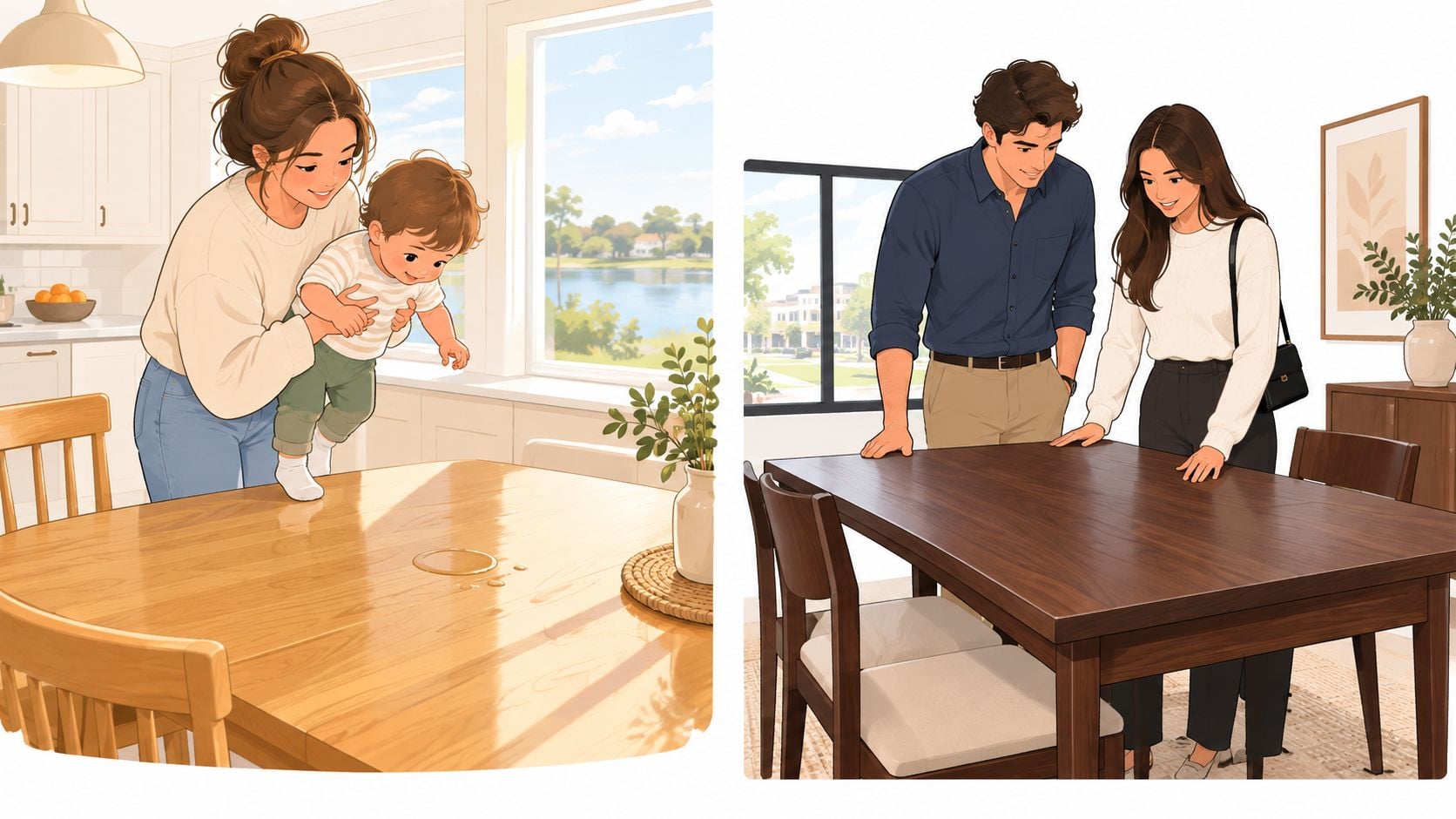
A Lake Mary family may begin a weekday with a toddler being guided away from a water ring forming beneath a breakfast cup on a honey oak table. By lunchtime, that same surface may hold school papers. In the evening, it becomes the place for dinner, bills, and a quick conversation before everyone scatters again.
Across Winter Park, another household may be deciding whether a darker walnut table will work beside a lanai where afternoon sun fills the room. That question isn't really about fashion. It's about whether the table's finish, scale, and undertone can live comfortably with existing floors, cabinets, upholstery, and the strong natural light found throughout Central Florida.
Brown works because it carries warmth
Brown remains the most natural finish family for wood furniture, and wood continues to dominate the dining-table category. One market report values the global dining table market at USD 8.68 billion in 2025 and projects it to reach USD 16.01 billion by 2034, with wood representing 52.69% of the market in 2025. Another industry estimate places wood at 39.45% in 2025 and projects the broader market to reach USD 12.52 billion by 2031. These estimates differ, but both point to the same practical conclusion, wood-finished tables remain a foundational choice rather than a niche style. (Fortune Business Insights dining table market report)
Painted farmhouse white can expose grit and everyday marks, while cool gray may feel severe against warm tile, green views, and the sunlight that defines Florida interiors. Brown offers visual weight without the formality of black and warmth without demanding a fully rustic room.
A table with history and purpose
Kitchen tables evolved from early dining and work surfaces into central household fixtures as homes established dedicated spaces for preparation, eating, and gathering. A historical review traces table use to Ancient Egypt, where wealthy households used wood or alabaster tables, with the practice later spreading through Ancient Rome and Greece. (Historical review of kitchen tables)
That long material history helps explain why a brown kitchen table still feels intuitive. It connects contemporary rooms to the oldest widely adopted furniture material while accommodating modern family life.
The sensible approach is to choose the table first as a functional anchor, then build around it. Size, species, finish, joinery, and chair comfort should guide the room, not a passing color trend.
How to Choose the Right Size and Shape for Your Space
The correct brown kitchen table is the one that fits the room before it fits the fantasy. Measure the kitchen or dining nook, account for circulation and chair space, then choose a shape that supports the way the household moves.
Start with the floor plan
Measure the usable footprint, not the architectural dimensions. Include cabinet doors, appliance clearances, door swings into hallways, and the path between the kitchen, patio, and living areas.
A practical planning sequence looks like this:
- Mark circulation space. Allow 36 to 42 inches of clearance around the table wherever people need to walk or pull out chairs.
- Reserve chair width. Plan for 24 inches per chair, especially if the household uses armchairs or upholstered seating.
- Test door movement. Swing nearby doors open on the floor plan. A table that looks appropriate on paper can obstruct a pantry, laundry room, or hallway.
- Account for daily use. A table used for homework and serving platters needs more usable surface than one used only for morning coffee.
A six-foot rectangular table can look elegant in a spacious showroom and still overwhelm a narrow galley kitchen in Altamonte Springs. The problem isn't the table. The problem is ignoring the room's circulation pattern.
Match the shape to movement
Round tables suit tighter eat-in kitchens, including compact layouts in Oviedo, because corners disappear and traffic can flow around the perimeter. A pedestal base can improve legroom, but the base still needs to leave enough room for chairs and feet.
Rectangular tables make sense for Seminole County families who regularly host. They use a long wall efficiently and offer straightforward seating at each end. Oval tables provide much of that seating capacity while softening the hard geometry of an open-plan room.
Square pub tables belong in smaller breakfast corners, not in every kitchen that happens to have a tall ceiling. Their compact footprint can work well, but the raised height may be less comfortable for long meals or younger children.
Practical rule: Bring a measured floor plan, cabinet dimensions, and a few photographs to the showroom. A design consultant can evaluate the actual footprint far more accurately than a shopper relying on memory.
The dining room table size guide can help homeowners organize those measurements before visiting the showroom. On the floor, shoppers should walk around the display, pull out each chair, and check whether the table still feels comfortable when someone passes behind them.
Comparing Wood Species and Brown Finishes That Read Beautifully in Florida Light
Brown isn't one color. In a Longwood showroom, the important distinction is undertone, grain, and how the finish changes from bright morning light to softer evening illumination. Warm brown, cool brown, and red-brown finishes can produce very different results beside the same cabinets.
The main choices
Rustic quartersawn white oak with an OCS Michael's Cherry stain suits homeowners who want farmhouse character without a disposable, distressed look. Oak has pronounced grain, which adds movement and can make a large tabletop feel more substantial.
Brown maple is smoother and more visually restrained. It accepts painted and stained finishes cleanly, making it a strong choice for transitional kitchens where the table needs to coordinate with cabinetry rather than dominate it.
Walnut offers a deeper, more dramatic presence for modern interiors. Its richer figure can be striking near large pool-facing windows, but the visual depth and material value usually place it above more straightforward brown maple choices.
A reclaimed-look distressed top hides minor scuffs effectively, which makes it practical for households with children, pets, and frequent entertaining. It shouldn't be mistaken for an excuse to accept poor construction. Distress is a finish language, not a substitute for sound joinery.
| Wood Species | Typical Brown Finish | Grain Character | Best For |
|---|---|---|---|
| Quartersawn white oak | OCS Michael's Cherry or warm brown | Pronounced, structured grain | Farmhouse and Arts & Crafts rooms |
| Brown maple | Smooth brown stain or painted finish | Subtle, even surface | Transitional kitchens and family spaces |
| Walnut | Deep walnut or chocolate brown | Dramatic, refined figure | Modern and tailored interiors |
| Reclaimed-look tops | Weathered brown or distressed finish | Varied and intentionally irregular | Active households seeking forgiving character |
The guide to choosing the right brown granite slab can also help homeowners coordinate a brown table with counters. The useful principle is to compare undertones in the actual room, because a warm brown table can clash with a red-brown counter or disappear beside a cool gray surface.
For a deeper review of grain and material differences, consult Slone Brothers' resource on types of wood for dining tables. For many Central Florida households, brown maple offers the most adaptable balance, white oak delivers the strongest textural identity, and walnut is the right decision when the room calls for depth rather than compromise.
What Makes a Brown Kitchen Table Built to Last
A brown kitchen table earns its place in a Central Florida home through construction, not color alone. Wood selection, joinery, and finish chemistry must work together, especially in Greater Orlando, where humid air and air-conditioned interiors place repeated stress on solid panels and joints.
Solid wood needs room to move
Wood absorbs moisture from humid air and releases it when conditions dry. Keep indoor relative humidity within a stable 35 to 50% range. In North American interiors, flatsawn lumber can move roughly one-quarter inch per 12 inches across the grain as seasons change. (Wood movement and seasonal humidity guidance)
That movement is normal. A well-built table accommodates it with floating panels, properly designed breadboard ends, suitable fasteners, and balanced finishing. Finishing both faces slows moisture exchange and helps reduce cupping or warping, although no finish can stop natural wood movement.
Ask to see how the tabletop is attached to its base. In a Slone Brothers showroom, that detail is easier to examine than it is through an online product photo. Look for room for seasonal expansion rather than a top rigidly trapped by the apron.
Joinery decides whether repairs remain possible
Mortise-and-tenon construction creates an interlocking bond suited to repeated stress. Precisely drilled, properly glued doweled joints can also perform well. Dovetails belong mainly in drawers and casework, while pocket screws suit some applications but generally provide less long-term repairability and structural confidence in heavily loaded table frames.
For an heirloom table, count less on visible hardware and more on the maker's decisions. The joints should support daily weight, accommodate movement, and remain serviceable when the table eventually needs attention.
Finish performance matters every day
Abrasion resistance is often assessed through Taber wear testing, which reports the cycles required to wear through 0.001 inch of coating. Higher cycle counts indicate stronger wear protection, a practical consideration for plates, homework, citrus spills, and sunscreen residue. (Wood finish durability testing protocols)
Film-forming finishes slow water-vapor transfer and give the tabletop more time to adjust during humidity changes. Conversion varnish, polyurethane, and hard wax oil each balance protection, repairability, sheen, and tactile feel differently. Ask the Slone Brothers team which finish suits your household rather than choosing by stain color alone.
| Wood Species | Janka Hardness | Best Joinery | Recommended Finish |
|---|---|---|---|
| Oak | 1,350 | Mortise-and-tenon or well-engineered floating construction | Durable film finish for active use |
| Maple | 1,450 | Mortise-and-tenon or precise doweling | Protective finish that preserves a smooth surface |
| Walnut | 1,010 | Mortise-and-tenon with movement-aware tabletop construction | Quality film finish or carefully maintained hard wax oil |
Match the finish to the way your household uses the table. Daily family meals call for protection first. A formal dining space can prioritize touch and visual depth. The right brown kitchen table should look good online, then prove its construction under showroom scrutiny.
Why Amish and American-Made Construction Is Worth the Investment
An Amish-built or American-made brown kitchen table costs more because the buyer is paying for material, labor, oversight, and serviceability rather than a temporary appearance. That distinction becomes clearer when the table is evaluated over its useful life.
One buyer's guide estimates that solid hardwood furniture may cost two to three times more initially, yet last 20 to 50 or more years, compared with five to 10 years for fast furniture. The same guide estimates a 40 to 60% lower lifetime cost for the solid hardwood option. (Solid wood lifetime value guide)
Those figures don't mean every premium table automatically earns its price. They do show why upfront cost alone is a poor measure of value. A table that can be repaired, refinished, and passed to another generation has a different economic profile from a piece designed for replacement.
Construction tells the story
American-made furniture is commonly associated with tighter manufacturing oversight, stronger joinery, and durable finishing. Dovetail and mortise-and-tenon techniques create interlocking bonds intended to withstand daily use for decades. (American-made furniture construction guide)
Amish furniture is widely characterized by solid-wood construction and traditional joinery rather than particleboard and minimal fasteners. Many Amish craftspeople use joinery and non-toxic adhesive instead of relying primarily on nails or screws, producing furniture designed for generations of use. (How Amish furniture is made)
Local service changes the ownership experience
A Central Florida homeowner also benefits from a domestic supply chain when replacement parts, refinishing, or future adjustments become necessary. That matters in Longwood, Lake Mary, and Sanford homes where a table may remain in service through renovations, additions, and changing family needs.
Slone Brothers Furniture carries lines such as Simply Amish, with hand-selected solid hardwoods and traditional joinery, and Mavin, whose dining collections are built by custom bench-carvers in Amish country. Availability should be confirmed before a showroom visit, particularly when a specific species, stain, or table extension is required.
For readers evaluating the construction tradition more closely, the guide on what Amish furniture is provides useful background. The recommendation is clear. If the table will serve as the household's daily center, heirloom construction deserves serious consideration.
Coordinating Chairs, Lighting, and Décor Around Your Brown Kitchen Table
A brown kitchen table looks intentional when the surrounding pieces respond to its undertone, scale, and visual weight. It looks accidental when every brown object in the room comes from a different color family.
Start with chairs
Wood chairs work best when their grain and undertone relate to the table. They don't need to be identical, but a red-brown chair beside a neutral walnut table can create visual friction.
Upholstered chairs introduce softness and texture while helping disguise everyday wear from children. Performance-minded fabric or leather can be especially appropriate for families who use the table constantly.
Mixed chair sets can work, but the table should remain the dominant piece. A pair of armchairs at the ends and simpler side chairs often creates variety without making the dining area feel assembled from unrelated parts.
The guide to choosing dining room chairs can help households evaluate seat height, back support, arm clearance, and upholstery before committing to a complete set.
Use lighting to flatter the wood
A pendant should generally hang 30 to 36 inches above the tabletop, with its size proportioned to roughly one-third of the table's shortest dimension. The fixture should illuminate the surface without blocking conversation across it.
Warm 2700K bulbs flatter brown wood more effectively than cool daylight LEDs. In a room with strong afternoon sun, dimmable warm lighting gives the table a more controlled evening appearance.
Finish the room without overdecorating
A rug should extend eight inches beyond the chairs on all sides so the back legs remain supported when people pull seats out. A centerpiece should leave sightlines open and should never make the table difficult to use.
Warm whites, muted greens, and restrained earthy tones complement oak and walnut without competing with them. For softer seasonal texture, homeowners can also review these personalized blanket decor ideas, then translate the same layered approach into chair cushions, nearby seating, or a subtle accent textile.
Custom Orders, Clearance Finds, and the Showroom Advantage
A brown kitchen table should fit the home, not force the home to accommodate a near-fit purchase. That makes an in-person showroom valuable, particularly when a kitchen has an unusual alcove, narrow passage, or extended family seating requirement.
Three practical paths
A custom order allows a household to specify dimensions, wood species, stain, edge profile, and extension needs. The custom order furniture program is the appropriate route when standard sizes leave unusable space or fail to provide enough seating.
An in-store clearance selection can suit a homeowner who needs immediate delivery and finds a table with the right proportions and finish. The trade-off is limited choice, so the buyer should inspect the grain, underside, hardware, and chair clearance carefully.
Flexible financing options, including available promotional structures, can help a homeowner choose a better-built table without reducing the decision to the lowest monthly figure. Terms vary, so the financing coordinator should explain the complete obligation before purchase.
Online ordering removes the chance to inspect grain direction, finish consistency, edge treatment, and joint quality in person. Warehouse pieces may also arrive without the same acclimation considerations as furniture evaluated for a local Florida home.
At the Slone Brothers Furniture showroom on Ronald Reagan Boulevard in Longwood, design consultants and financing coordinators can compare custom timelines with available clearance pieces, review finishes under showroom lighting, and plan delivery for the home. That face-to-face process is especially useful when the table must coordinate with cabinets, flooring, and existing dining chairs.
Slone Brothers offers custom dining furniture, Amish and American-made collections, design guidance, financing options, clearance selections, and home delivery for Central Florida homeowners choosing a brown kitchen table. Visit Slone Brothers Furniture in Longwood, FL, and work directly with an experienced design consultant who can help turn the right table into a lasting centerpiece for the home.