

Quality Dark Wood Dining Room Sets: Slone Brothers

Sunday dinners, birthday cake, homework spread across placemats, and neighbors gathered around for coffee all tend to happen at the same place. For many Central Florida families, that place is the dining table. That's why dark wood dining room sets still hold so much appeal. They bring warmth, structure, and a sense of permanence to a room that sees real daily use.
A homeowner in Longwood or Lake Mary often starts with the same question. Should the dining set lean classic and grounded, or light and casual? Dark wood usually answers both needs at once when it's chosen well. It can feel formal enough for holidays and relaxed enough for weeknight meals, especially when the shape, finish, and chairs fit the home around it.
For homeowners who want something more personal than a quick catalog purchase, it also helps to understand the difference between standard production furniture and made-to-order work. A helpful overview of that process appears in this guide to bespoke furniture, which explains why customization matters when a table is meant to stay in the home for years.
Many shoppers begin by browsing solid wood dining tables and then realize the decision is bigger than the tabletop alone. Wood species, finish tone, chair scale, room size, and Florida-friendly styling all affect whether a set feels heavy, elegant, practical, or inviting.
Table of Contents
- Your Guide to Choosing a Timeless Dark Wood Dining Set
- The Enduring Appeal of Dark Wood Dining Furniture
- How to Find the Perfect Dark Wood Dining Set
- Measuring Your Space for the Right Fit
- Styling Your Dining Set in a Florida Home
- Caring for Your Long-Term Furniture Investment
- Find Your Forever Dining Set at Slone Brothers
Your Guide to Choosing a Timeless Dark Wood Dining Set
A family moving into a new home in Sanford or updating a dining area in Orlando usually wants the same thing. The room should look polished, but it also has to work hard. The table can't be precious. It has to handle cereal bowls, game nights, holiday serving dishes, and the occasional backpack dropped on the corner.
That's where dark wood dining room sets often make sense. They anchor the room visually. They also give the space a settled, lived-in look that doesn't depend on a trend cycle or one very specific wall color.
For many Central Florida homes, the dining area isn't sealed off in a formal room. It opens to the kitchen, breakfast nook, or family room. A dark wood set has to do more than look good on its own. It needs to connect with flooring, nearby cabinetry, and the light that changes through the day.
A good dining set should feel intentional at dinner time and easy to live with the rest of the week.
That's why the smartest choice usually comes down to four questions:
- How durable is the material for daily meals and regular entertaining?
- How well does the size fit the room and traffic flow?
- How heavy does the finish read in that specific light?
- How flexible is the design if the home changes over time?
Shoppers in Longwood, Lake Mary, and across Central Florida often discover that dark wood can suit more than one style. A walnut-toned table with cleaner lines can look transitional. A deeper cherry or mahogany finish with more detail can lean traditional. Both can work beautifully when the scale is right.
Slone Brothers Furniture has served Central Florida since 1980, and that long view matters when helping homeowners choose pieces meant to stay in service for years. A dining set isn't just a room filler. It becomes part of the household routine, which is why thoughtful selection matters so much from the start.
The Enduring Appeal of Dark Wood Dining Furniture
Why dark wood still feels relevant
Dark wood dining room sets haven't lasted because of nostalgia alone. They've stayed popular because they give a room visual depth. In homes with pale walls, tile floors, or bright Florida daylight, darker wood often provides the contrast that keeps a dining space from feeling washed out.
There's also a strong design history behind that appeal. Dark wood dining room sets have been a longstanding symbol of formal dining, with woods like cherry, walnut, and mahogany historically associated with richer finishes and upscale presentation, as noted in this expert wood guide. That association still influences how people respond to these pieces today.
A dark finish tends to communicate stability. It looks grounded. It also pairs easily with details homeowners already have, such as cream upholstery, woven textures, metal lighting, or painted buffets.
What craftsmanship signals to look for
Appearance is only part of the story. Buyers often notice a dark finish first, but the lasting value usually comes from how the piece is built. The same guidance linked above points to dovetail, mortise-and-tenon, and dowels as quality construction details people still use to judge dining furniture.
That matters because dark finishes can make a table feel more substantial. If the construction doesn't support that look, the piece can disappoint quickly. A handsome stain can't fix weak joinery, uneven edges, or a finish that feels thin to the touch.
A careful buyer usually checks for a few signs:
- Stable joinery: Chairs shouldn't wobble, and table bases should feel planted.
- Consistent finish application: The color should read even across legs, edges, and leaf seams.
- Smooth protective coating: The surface should feel sealed and intentional, not chalky or rough.
- Balanced proportions: Thick tops and heavy legs need enough room around them so they don't overwhelm the space.
Dark wood works best when the visual weight is matched by real craftsmanship.
This is one reason dark wood crosses style categories so well. In a traditional dining room, it supports a more formal mood. In a transitional home, it brings needed contrast and warmth. In a newer Orlando-area build with open sightlines, it can add definition where many finishes look too similar.
A homeowner doesn't have to want a formal room to appreciate that heritage. Plenty of today's most livable dining spaces still rely on the same idea. A well-made dark wood table gives the room a center of gravity.
How to Find the Perfect Dark Wood Dining Set

Start with the wood, not just the color
Many shoppers begin with a finish sample and stop there. That's understandable, but it's backward. The color matters, but the wood species affects how the table wears, how the grain shows through a dark stain, and how the piece performs over time.
Consumers consistently prioritize durability, and oak is widely recognized as a leading dining-table wood because of its high hardness and scratch resistance, according to this dining table wood overview. That's especially important for dining furniture because it's a high-contact category used for everyday meals, projects, and entertaining.
Dark wood sets also commonly feature premium species such as walnut and cherry for their rich color and refined appearance. Those woods can create a more formal look, while oak often appeals to households focused on rugged everyday use.
For homeowners comparing options, a deeper look at types of wood for dining tables can help narrow the field before choosing a finish.
Use a practical shopping checklist
A strong dark wood dining set should answer more than one need at once. It should fit the room, fit the lifestyle, and still look right years from now.
A simple showroom checklist helps:
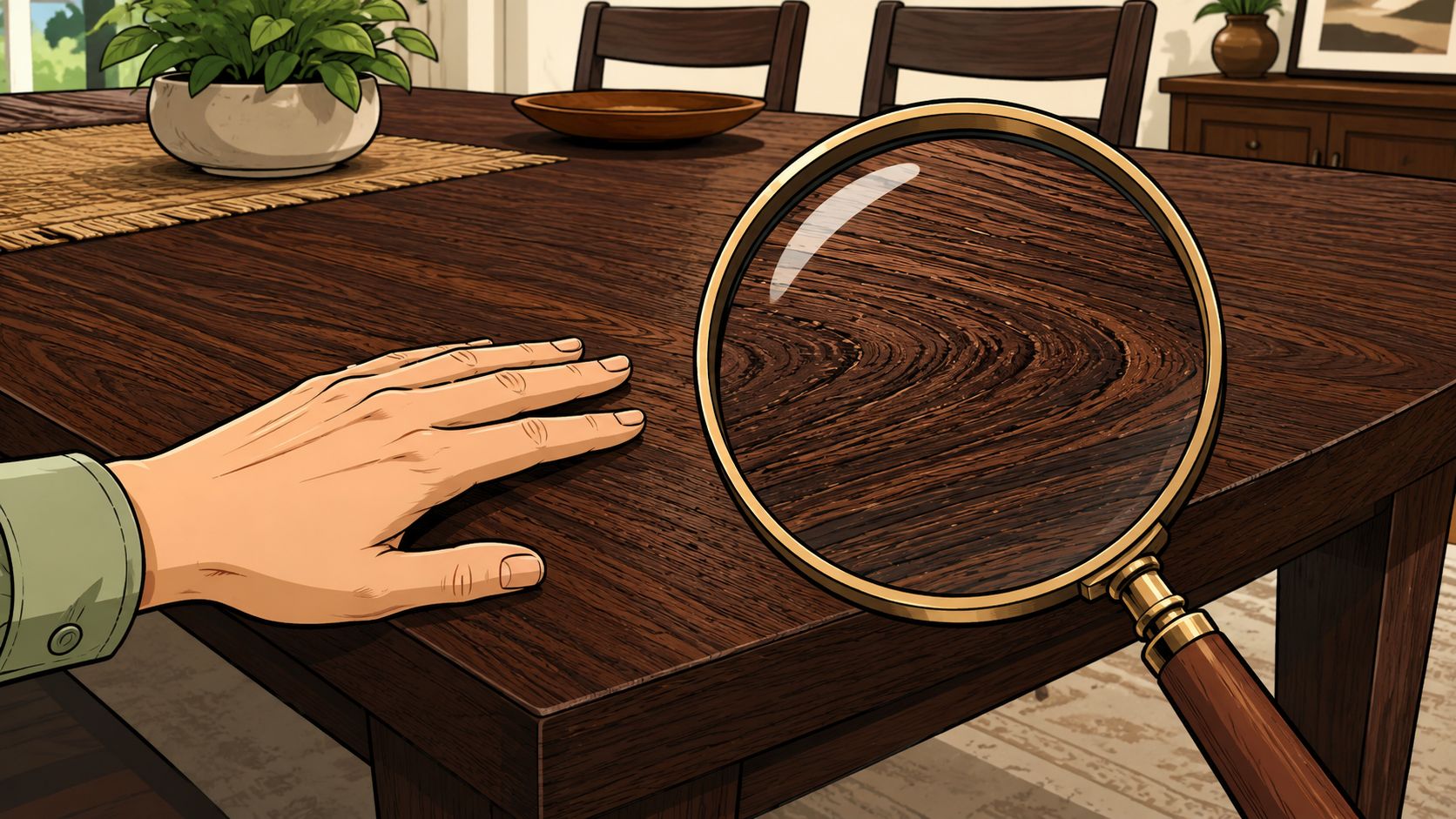
- Touch the top surface. It should feel smooth and protected, not dry or uneven.
- Look at the grain under the stain. Some dark finishes are flat and opaque, while others still let the natural character of the wood show through.
- Pull out a chair and sit. The chair should feel stable and comfortable without scraping or rocking.
- Check extension details if the table expands. Leaf storage, seam alignment, and easy movement matter more than people expect.
- Step back and study the base. Pedestal, trestle, and four-leg designs all change how the room feels and how people move around it.
A buyer who wants long-term value should also ask whether the set is made from solid wood, whether it's American-made, and whether custom ordering is available for finish and size changes. In Longwood, shoppers often want a set that works for both everyday family meals and larger gatherings during the holidays, which makes those choices especially useful.
Practical rule: If the finish looks good only from a distance, it probably isn't the right piece.
Some households also need flexibility. A compact table that expands can make more sense than a permanently oversized one. This is where harder woods and careful engineering matter. One industry source notes that dark options are commonly offered in solid walnut, dark-stained cherry, and maple for extendable dining tables because manufacturers have to balance appearance with stability under repeated leaf expansion and contraction.
For shoppers considering custom-order furniture, one local option is Slone Brothers Furniture, which offers access to American-made and Amish-crafted dining pieces from brands such as Mavin, Simply Amish, and Canadel, along with finish and size customization through its order programs. That kind of flexibility can be especially useful when a Central Florida homeowner needs a table to fit a specific footprint or coordinate with existing cabinetry and flooring.
Measuring Your Space for the Right Fit

A simple way to map the room
A table can be beautifully made and still feel wrong if it doesn't fit the room. This happens often in open-concept Central Florida homes, where the dining area shares visual space with the kitchen or living room. On paper, the room looks generous. In daily life, chairs bump into walkways and the set feels crowded.
A useful first move is to mark the table footprint on the floor with painter's tape. Then add chair space around it. This gives a more honest sense of the room than a rough guess based on wall measurements.
Homeowners can compare their room against a more detailed dining room table size guide before they commit to a shape or extension style.
The easiest measuring routine usually looks like this:
- Measure the full room first: Include openings, windows, and nearby islands or cabinets.
- Mark the table size on the floor: This shows how much visual weight the set will carry.
- Add room for chairs to move: A table doesn't live at its exact top dimensions. The chairs create the true footprint.
- Walk the traffic paths: People should be able to pass behind seated guests without the room feeling pinched.
How to keep dark wood from feeling too heavy
A common but underserved question is how dark wood dining sets affect smaller or lower-light rooms, since most buying guides focus on style more than the way dark finishes can visually shrink a space. Shoppers are often choosing between color depth and space optimization, as discussed in this dining table buying guide.
That concern is real, but it doesn't mean dark wood is off the table. It usually means the rest of the room has to work a little harder.
A few adjustments help immediately:
| Room challenge | Better choice |
|---|---|
| Low natural light | Upholstered or lighter-toned chairs |
| Narrow dining zone | Slimmer legs or a pedestal base |
| Busy open layout | Cleaner silhouette with less carving |
| Dark flooring | Rug or seating that lightens the composition |
In smaller rooms, the problem usually isn't the dark finish alone. It's dark finish plus bulky scale plus weak lighting.
In Orlando-area homes with tile floors and brighter wall colors, dark wood often looks better than expected because the surrounding finishes lighten the overall composition. In a lower-light dining room, though, the same set may need a lighter rug, a brighter overhead fixture, or chairs with visual openness to keep the room balanced.
The goal isn't to avoid dark furniture. The goal is to give it enough breathing room so the room still feels easy to move through and pleasant to gather in.
Styling Your Dining Set in a Florida Home
Balance dark wood with lighter elements
Dark wood has a natural formality, but a Florida home usually looks best when that richness is balanced with ease. The most successful rooms in Longwood, Lake Mary, and greater Orlando don't fight the dark finish. They soften it.
That often means mixing the set with lighter textures and finishes around it. Cream upholstery, woven chair backs, linen curtains, pale ceramics, and natural fiber accents all help dark wood feel fresh rather than heavy.
A few combinations tend to work especially well in Central Florida:
- Dark wood with light upholstered chairs: This keeps the table grounded while the seating feels airy.
- Dark wood with rattan or woven accents: The room picks up a relaxed coastal note without losing polish.
- Dark wood with soft white walls: Contrast becomes part of the design instead of an afterthought.
- Dark wood with greenery and organic decor: Plants, branches, and textured bowls prevent the room from feeling overly formal.
Homeowners looking for more room-specific ideas can explore decorating a Florida home to see how warm wood tones can sit comfortably within a lighter regional palette.
Lighting, rugs, and texture choices that help
Lighting changes everything with dark finishes. Under weak light, a dark table can flatten out and lose detail. Under the right fixture, the grain, edge profile, and richness of the stain become much more visible.
A chandelier or pendant should do more than sit over the center of the table. It should create enough layered light that the wood reads warm, not muddy. That's especially helpful in dining rooms that receive stronger daylight only part of the day.
Rugs also play an important role. A lighter rug under a dark set can lift the whole composition. A very dark rug under a dark table usually makes the room feel visually compressed unless the space is large and bright.
A dark dining set often looks most elegant when at least two surrounding elements are lighter, softer, or more textured.
For a Florida-friendly look, it helps to think in layers:
- Anchor with the table. Let the dark wood be the strongest visual element.
- Soften with chairs. Upholstery, caning, or lighter wood accents reduce visual density.
- Brighten below. A rug can define the dining zone and add contrast.
- Warm the room above. Lighting should highlight the top surface and make evening meals feel inviting.
- Add natural texture. Woven trays, linen runners, and subtle coastal accessories keep the room from feeling stiff.
Some homeowners want help pulling all of that together, especially in open-concept homes where dining, living, and kitchen finishes all have to cooperate. That's where an in-house design team can be useful. Complimentary guidance on space planning, finish coordination, and room flow can save a lot of second-guessing before a purchase is finalized.
Caring for Your Long-Term Furniture Investment
A dark wood dining set earns its keep. It handles plates, serving dishes, school projects, celebrations, and day-to-day life. Good care doesn't need to be complicated, but it does need to be consistent.
One important trade-off is worth knowing upfront. Dark finishes can make dust, fingerprints, and surface scratches more noticeable under certain lighting, as noted in this dining set category guide. That doesn't make dark wood a poor choice. It just means maintenance habits matter a little more.
Daily habits that protect the finish
Most wear comes from small repeated actions. Sliding a ceramic bowl, setting down a hot dish, or wiping with the wrong cloth can all affect the surface over time.
A better routine is simple:
- Use placemats and trivets: Heat and abrasion are easier to prevent than repair.
- Wipe spills promptly: Moisture left sitting on the finish is never a good long-term habit.
- Dust with a soft cloth: This helps avoid dragging grit across the top.
- Lift, don't slide: Serving pieces, centerpieces, and decor can leave fine marks when pushed across the surface.
For households that want a clearer maintenance routine, this guide on how to care for wood furniture can help establish good habits early.
What owners usually notice after move-in
The first surprise is often visibility. A dark tabletop may hide some general wear well, but in certain light it can also highlight dust or fingerprints. This is especially common in homes with strong side light from large windows.
The second surprise is that good finishes still benefit from everyday protection. High-quality protective coatings help reduce visible wear, but they work best when owners still use coasters, pads, and sensible cleaning practices.
A dining set lasts longer when the household treats it like working furniture, not disposable furniture.
In Central Florida, that long-term mindset matters. Humidity, active family life, and frequent entertaining all make durable materials and smart care routines more valuable over time.
Find Your Forever Dining Set at Slone Brothers
What makes a set worth keeping
A dining set becomes a long-term success when three things line up. The material holds up, the scale fits the room, and the style still feels right after the excitement of purchase wears off. Dark wood tends to perform well on all three fronts when the buyer chooses carefully.
That's especially true for extendable tables. For dark wood dining sets, manufacturers often favor harder woods like walnut, cherry, or maple, especially for extendable tables. The finish system is engineered to preserve visual uniformity and handle the dimensional stress of repeated leaf expansion, according to this dark wood table construction overview.
A strong choice for a Central Florida homeowner often comes down to questions like these:
- Will this finish still work if the wall color changes later?
- Does this table handle both daily meals and holiday seating needs?
- Do the chairs feel comfortable enough for a long dinner?
- Is the build quality strong enough for years of regular use?
Why local showroom shopping still matters
Photos can show color. They rarely show proportion, finish depth, seat comfort, or how a table edge feels in person. That's why many homeowners still prefer to narrow choices online and make the final decision in a showroom.
For a local, family-owned business serving Central Florida since 1980, that in-person process is part of the value. Homeowners in Longwood, Orlando, Sanford, and Lake Mary can compare wood tones in real light, look closely at craftsmanship, ask about custom-order options, and see which set suits their home.
The right dining set should feel settled, useful, and easy to live with from the first meal onward. It should support everyday life now and still feel relevant years later. That's the promise of dark wood when it's chosen well.
Ready to find the perfect piece for a Central Florida home? Visit Slone Brothers Furniture in Longwood, FL, and let the design experts help bring the right dark wood dining room set, custom order, or American-made dining solution into focus.