
Living Room Furniture High End: How to Buy Pieces That Last


Buying the best-known brand isn't enough. For homeowners comparing living room furniture high end in construction rather than appearance alone, the better question is what happens when a cushion softens, upholstery wears, or the room needs a different arrangement. A beautiful sofa that can't be serviced isn't an heirloom investment.
For Longwood and Greater Orlando homeowners, lasting value comes from inspecting the structure, choosing materials for Florida conditions, and understanding ownership after delivery. Slone Brothers Furniture's local, family-owned history since 1980 provides a setting for that conversation, with experienced design consultants rather than an anonymous checkout process.
What Makes Living Room Furniture High End?
High-end living room furniture is built to be inspected, made from materials selected for sustained use, and supported by people who can explain its service needs. Premium pricing is justified by structural integrity, consistent comfort, and repair options, not decorative details alone.
A sofa frame resembles a house foundation. It disappears beneath the finished surfaces, but its strength determines whether everything attached to it stays aligned.
Construction markers that separate heirloom pieces from shortcuts
| Component | Built to last | Common shortcut |
|---|---|---|
| Frame | Kiln-dried hardwood or engineered plywood | Particleboard or MDF with staples |
| Joinery | Mortise-and-tenon joints and corner blocks | Stapled and glued butt joints |
| Seat cushion | High-density foam, down-wrapped or hand-tied core | Loose fill or low-density polyurethane |
| Suspension | Eight-way hand-tied or sinuous steel springs | Elastic webbing with no spring system |
| Finish | Hand-applied, multi-coat finish on exposed wood | Thin spray topcoat |
| Leather | Full-grain or top-grain hide | Bonded leather or polyurethane coating |
Frame material and joinery work together. Properly dried hardwood and structural plywood provide dependable fastening surfaces. Particleboard in stressed frame locations deserves scrutiny, especially where moisture exposure or repeated loading could compromise connections.
Mortise-and-tenon joints create interlocking connections, while corner blocks help resist sideways distortion, called racking. Staples aren't automatically evidence of poor furniture, but they shouldn't substitute for a sound structural joint.
Cushions need a resilient core, not merely a generous-looking cover. Down wrapping adds softness, but requires maintenance; foam density and foam firmness are different specifications, so a hard cushion isn't necessarily a durable cushion.
Suspension quality also involves execution. Well-installed sinuous springs can perform well, while poorly anchored springs cannot; engineered webbing can be appropriate in some designs, but its specification and tension deserve an explanation.
Look beyond the material label
A finish should protect edges and exposed surfaces consistently. Hand application alone doesn't prove superiority, just as a sprayed finish isn't automatically inferior. Film quality, adhesion, coverage, and repair options matter more than the romance of the application method.
The same inspection-first mindset appears in Shivora Candles' quality checklist for Canadian candle shoppers: distinguish material descriptions from evidence of workmanship. For furniture, that means examining what a polished photograph leaves hidden.
The showroom test: What is the frame made of, how are the joints connected, and what is inside the seat cushion?
Clear answers should include materials and construction, not only a collection name.
Which Brands Define Premium Living Room Furniture?
A premium name is a useful starting point, not proof that a piece deserves its price. Judge a brand by what it makes, how well the design fits your room, and whether the furniture can adapt or be serviced over time.
Brands and their strengths
| Brand | Country of origin | Known for |
|---|---|---|
| Stickley | United States | Arts and Crafts heritage and solid wood furniture |
| Bassett Furniture | United States | Upholstery and customizable furniture |
| Stressless | Norway | Recliners and chairs with ergonomic features |
| Palliser | Canada | Contemporary upholstery, including sectionals |
| MAVIN | United States, Amish country | American-made wood furniture |
| Hooker Furniture | United States | Furniture for living rooms and other home spaces |
Slone Brothers Furniture carries these brands alongside Art Furniture, Lexington Furniture, Liberty Furniture, Riverside Furniture, Universal Furniture and Vaughan Bassett. The store also offers living room furniture including sofas, sectionals, loveseats, chairs, recliners, sleeper sofas, lift chairs and tables. A broad brand selection helps you compare styles, but the model and its construction still matter more than the label.
Stickley suits buyers drawn to Arts and Crafts design and visible woodwork. MAVIN focuses on American-made furniture produced in Ohio's Amish country. Its wood selection includes cherry, oak, maple, walnut or hickory, hand-selected by a third generation of lumber specialists. Its dining and bedroom offerings are distinct from a general claim about every living room piece.
Match the specialty to the room
For upholstery, compare the actual sofa or chair rather than relying on a brand's general reputation. Slone Brothers lets customers customize sofas, chairs, loveseats, sectionals and other items through brand-page design tools, in the store, or during a home visit. Fabrics and finishes can be customized, so consider whether those choices improve the fit and suit your intended use.
Stressless centers its seating on ergonomic features. Comfort remains personal, and an elegant design is valuable only if it suits the person using it. Ask how the chair's moving parts can be serviced before committing to a feature-rich model.
- For exposed craftsmanship: Ask what materials and finishes are available, and whether the piece can be repaired or refreshed.
- For upholstered seating: Compare cushion choices, fabric options and proportions on the model you are considering.
- For motion furniture: Consider control access and serviceability as well as the features you will use.
Slone Brothers has been creating interiors since 1980 and offers professional interior design services for homes and businesses. Use that support to assess how a chosen piece fits your room and needs, then make the final judgment on the individual furniture, not the name alone.
How to Inspect a Sofa or Chair in Person
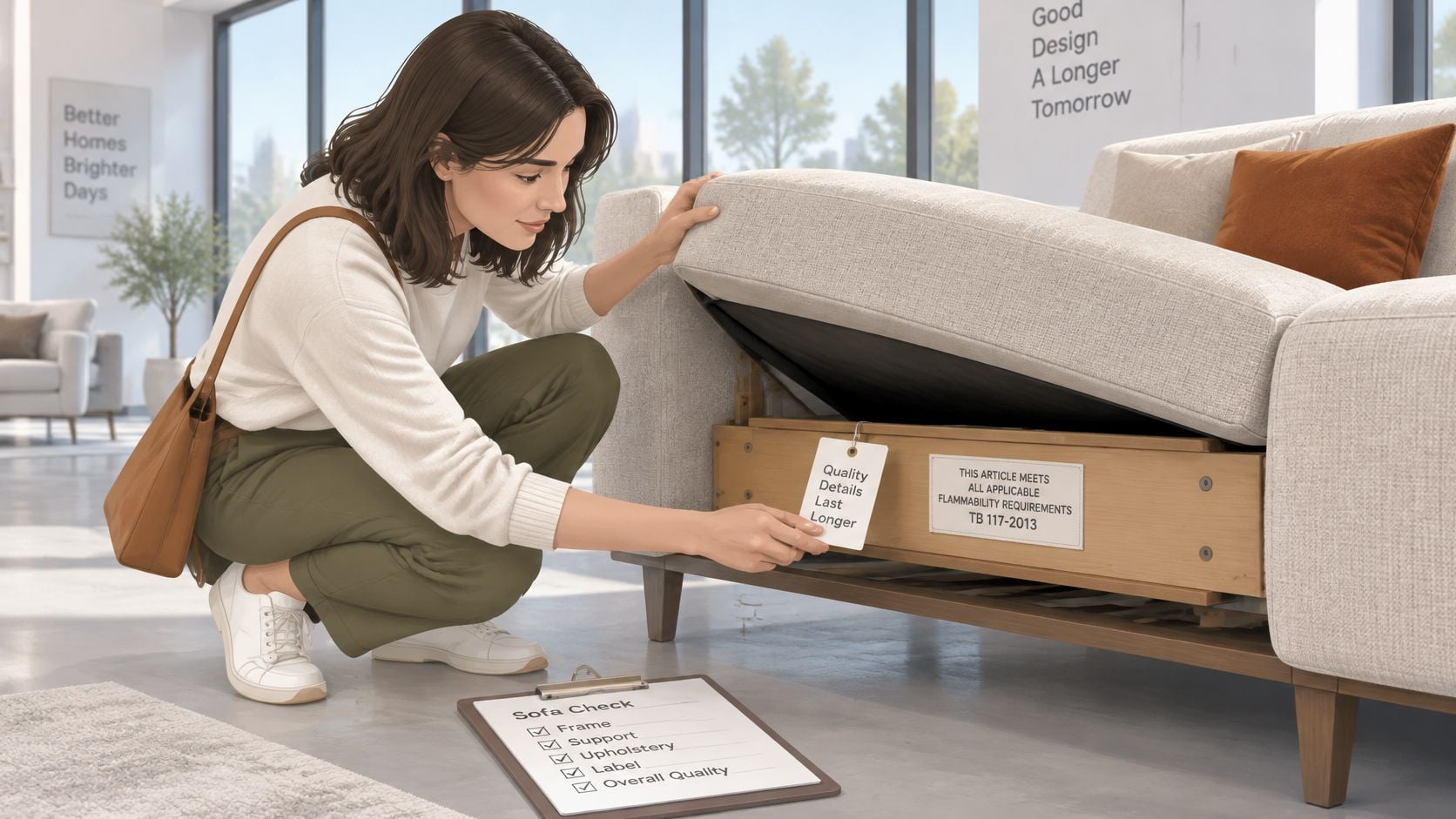
A hands-on showroom inspection reveals comfort, movement, and workmanship that photography can't establish. The best routine combines a safety-label check with seated testing and a careful look at the hidden structure.
Follow a consistent inspection routine
Locate the permanent compliance label. The U.S. Consumer Product Safety Commission's upholstered furniture guidance explains that covered furniture must carry a permanent label stating compliance with federal flammability requirements. This establishes a safety baseline, not a craftsmanship grade or a guarantee against ignition.
Sit fully back in a normal resting position. Feet should feel supported, and the seat edge shouldn't press uncomfortably behind the knees. A deep lounge sofa and an upright conversation chair serve different purposes.
Check stability with the consultant's assistance. Gentle pressure can reveal unexpected movement, creaking, or twisting. Heavy reclining furniture shouldn't be lifted casually, and a noise needs diagnosis rather than an automatic rejection.
Compress and release the seat cushion. Observe recovery, then sit again and assess support beneath the initial softness. Recovery speed alone doesn't establish foam density, so the written cushion specification matters.
Examine seams and pattern placement. Look along welts, arm fronts, cushion corners, and exposed backs. Straight stitching and thoughtful pattern alignment indicate care, although intentional pattern placement may differ between designs.
Request a view of the structure. A sample frame or construction diagram can clarify joints and reinforcement without disturbing the upholstery. Slone Brothers Furniture's guide to mortise-and-tenon joint furniture explains the connection worth recognizing.
Operate every moving function. Recline, return upright, adjust the headrest, and test accessible controls. Motion should feel controlled, with adequate clearance and no catching upholstery.
Judge the whole seated experience
An expensive chair shouldn't require constant repositioning. Shoulders should relax, the lower back should feel supported, and standing should feel manageable rather than like climbing out of a hollow.
A comfortable first impression isn't enough. The seat still needs to feel supportive after the initial softness stops attracting attention.
For couples choosing a sectional in Lake Mary or Altamonte Springs, both users should test the configuration. Different heights and sitting habits can call for different chair proportions within the same room.
Which Leather and Fabric Grades Hold Up Longest?
The upholstery label matters less than the material's finish, documented performance, and suitability for the household. Leather terminology needs clarification, while fabric durability requires more than a broad performance claim.
Leather and fabric grades by wear pattern and best use
| Grade | What it is | Typical wear pattern | Best use |
|---|---|---|---|
| Full-grain leather | Hide surface with natural grain retained | Develops patina; scratches remain more or less visible according to finish | Long-term seating where natural variation is welcome |
| Top-grain leather | Upper hide layer, often corrected and refinished | Uniform appearance; finish quality affects surface wear | Rooms needing a consistent appearance |
| Genuine leather | Broad leather description, sometimes used for coated split leather | Coated splits can crack or peel | Seating with clearly disclosed leather construction |
| Bonded leather | Leather fibers combined with binders on a backing | Surface can peel and flake | Not recommended for heirloom pieces |
| Performance fabric | Textile with specified performance characteristics | Can still develop pilling, seam wear, or fading | Active households with documented suitability |
| Natural linen or cotton blend | Natural-fiber textile or blend | May stain, wrinkle, or fade with exposure | Lower-traffic seating protected from direct sun |
Full-grain isn't synonymous with stain-proof. A lightly protected hide can show spills and body oils more readily than a protected, corrected leather. Likewise, genuine leather isn't a precise quality grade, so the actual hide layer and surface treatment need to be identified.
Bonded leather isn't equivalent to an intact hide. For a homeowner planning eventual upholstery renewal, it's a poor substitute for a clearly specified leather or textile.
Ask for test results, not adjectives
ASTM's textile standards include ASTM D3886-22, an abrasion-resistance method using an inflated-diaphragm apparatus. A named method and documented result provide a more useful comparison than luxury, durable, or commercial-grade language alone.
Abrasion testing doesn't reproduce every household hazard. Pet claws, sharp hardware, sunlight, body oils, and repeated cushion compression can create damage that an abrasion result won't predict.
For a sunlit Winter Park living room, the specification conversation should include:
- Cleaning code: Identify permitted cleaning methods before selecting the fabric.
- Lightfastness: Request information relevant to large windows and afternoon exposure.
- Construction: Check seams, cushion reversibility, and replacement availability.
- Warranty exclusions: Understand how staining, fading, and pet damage are treated.
The Slone Brothers Furniture guide to choosing upholstery fabric supports that selection process. For leather maintenance, leather sofa upkeep by Eco Clean Solutions offers a useful supplementary resource, with the furniture manufacturer's instructions taking priority.
How Does Solid Wood Hold Up to Florida Humidity?
Well-constructed solid wood can serve Central Florida homes for the long term when its design accommodates movement and its environment remains reasonably stable. Engineered panels need a separate evaluation of structural purpose and documented emissions compliance.
Wood exchanges moisture with surrounding air, expanding and contracting primarily across the grain. The important distinction isn't solid versus engineered, but whether the maker allows that movement without forcing joints or broad surfaces out of alignment.
Protect the wood without trapping its movement
A solid wood tabletop needs attachments that accommodate seasonal movement. A rigid connection across a broad panel can create problems even when the timber itself is excellent.
Consistent finishing helps moderate moisture exchange, but a finish doesn't make wood waterproof. Undersides and concealed surfaces deserve inspection, while drawer interiors may intentionally use a different treatment.
- Placement: Keep furniture away from direct afternoon sun, frequently opened exterior doors, and concentrated air-conditioning discharge.
- Cleaning: Use a soft cloth, remove spills promptly, and avoid leaving damp objects against the finish.
- Air circulation: Leave breathing room behind consoles rather than pressing them tightly against walls.
- Care products: Avoid silicone-heavy polishes or aggressive cleaners unless the finish maker specifically approves them.
For homes in Sanford, Lake Mary, and Winter Park, stable indoor conditions matter more than occasional polishing. Slone Brothers Furniture's wood furniture care guide provides a useful maintenance reference.
Separate emissions from craftsmanship
The EPA's composite-wood formaldehyde guidance lists these emission limits for regulated panels:
- Hardwood plywood with veneer or composite core: 0.05 parts per million.
- Medium-density fiberboard: 0.11 parts per million.
- Thin medium-density fiberboard: 0.13 parts per million.
- Particleboard: 0.09 parts per million.
These are panel limits, not an overall quality grade for a finished console or bookcase. Finished goods don't require separate formaldehyde-emissions certification; their regulated composite-wood components must comply.
The useful questions are specific: which panels are present, where are they used, and does the supplier document compliance? A premium price answers none of them.
Is Premium Worth the Price Over 10 to 20 Years?
A high purchase price earns its place when a sofa combines lasting comfort with repairable construction and parts that remain available. Treat cost per year as a planning tool; it estimates value but does not guarantee that an expensive sofa will outlast a cheaper one.
Estimated cost per year by quality tier
These lifespan ranges are illustrative ownership scenarios, not measured averages, warranties, or predictions. Use a written quotation and a realistic maintenance allowance before estimating annual cost.
| Tier | Expected lifespan |
|---|---|
| Entry-level sofa | Hypothetical planning scenario of 3 to 5 years |
| Mid-market sofa | Hypothetical planning scenario of 7 to 10 years |
| Heirloom-quality sofa | Hypothetical planning scenario of 15 to 25 years |
Annual ownership cost equals purchase, delivery, and maintenance costs divided by useful years of service. Without confirmed prices and a defensible lifespan assumption, a dollar-per-year figure can imply more certainty than the comparison supports.
The furniture repair study published in Circular Economy and Sustainability reports that financial considerations generally outweigh environmental concerns in repair decisions, while perceived repairability and personal attachment also influence behavior. Ask about repair options before buying, rather than waiting until a component fails.
Put serviceability into the budget
A sound frame may make reupholstery worthwhile, but repair is not automatically cheaper than replacement. Include labor, fabric, cushion renewal, and transport in the estimate.
Replaceable inserts can address cushion wear without replacing the entire sofa. Removable covers help when their care instructions suit your household. Modular furniture can adapt to a move or a room change, provided compatible connectors and components remain available.
Ownership rule: A replaceable component has value only when its replacement is available.
That distinction matters in homes with children or pets, where wear may affect cushions and covers. For a move to Lake Mary or Sanford, a sectional's reconfiguration options can also affect whether it continues to fit the room.
Slone Brothers Furniture's guide to how long furniture should last offers context for setting realistic ownership expectations.
Choose a payment approach without weakening the specification
- Payment in full: Set aside an allowance for delivery, care, and future maintenance.
- Financing: Slone Brothers Furniture offers financing options. Compare the total payable cost, repayment terms, and promotional conditions before agreeing.
- Phased purchasing: Buy foundational seating first, then add tables and secondary chairs that suit its scale.
Before you commit, get clear answers to three questions: what can be replaced, what does the warranty cover, and what would a repair involve? Ask the consultant to distinguish the manufacturer's obligations from ordinary wear and optional paid service.
How Do You Style a Living Room Around Pieces That Last?
A room looks considered when its furniture shares compatible scale, a clear focal point, and comfortable circulation. Matching every piece isn't necessary, and replacing everything at once can erase the character that makes a home personal.
Start with the sofa footprint and actual movement through the room. Mark its outline on the floor, open nearby doors, and test the route between seating, windows, and adjacent rooms before committing to a configuration.
Establish a visual hierarchy
A substantial solid wood coffee table can sit comfortably beside restrained upholstery when their proportions agree. Wood tones don't need to match exactly, but their undertones and visual weight should feel intentional.
A rug should connect the seating group rather than sit isolated between it. Table placement should allow comfortable reach without forcing guests to turn sideways through the room.
Art can establish the focal point without requiring a matching furniture collection. For households incorporating devotional objects, HD Asian Art's guide to designing home altars with Burmese art offers context for a respectful, deliberate arrangement rather than treating sacred objects as interchangeable accessories.
Bring these decisions to the showroom
- Scale: Balance sofa depth, chair height, and table mass.
- Focal point: Decide whether seating addresses conversation, a view, artwork, or entertainment.
- Layered light: Combine ambient illumination with reading light near the seats.
- Repeated accent: Carry a restrained color through selected textiles or objects.
- Clear paths: Preserve comfortable movement without cutting through the conversation group.
In Central Florida, filtered window treatments help manage strong afternoon exposure. Lamps should also support the room after sunset, when daylight no longer softens contrasts or illuminates reading areas.
Choose Custom or Ready-Made Before You Visit Longwood
Choose custom furniture when a specific dimension, seat specification, upholstery, or finish solves a daily problem. Ready-made furniture is the practical choice when an available piece already fits and the delivery schedule matters more than tailoring.
A family moving into a townhouse may need a custom sectional that fits a narrow stairway and a bright window. A Koelnmesse report discussing a YouGov furniture survey.pdf) describes competing furniture preferences among German respondents. For your decision, start with the room, the order details, and current availability.
Customize the decisions that change daily use
Prioritize seat depth, arm height, overall width, and upholstery suitability before decorative trim. A sofa that clears the doorway and supports its users serves the household better than an elaborate specification without a practical purpose.
Special-ordered furniture typically takes 6 to 8 weeks, and delays may occur when fabrics or components are unavailable. This is an industry lead time, not a guaranteed completion date for an individual order. Check current availability and delivery timing before coordinating with a move-in schedule.
Slone Brothers Furniture offers custom orders, and its custom-order furniture guide explains how to get started. Custom production is sustainable only when the fit is correct and the piece can be repaired. Ask how the chosen materials and construction can be serviced over time.
Prepare for a productive showroom visit
Bring the measurements and details that affect fit and delivery:
- Room measurements: Include wall lengths, windows, outlets, and permanent architectural features.
- Access details: Record doorway widths, hallway turns, stairs, and elevator restrictions.
- Room photographs: Show adjoining spaces and furniture that will remain.
- Household needs: Note preferred sitting positions, entertaining habits, pets, and accessibility considerations.
Slone Brothers Furniture offers complimentary design guidance, including in-home consultation, to help coordinate these decisions. White-glove delivery is available within 50 miles of the Longwood showroom for $199.00, so include delivery in the furnishing budget.
A productive visit is a face-to-face discussion about how the whole home should function, from the first seating decision through delivery and service. Bring your measurements and priorities, then assess each option for fit, comfort, and repairability before committing.