

Adjustable Headrest Recliner: The Complete Buyer’s Guide

A reader in Winter Park settles into a recliner after a long day, raises the footrest, and expects the usual relief. Instead, the head tips forward, a cushion gets wedged behind the neck, and the chair still feels wrong. The problem often isn't the padding. It's the lack of biomechanical adjustability.
An adjustable headrest recliner is designed to follow the occupant's body as the chair changes position. For Central Florida homeowners furnishing a living room, home theater, or reading corner, that distinction matters. A recliner should support the person using it, not force every family member into the same fixed posture. The right choice comes from examining adjustment range, mechanism quality, construction, upholstery, and fit in person.
Why Your Current Recliner Might Be Hurting Your Neck
A Lake Mary homeowner may describe the problem this way: the recliner feels comfortable for the first few minutes, then the neck begins to tighten. A pillow gets folded behind the head. The seat gets repositioned. The television angle changes. By the end of the evening, the chair has become another source of irritation rather than a place to recover.
Fixed headrests create this problem because they assume one body proportion and one sitting posture. A taller person may find the support too low, while a shorter person may feel the cushion pressing the head forward. Even people with similar height can have different torso lengths, shoulder positions, and preferred recline angles. A fixed backrest can't account for those differences.
The average body is a furniture shortcut
Mass-market recliners often look generous in a showroom but reveal their limitations at home. The headrest may align correctly only when the user reclines to one specific point. Sit more upright for conversation, reading, or a laptop, and the neck loses support. Recline farther for a film, and the head may fall behind the intended support zone.
A well-designed adjustable headrest changes that relationship. The headrest can move vertically, pivot, or both, allowing the occupant to position support beneath the base of the skull instead of relying on a generic contour. That flexibility becomes particularly valuable in multigenerational households in Longwood, Sanford, or Altamonte Springs, where one chair may serve several people.
Practical rule: A recliner should be judged in the positions the household actually uses, not by its appearance while standing upright on a showroom floor.
Comfort is part of responsible furniture planning
Persistent stiffness deserves appropriate medical attention, and furniture shouldn't be presented as a treatment. Still, homeowners evaluating their daily seating can benefit from practical resources on integrated self-care for neck and back while they assess their environment and habits.
The same principle applies to selecting a chair. A recliner with independent head and lumbar adjustments offers a more individualized foundation than a fixed design. Central Florida shoppers comparing options can review recliners designed for back support before visiting a showroom, then test whether the chair supports the neck without pushing it forward.
The Science Behind Proper Headrest Positioning
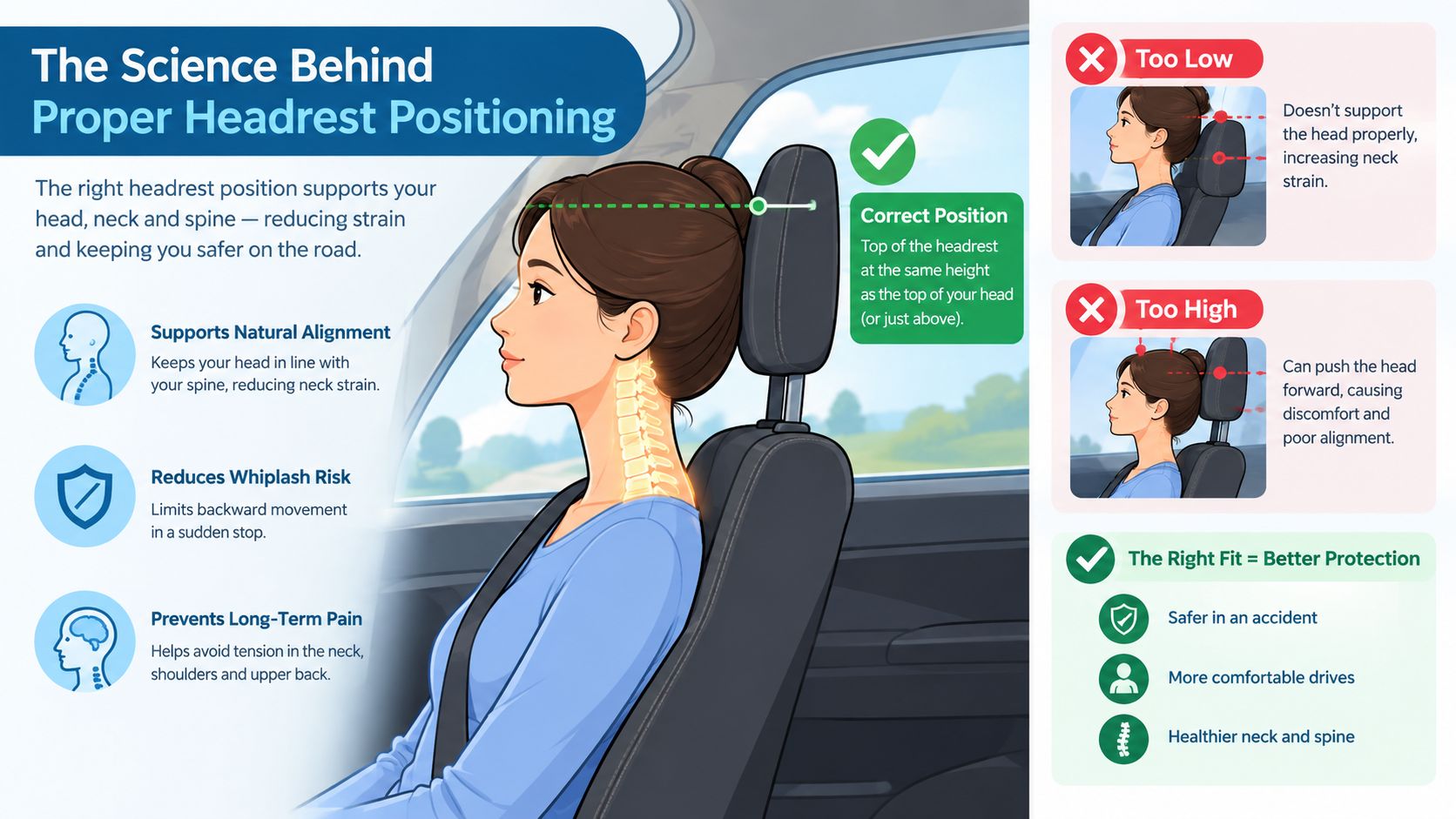
Proper positioning starts with the seat, not the headrest. The occupant should first establish a stable seat depth, back angle, and footrest position. Only then can the headrest be adjusted accurately, because the relationship between the pelvis, spine, shoulders, and head changes as the recliner moves.
A 2024 biomechanics summary reported that an ergonomic chair headrest needs roughly 65–75 cm of height range to serve different users comfortably, as detailed in the biomechanics summary on headrest adjustability. That range makes an important point: a small decorative movement isn't the same as meaningful ergonomic adjustment.
Use a repeatable positioning protocol
Once the seat is set, the occupant should check three contact points:
-
Base of the skull: The headrest should lightly cradle the base of the skull. It shouldn't press the head forward or leave a noticeable gap.
-
Neck position: The neck should remain relaxed rather than reaching backward or bending forward to meet the cushion.
-
Line of sight: For reading or screen-based activities, the head should face the target without the chin lifting or dropping excessively.
Industry ergonomic guidance commonly identifies a slight recline of about 100–110 degrees as a workable posture for reading and screen-based tasks, with the seat positioned first and the headrest set afterward. The adjustable headrest positioning guide explains this sequence and the importance of avoiding forward pressure on the neck.
Range matters more than a feature label
Another user-comfort study summarized in the same technical research found that support for at least 95% of users required 6.5 inches of vertical travel and 3 inches of horizontal travel. In that summary, 88% of participants rated the headrest comfortable or very comfortable, while 70% said they would likely request a headrest if one were offered. Those findings show why a serious buyer should ask about actual travel and pivot range rather than accepting “adjustable” as a vague marketing term.
The same standard applies to ergonomic office seating. Readers comparing recliner-like support for a home office can examine ergonomic office chair options and ask whether the adjustment range matches the user's body, desk height, and screen position.
Types of Adjustable Headrest Mechanisms
Headrest mechanisms fall into three practical categories: fixed or manually shaped support, manually adjustable systems, and power-controlled designs. Each can work well in the right setting, but they serve different users and routines.
A fixed headrest has no true adjustment. Its success depends entirely on the chair's proportions and the occupant's body. This approach can be acceptable for a single user whose preferred posture matches the chair, but it's the least adaptable choice for a household that shares seating.
Manual systems favor simplicity
Manual headrests use a ratchet, hinge, or articulated support that the user moves by hand. They generally offer straightforward operation and avoid motors, switches, and wiring. Their appeal is practical: fewer powered components and a tactile adjustment that can suit someone who changes positions occasionally.
The trade-off is access. A user may need to sit forward or reach behind the backrest to make a change. Manual systems also tend to provide defined positions rather than continuous fine control, depending on their construction. That can be enough for television viewing, but less satisfying for a reader who makes small posture changes throughout an evening.
Power systems favor precision
Power-controlled headrests use a motor and a button or control panel to move the support while the occupant remains seated. This is especially useful in home theater seating, where the viewer may want to adjust neck support without changing leg position or disturbing the room.
Power adjustment makes the most sense when the recliner is used frequently, shared by people of different sizes, or paired with power lumbar support. It isn't automatically the right choice for every chair. If the user mainly sits upright for short conversations, the added mechanism may see little use.
Automatic adjustment established a category milestone
Stressless identifies the addition of automatic headrest adjustment in its Stressless Plus™ system as a key development after the company's earlier 1971 launch, helping define modern comfort-focused reclining furniture in its history of ergonomic seating (Stressless history). The important lesson isn't that automation replaces fit testing. It shows how headrest movement became integrated into the overall reclining experience rather than treated as a decorative detail.
Before choosing a mechanism, a shopper should operate it repeatedly, listen for inconsistent movement, inspect the control placement, and ask how the headrest works with lumbar adjustment and the main recline. A broader overview of power reclining seating types can help Central Florida buyers identify which control system fits the room and the household.
Health Benefits Backed by Ergonomic Research
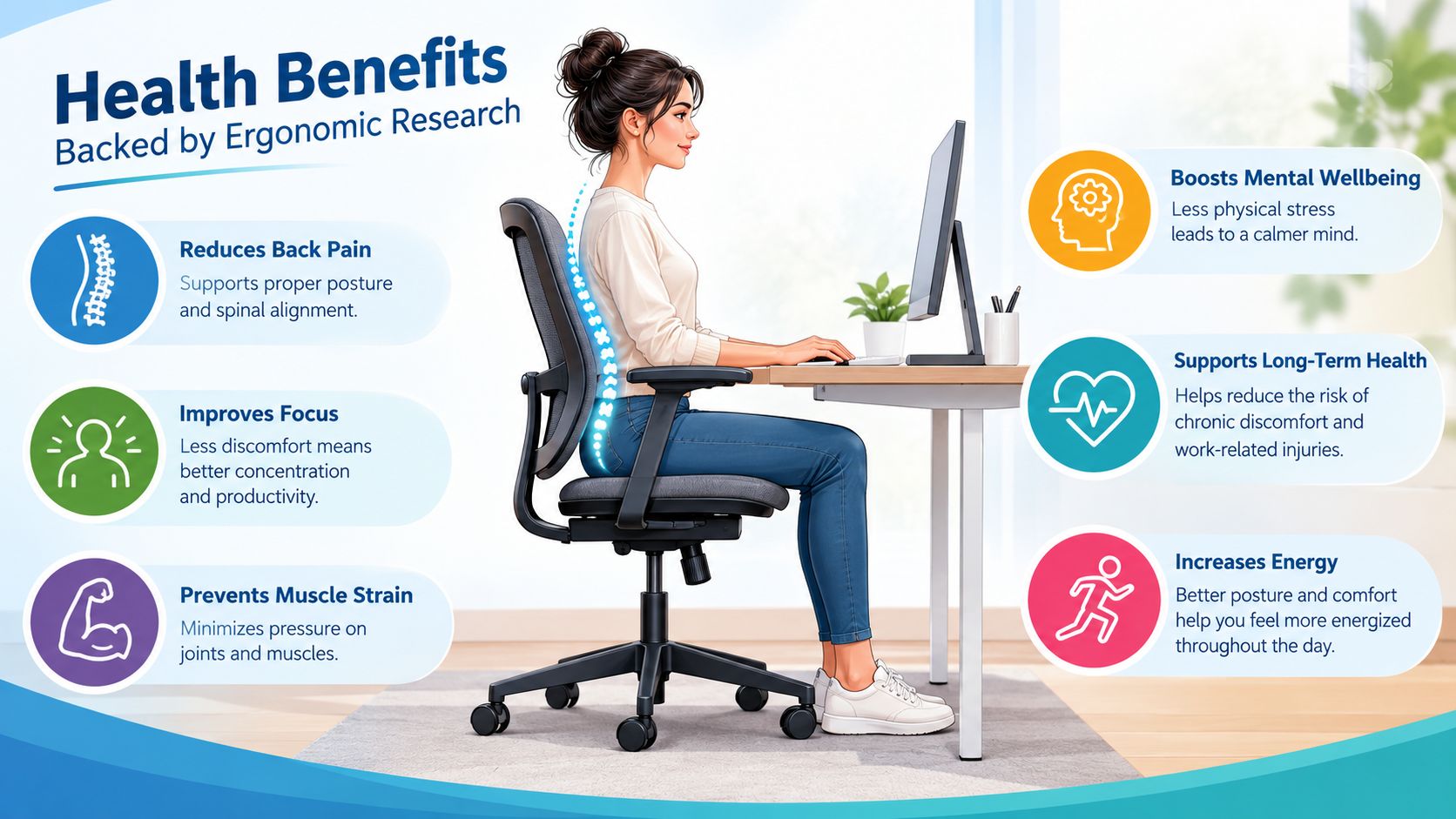
The strongest research case for head support appears in a reclined posture, especially when the occupant is maintaining a functional activity such as reading or typing. In Cornell ergonomics materials, a cited study found that a reclined posture with a headrest reduced muscle activity by more than 35% in the neck and more than 64% in the back, while typing accuracy was maintained (Cornell ergonomics materials).
Those figures don't mean every adjustable headrest recliner will produce the same result. The chair still needs appropriate seat depth, lumbar positioning, recline control, and headrest placement. A poorly fitted headrest can create pressure or move the head forward, defeating the purpose of the design.
Where the benefit is most relevant
An adjustable headrest earns its place when the chair supports sustained reclined activities:
-
Screen viewing: The occupant can position the head and neck for the screen rather than lifting the chin or collapsing forward.
-
Reading: Head support can reduce the effort required to hold the head in place during a long chapter.
-
Recovery after work: A properly fitted recliner can provide a more supported resting posture after hours at a desk or behind the wheel.
-
Shared seating: Different users can establish their own head and lumbar positions instead of inheriting one compromise setting.
Where the feature may be unnecessary
The headrest may receive little use during active forward-leaning tasks. Laptop work at a conventional table, detailed paperwork, and activities that require the torso to lean forward depend more on desk height, screen placement, and seat support than on a recliner headrest.
That trade-off is central to the value question. A premium upgrade makes sense when the household will use the adjustment often and benefit from changing support between upright and reclined positions. It makes less sense when the chair is primarily decorative or used briefly.
Health concerns also require good judgment. People with persistent pain, neurological symptoms, or diagnosed spinal conditions should seek clinical advice rather than treating furniture as a substitute for care. For readers evaluating broader comfort solutions, adjustable bases and their potential role in sleep support provides relevant furniture-planning context without reducing complex health issues to a single feature.
How to Measure for Your Perfect Fit
A showroom test becomes far more useful when the shopper arrives with a clear understanding of the body's preferred position. Measurements don't need to be complicated, but they should reflect how the recliner will be used in a Longwood or Orlando home.
Start with the user's normal posture
The first step is to sit in a firm chair with the feet supported and the back resting naturally. The user should note where the head wants support when sitting upright, then repeat the observation while leaning back in the posture used for television or reading.
Next, record the distance between the seated back and the base of the skull. The goal isn't to force the head against a support. It is to determine whether the recliner can bring the headrest into light contact without pushing the neck forward.
A household with multiple users should repeat this process for each primary occupant. The largest difference often appears between a taller adult and a shorter family member, but torso length and shoulder position matter just as much as overall height.
Test the chair in stages
At the showroom, the seat should be adjusted before the headrest. The guidance in the furniture measurement guide can help shoppers prepare room dimensions, doorway clearances, and placement details before selecting a model.
Use this sequence:
-
Set the seat: Establish comfortable seat depth, back angle, and footrest position.
-
Set lumbar support: Adjust the lower back until the pelvis feels stable and the spine isn't being pushed forward.
-
Set the headrest: Move the support until the base of the skull is lightly cradled and the neck remains neutral.
-
Change positions: Test upright conversation, reading, screen viewing, and deeper relaxation.
-
Repeat for other users: Save each person's preferred position if the controls make that possible.
Look for pressure, gaps, and compensation
A correct fit feels quiet. The head doesn't need to search for the cushion, the chin doesn't lift to see the screen, and the shoulders don't rise to create support. If the user immediately reaches for a pillow, shifts repeatedly, or feels pressure at the back of the skull, the chair deserves closer scrutiny.
A recliner should also fit the room. Central Florida homeowners should consider wall clearance, traffic flow, flooring, and the scale of surrounding living room furniture. The most technically advanced chair still fails as a purchase if it overwhelms the room or blocks the path between a Winter Park family room and its adjoining spaces.
Premium Brands and Their Headrest Technologies
Premium recliners differ in how precisely they coordinate the headrest, back angle, lumbar zone, and seat depth. Feature counts tell you little. At Slone Brothers Furniture, compare the mechanism's adjustment range with each user's seated height, shoulder position, and preferred viewing angle. A headrest that moves only a small distance cannot correct a poor body-size match.
Integrated ergonomic movement
Norwegian-engineered recliners available in our showroom may feature integrated Glide-style systems and automatic headrest adjustment. These mechanisms allow the headrest to follow the back as the chair reclines, rather than leaving the neck unsupported while the torso changes position.
The useful test is precise. Set the seat and back first, then position the headrest so it supports the base of the skull without pushing the head forward. Check the same setting upright, during reading, and in a deeper recline. Smooth movement matters, but correct alignment matters more.
Precision and customization
High-performance luxury leather recliners combine durable upholstery with engineered motion and a finished profile suited to formal living areas or media rooms. Their value depends on how accurately the controls place the headrest, lumbar support, and footrest for the intended user.
Custom bench-made recliners offer broader choices in frame details, cushion feel, fabric, and leather. That flexibility helps when the chair must coordinate with an existing room instead of looking like a generic standalone seat. Customization should still begin with measurements. Upholstery and finish cannot compensate for a headrest that stops below the neck or presses into the skull.
Contemporary leather and fabric home-theater seating often uses power headrests in coordinated rows, loveseats, or sectional arrangements. These configurations suit households that want screen-focused seating, provided every user can reach and operate the controls.
Choose by use, not reputation
Match the technology to the room's purpose:
- Daily reading and relaxed conversation: Choose nuanced headrest adjustment and a stable upright position.
- Dedicated viewing: Require independent headrest and lumbar controls, quiet operation, and accessible buttons.
- Custom interior design: Weigh upholstery, scale, finish, and configuration alongside the mechanism.
- Shared family use: Favor a wide adjustment range and controls each user can operate without assistance.
A premium price can cover frame engineering, upholstery selection, control integration, and service support. The investment earns its place when those parts continue working together after the novelty of powered adjustment fades. Test the chair with the people who will use it, and reject any model that requires a pillow or repeated repositioning to achieve neutral neck support.
Why Quality Construction Matters More Than Features
An adjustable headrest is only as dependable as the recliner supporting it. A control panel can't compensate for a weak frame, collapsing cushion, poor joinery, or upholstery that loses its shape around moving sections.
Solid wood construction generally offers greater structural integrity, weight, and longevity than particle board in load-bearing furniture. The distinction matters at the points where the back, arms, base, and reclining hardware meet. Quality furniture also depends on how components are joined, not on the material name printed on a specification sheet.
Examine the hidden structure
A careful buyer should ask about:
-
Frame material: Solid wood or engineered components in the structural areas.
-
Joinery: Secure, purposeful connections rather than staples used as a substitute for construction.
-
Cushion resilience: Foam and wrap systems that retain support instead of compressing quickly.
-
Mechanism integration: Hardware mounted and aligned so movement remains smooth and stable.
-
Upholstery quality: Leather or fabric selected for the chair's use, with seams and stress points finished cleanly.
Florida's humidity and intense sunlight add another layer of responsibility. Leather needs appropriate conditioning, while fabric selection should reflect cleaning expectations, household activity, and the room's exposure to natural light. A recliner placed near a bright window in Sanford has different maintenance demands from one installed in a shaded home theater.
Standards and safety deserve attention
Recliner construction includes stability and mechanism concerns, not just comfort. EN 1022:2023 applies to adult seating for users weighing up to 110 kg and defines specific seat and back loading points, including 175 mm forward of the seat and back junction for the seat load and 300 mm upward from that junction for the back load (EN 1022:2023 seating stability information).
Industry safety guidance also addresses entrapment around the leg rest and reclining mechanism. One cited guideline states that openings between the upholstered seat and leg rest should measure five inches or less, while a CPSC staff document references provisions in UL 962 and ANSI/BIFMA X5.4-2020 concerning reclining mechanisms, stability, legrest durability, and pinch points (CPSC recliner entrapment guidance).
For buyers, the conclusion is simple. A recliner should be evaluated as an engineered seating product, with a stable base, durable mechanism, secure leg rest, and headrest that remains aligned through movement. That is where long-term value comes from.
Testing Recliners in Our Longwood Showroom
A showroom visit should feel more like a fitting appointment than a quick transaction. Shoppers should wear clothing similar to what they normally wear at home, bring room measurements, and sit in each candidate through the positions that matter most.
The practical test is straightforward:
-
Begin upright: Check whether the seat supports conversation without forcing a slouch.
-
Recline gradually: Watch whether the headrest follows the head or leaves a gap.
-
Try the activity: Read, look toward a screen, or hold a tablet at the height used at home.
-
Test every control: Operate headrest, lumbar, recline, and footrest adjustments without assistance.
-
Invite the household: A chair shared by several people should be tested by all primary users.
Experienced design consultants should ask about room dimensions, existing furniture, upholstery preferences, and daily routines. They shouldn't push a feature because it appears on a specification sheet. At Slone Brothers Furniture, the showroom experience also connects seating selection with complimentary in-home interior design services, custom-order furniture, delivery planning, and the larger visual balance of the room.
The showroom serves Longwood, Orlando, Lake Mary, Sanford, Winter Park, Altamonte Springs, and surrounding Central Florida communities. A personal fitting is the most reliable way to determine whether an adjustable headrest recliner represents meaningful long-term comfort or an attractive list of features.
Ready to invest in furniture that supports daily comfort for years to come? Visit Slone Brothers Furniture in Longwood, FL, where experienced design consultants can help Central Florida homeowners test adjustable headrest recliners, compare construction, and coordinate the right piece with the rest of the home. Schedule an in-person visit and experience human, low-pressure furniture guidance rather than relying on online guesswork.