
Master Your Chair Seat Height for Perfect Comfort in Your Central Florida Home (2026)


Getting the chair seat height right is the secret to real comfort, whether you're gathering for a family dinner in Lake Mary or settling into your home office in Orlando. It's the subtle difference between a relaxing meal and a cramped, awkward experience where everyone's fidgeting.
Most adults should look for a standard dining chair seat height of 18 to 20 inches. This specific range pairs with a conventional 30-inch table to leave that critical 10- to 12-inch gap for legroom, ensuring knees aren't jammed against the underside of the table. If you are shopping for a desk, aim for a seat height that allows your feet to rest flat on the floor and your elbows to angle near the desktop surface.
At Slone Brothers Furniture, we believe your home should be a place of ultimate comfort.
This guide will walk you through everything you need to know, starting with the most important concept of all: the 'seat height gap.'
Why Chair Seat Height Is the Secret to Comfort
Have you ever sat down at a table and felt like your knees were jammed against the underside? Or maybe you've felt like a little kid, with the tabletop coming up to your chest. That common, uncomfortable feeling is all about the chair seat height. It's not just about the chair itself, but its relationship with the surface you're using.
At Slone Brothers Furniture, we've been helping Central Florida families find that perfect fit since 1980. We know from experience that comfort isn't a luxury—it's what makes a house feel like a welcoming home. An incorrect chair height can lead to bad posture, back pain, and even kill the mood when guests can't get comfortable.
The Golden Rule: The 10-12 Inch Gap
The key to getting the positioning just right is to leave a gap of 10 to 12 inches between the top of the chair seat and the underside of your table. This little bit of space is the sweet spot—it gives you plenty of legroom without making you feel like you're sitting too low.
This simple diagram shows exactly what we're talking about. It's all about that relationship between the table, the chair, and that all-important comfort gap.
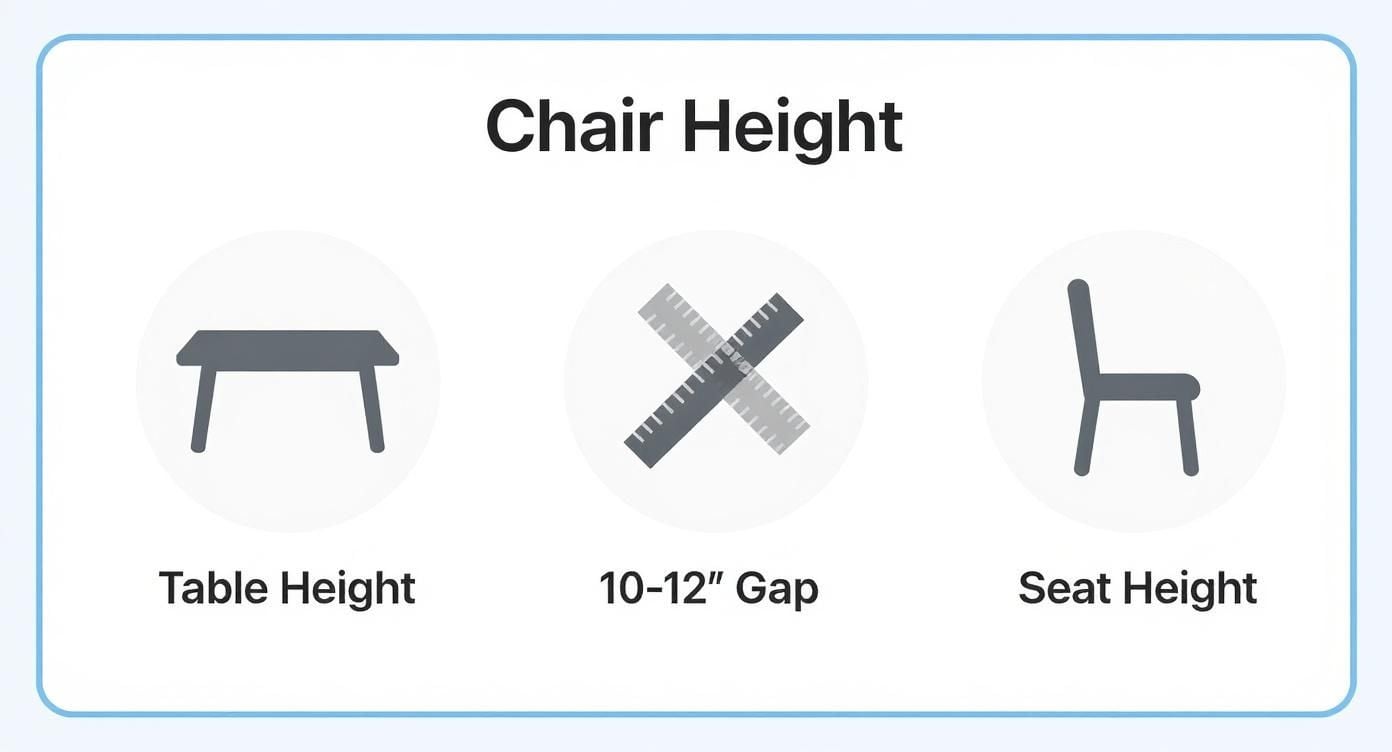
As you can see, hitting that balance is the first step toward creating an ergonomic, comfortable space in any room. Once you understand this principle, you can choose furniture that doesn't just look great, but feels great, too.
Quick Reference: Seat Height Pairings
To simplify your search, here are the standard seat heights that correspond to the most common table and counter heights found in homes:
- Dining Tables (30" height): Look for a seat height of 18–20 inches. This creates the standard 10-12 inch clearance.
- Kitchen Islands / Counters (36" height): Look for a seat height of 24–27 inches.
- Bar Tables (40–42" height): Look for a seat height of 28–33 inches.
- Standard Desks: The goal is less about a fixed table measurement and more about your body; adjust the seat so your feet are flat and your forearms are parallel to the ground when typing.
More Than Just a Number
Beyond the measurements, the right chair height just helps a room feel right. It creates a cohesive look where every piece of furniture works together in harmony. While getting the height correct is a critical starting point, it's just one piece of the puzzle. For more detail, see the five things to look for in a new sofa or chair.
From dining rooms in Sanford to home offices in Longwood, getting this one detail right is a cornerstone of good design and lasting comfort.
Matching Chair Heights to Different Rooms
Not all chairs are created equal. The height of a chair is directly tied to its purpose, and a piece designed for a relaxed living room chat would feel completely out of place at a formal dining table. For our customers across Sanford and Longwood, understanding these standard heights is the first step toward creating a space that looks right and feels even better.
Chair Height Dimensions by Type
| Seating Type | Standard Seat Height | Typical Table/Counter Height | Recommended Clearance | Comfort Notes |
|---|---|---|---|---|
| Dining Chairs | 18–20 inches | 30 inches | 10–12 inches | Standard; ensure enough thigh room under apron |
| Counter Stools | 24–27 inches | 36 inches | 9–12 inches | Popular for kitchen islands; often require footrests |
| Bar Stools | 28–33 inches | 40–42 inches | 9–12 inches | Best for dedicated home bars or pub tables |
| Lounge/Armchairs | 16–19 inches | N/A (Coffee tables) | N/A | Lower seats encourage leaning back; harder to stand from |
| Desk/Office Chairs | 16–21 inches (adjustable) | 29–30 inches | Adjustable | Must accommodate feet flat and knees at 90 degrees |
Understanding the Terminology: Standard vs. Average vs. Normal
In our showroom, we hear customers use the terms standard chair height, average chair seat height, and normal chair height interchangeably. These terms all generally point toward that 18- to 20-inch mark for dining. However, the most comfortable seat height is highly individual. While an 18-inch seat is the industry 'average' or 'normal,' it may not be the right fit if the table apron is thick or if you have significantly longer legs than average.
Also, keep in mind the distinction between the chair's overall height and its seat height. Average chair height refers to the total structure from floor to top of the backrest, while seat height is strictly the floor to the sitting surface. Only the seat height matters when matching to a table.
Let's break down the common chair types and their typical seat heights, helping you visualize how each one fits into the different settings of your Central Florida home.
For Your Dining Room and Kitchen
The heart of the home is usually the dining table or kitchen island, and function is king. Mismatched heights here can turn a pleasant meal into an awkward, uncomfortable experience.
- Dining Chairs: These are the standard for most dining tables, with a typical seat height of 18 to 20 inches. This range is specifically designed to pair with a standard 30-inch-high dining table, leaving you that ideal 10-12 inch gap for legroom. To get the full picture, our guide to understanding dining table heights is a great next step.
- Counter-Height Stools: A hugely popular choice for kitchen islands and 36-inch-high counter tables. These stools have a seat height of 24 to 27 inches, making it easy to pull up a seat for a quick breakfast or to help with homework at the kitchen counter.
- Bar-Height Stools: If you've got a taller home bar or a pub table (usually 40-42 inches high), you'll need a true bar-height stool. Their seat height ranges from 28 to 33 inches, lifting you to the perfect level for drinks and conversation.
At Slone Brothers, we often see people fall in love with a stool that's just the wrong height for their counter. But here's another recurring issue: we frequently see customers who assume a standard 18-inch dining chair will fit perfectly under any table, only to discover later that a thick, decorative table apron clamps their knees. In our Longwood showroom, we recently watched a couple return a beautiful set because the 3-inch-thick apron on their table left zero room for legs, rendering the 'perfect height' chairs unusable. Bringing those specific measurements to our design team ensures we account for apron thickness before you buy.
For Comfort and Work
Moving away from the dining area, other rooms have their own unique seating needs. Here, comfort and ergonomics take center stage, whether you're unwinding after a long day or getting down to business in your home office.
Lounge and Living Room Chairs
These pieces are built purely for relaxation. Lounge chairs, accent chairs, and club chairs almost always feature a lower seat height, typically falling between 15 to 18 inches. This lower profile naturally encourages you to lean back and get comfortable, creating that cozy, inviting atmosphere you want in a living room. Think of them as an investment in your home’s comfort.
Home Office Chairs
For a productive workspace, ergonomics are more than a buzzword. A good office chair is almost always adjustable, with a seat height that can typically move anywhere from 16 to 22 inches. This adjustability is key. It allows you to set the chair to a height where your feet rest flat on the floor and your knees are at a comfortable 90-degree angle, promoting good posture through a long workday. See best ergonomic office chairs.
How to Measure for the Perfect Fit
Taking a few quick, accurate measurements is the single best thing you can do to guarantee comfort and avoid the headache of a return. Whether you’re furnishing a dining room in Lake Mary or a cozy kitchen nook in Orlando, a few moments with a tape measure will help you shop with confidence.
This practical advice is a core part of the complimentary service our in-house Design Team offers. When you visit our showroom, we want to help you find the right piece, not just any piece.
The process is simple, but getting it right matters. See key measurements for optimal wheelchair fit for information on the ergonomics of seating, especially for specific needs.
Measuring Your Chair and Table
Getting the numbers you need only takes a couple of steps. Following this process will help you maintain the 10-12 inch gap for legroom.
- Measure Your Existing Chair: Grab a tape measure and run it from the floor to the very top of the seat cushion. You'll want to measure at its flattest point, which is usually near the center. If you have a hard-surfaced chair, just measure to the top of the seat. This number is your current chair seat height.
- Measure Your Table Height: Now for the important part. Measure from the floor to the underside of your tabletop—not the top surface. This is the actual clearance your legs have to work with, and it's the number that really matters.
Calculating Your Ideal Seat Height
Once you have your table’s underside measurement, the rest is easy. All you have to do is subtract 10 to 12 inches to find your target chair seat height range.
For example, if the underside of your dining table is 29 inches from the floor, you should be looking for a dining chair with a seat height somewhere between 17 and 19 inches. This range gives you the perfect amount of space to be comfortable without feeling like you're sitting on the floor.
Bringing these measurements with you to our Longwood showroom is the single best way to ensure a perfect fit. And if you need a little more help, we offer more tips on how to measure your furniture to prepare for any new purchase. It helps our design experts quickly guide you to the beautiful, American-made pieces that will work perfectly in your home.
Common Measurement Mistakes
During consultations, we see a few recurring errors that throw off the fit:
- Measuring to the tabletop instead of the underside: If you measure from the floor to the top of the table and subtract 12 inches, you might end up with a chair that is too high. You must account for the thickness of the wood or glass.
- Ignoring thick cushions: A plush, high-resilience cushion can compress down by an inch or more when you sit. If you have a heavy cushion, it may be safer to aim for the taller end of a seat height range (closer to 20 inches) so the compressed seat still maintains clearance.
- Confusing stool height with overall stool height: Make sure you are measuring the seat pan, not the bottom of the footrest rail.
- Assuming a counter stool works at bar height: As noted above, mixing and matching these two is a recipe for back and shoulder strain.
The Science of Comfortable and Ergonomic Seating
For the many of us working from home across the Greater Orlando area, getting ergonomics right is no longer a perk—it’s absolutely essential for staying healthy and productive. The science behind comfortable seating really boils down to getting the chair seat height right for your body. Think of it as a key investment in your daily well-being.
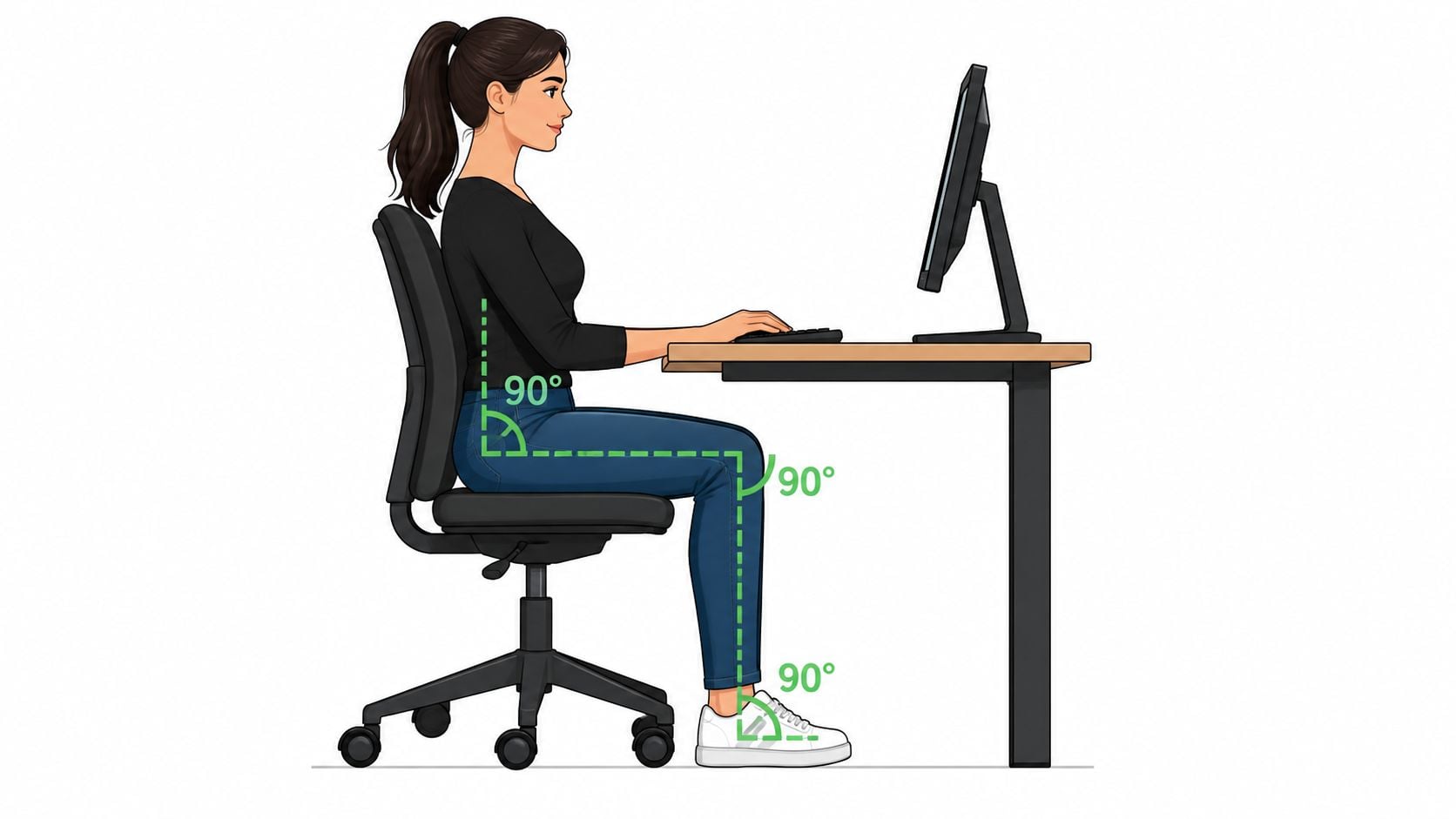
The foundation of great posture is something experts call the "90-90-90" rule. It’s a simple guideline, but it’s the gold standard for creating a healthy seated position that minimizes strain on your body.
Achieving the 90-90-90 Rule
The whole point of this rule is to create three 90-degree angles with your body, which ensures proper alignment and support from head to toe. Here’s how it works:
- Feet: Your feet should be planted flat on the floor—not dangling in the air or tucked under your chair.
- Knees: Your knees need to be bent at a comfortable 90-degree angle, with your shins perpendicular to the floor.
- Hips: Your hips should also be bent at about 90 degrees, keeping your thighs parallel to the floor.
This all starts with setting the right chair seat height. If your seat is too high, your feet won't reach the floor, which can cut off circulation. On the other hand, if it’s too low, your knees will pop up higher than your hips, putting a ton of unnecessary strain on your lower back.
It might not seem like a big deal, but over time, these small misalignments can lead to nagging back pain, poor circulation, and even neck strain as your body tries to compensate.
What Makes a Seat "Comfortable" in Practice?
Beyond the 90-90-90 rule, a comfortable seat height accounts for several other variables. For dining, your forearms should rest naturally on the table surface without hunching your shoulders or reaching down. You also need enough clearance to cross your legs or shift positions, which means the chair's apron (the frame under the table top) shouldn't press into your knees.
Anthropometric research highlights why comfort varies from person to person. One study examining chair-related body measurements found a mean popliteal height of 42.98 cm, with a standard deviation of 2.48 cm. Popliteal height approximates the distance from the floor to the underside of the knee, which is a key determinant for the ideal seat height. Another study suggested an ideal seat height of roughly 33 cm (13 inches) for specific populations, illustrating that a single universal height rarely fits everyone perfectly.
Furthermore, comfort depends heavily on how long you sit. Office chairs require a wider, adjustable range—typically 16 to 21 inches—because users spend longer periods seated and work surfaces vary. As noted in ergonomic self-help guidelines, this range allows the seat to be raised or lowered so the user can keep both feet supported, maintain a relaxed knee angle, and position the elbows comfortably near desk height. A fixed 18-inch chair may work well for many adults, but it cannot accommodate every worker.
Small adjustments can make a significant difference in your daily comfort and long-term health. Finding a chair that allows you to achieve this natural, supported posture is one of the best investments you can make for your home office.
How We Determine the Right Chair Seat Height
At Slone Brothers Furniture, we don't offer arbitrary numbers; our recommendations are built on pairing ergonomics with real-world usability. When we evaluate a chair for our showroom, we apply a specific set of criteria to ensure it offers a good fit for the widest possible range of customers.
Our methodology starts with underside clearance. We measure the chair's seat height and then simulate pairing it with a standard dining table (30 inches). If the gap between the seat and the table's underside falls outside the 10-to-12-inch band, we consider it a potential fit issue. We physically test the chairs in our showroom to confirm that a person of average height can slide in and out easily without their shins banging the table frame.
We also account for cushion compression. A seat that measures 18 inches when empty might compress to 16.5 inches when an adult sits down. We factor this into our 'standard' ranges to ensure the dynamic height still provides adequate legroom. Finally, we evaluate stability and posture support. A chair might hit the perfect height metric, but if the base is too narrow or the backrest forces an unnatural slouch, we disqualify it from our recommendation list. We rely on authoritative resources, such as the abilityfurniturehire.co.uk guide on chair hire, to cross-reference our standards against broader ergonomic needs.
Additionally, we cross-reference our internal benchmarks with established ergonomic data. For general dining and purpose-built chairs, the commonly used standard seat height is approximately 18 inches, or 45.7 centimeters. A broader ergonomic range is about 16 to 18 inches, equivalent to 405–460 millimeters, depending on the chair’s purpose, cushion compression, and the user’s leg length guynnfurniture.net/standard-chair-dimensions/. For office environments, seating guidance places adjustable seat height between 16 and 21 inches to accommodate varying work surfaces churchofjesuschrist.org/study/manual/safety-health-and-environmental-manual/05/5-8-office-ergonomics-self-help-guidelines?lang=eng. Our showroom experience consistently confirms that understanding these anthropometric variances is essential for avoiding the fit problems we see daily.
What Is the Most Comfortable Seat Height?
While the industry standard for dining chairs sits at 18 to 20 inches, the 'most comfortable' seat height is entirely dependent on the activity and the user's body dimensions. For dining, a seat that allows your feet to rest flat and your thighs to remain horizontal is ideal. For lounging, a slightly lower seat (around 16 to 18 inches) is often preferred because it mimics the feeling of sinking into a couch, promoting relaxation. For task-oriented work, such as cooking at a counter or typing at a desk, the seat must be adjustable to maintain the 90-degree angles in your hips and knees throughout the day.
If you are taller than average, you may find 20 inches to be the ceiling of comfort for dining; going higher might make your knees hit the table. If you are shorter, you might find 18 inches pushes your knees too high, making the table feel distant. In these cases, an adjustable chair or a custom-order piece is the most comfortable solution.
The Long Road to the Adjustable Chair
We really take adjustable chairs for granted these days, don't we? A simple push of a lever and you're at the perfect height. But this convenience wasn't always a given. The journey from static, one-size-fits-all seating to the dynamic, ergonomic chairs we offer in our Longwood showroom is a fascinating story of innovation, trial, and a whole lot of error.
Believe it or not, early stabs at adjustability were more conceptual than practical. Take architect Frank Lloyd Wright’s 1904 design, for example. While it was a significant early step with an adjustable seat, the chair was notoriously unstable and uncomfortable. It even earned the nickname 'suicide chair'—a stark reminder of just how far we've come.
A Shift in Thinking
For decades, chair design didn’t change much. It wasn't until the mid-20th century, as desk jobs became the norm in offices across America, that designers started to seriously rethink the chair's purpose. The focus shifted from pure looks to function and how a chair could serve the human body. This new perspective paved the way for a real breakthrough.
The modern adjustable office chair arrived with the introduction of the Herman Miller Ergon chair in 1976. This design was a major milestone. It was built on scientific research about posture and comfort, creating a chair that actively supported the person sitting in it. Features we now consider standard, like easy height adjustment and proper spinal support, took hold in quality office furniture.
Quality That Blends Science with Style
This history of innovation directly shapes the furniture we select for our Central Florida customers today. The principles of ergonomic design aren't just for office chairs anymore; they're woven into many of the high-quality pieces we carry, from adjustable counter stools to recliners engineered for maximum support.
At Slone Brothers Furniture, we believe that great design is a blend of timeless style and modern science. That's why we are so proud to offer a vast selection of Amish and American-made furniture that combines classic craftsmanship with the best of today's ergonomic insights.
We see this evolution as a commitment to lasting value. A well-designed, adjustable chair isn't just a piece of furniture; it's an investment in your daily comfort and well-being, built to last for years. Our team is passionate about helping you find pieces that honor this incredible tradition of quality and thoughtful innovation.
Finding Your Custom Fit at Slone Brothers
What happens when a standard-height chair just doesn’t feel right for your family or your unique Central Florida home? We believe you should never have to settle for discomfort just to fit a one-size-fits-all measurement. The Slone Brothers Furniture difference shines, moving far beyond what typical big-box stores can offer.
For us, finding that perfect fit isn’t just a sales pitch; it’s a commitment we’ve honored since 1980.
The Power of Customization
Many of our customers in Longwood and Lake Mary are surprised when they learn that "custom" is a real, accessible option. While not every single chair can be altered, we partner with exceptional Amish and American-made brands that give us incredible flexibility. For many dining chairs and stools, we can specify a different leg height, creating a bespoke solution for your home.
You won't find this kind of personal service at a national chain. Our Custom-Order Program is all about empowering you to create furniture that is perfectly scaled to your table, your counter, and the people you share your life with.
Finding the right chair is about more than just numbers on a tape measure; it's about creating a welcoming space where your family can gather comfortably. Our design team is here to make that happen.
Your Local Design Experts
Diving into the world of custom furniture can feel like a lot to take on, but you don’t have to go it alone. Our in-house Design Team offers complimentary consultations right here in our showroom. They are experts at listening to what you need—whether it’s a slightly lower chair for a beloved grandparent or a taller stool for that new custom-built kitchen island.
They’ll walk you through our vast selection, explain all your options, and make sure the final piece is absolutely perfect. When you're ready to create a dining space that fits your life, see how to choose the right dining room chairs for ideas.
Our passion is helping every family in Central Florida discover furniture that feels like it was made just for them.
Your Chair Seat Height Questions Answered
Even with all the right information, a few specific questions always seem to pop up when our customers in the Longwood showroom start looking for new chairs. Getting the chair seat height just right can feel a bit tricky, so we’ve gathered some of the most common questions we hear to give you clear, straightforward answers.
Our goal is simple: to help you find beautiful, comfortable furniture that you'll love for years to come.
What Is the Biggest Mistake People Make?
By far, the most common mistake we see is people guessing the height or choosing a chair based only on its style without ever measuring their table. It’s an easy trap to fall into. You see a gorgeous chair, and you can already picture it in your home—but if it’s too low or too high for your dining table, it will quickly become uncomfortable and impractical.
Always, always measure your table height first. From there, you can aim for that essential 10-12 inch gap between the tabletop and the chair seat. Bringing your measurements into our showroom is the best first step you can take, and our Design Team is always here to help you double-check everything.
What Should I Do if My Feet Do Not Touch the Floor?
If you sit down in a chair and your feet are left dangling, that's a clear sign the seat is too high for your body. This isn't just a minor annoyance; it can cause poor circulation and put unnecessary strain on your lower back over time.
For a fixed-height chair, like a dining chair or a stool, a stylish footrest is an excellent and simple ergonomic fix. But when you’re shopping, the best practice is to always sit in a chair and test the fit before you make a decision. See how it feels—it’s the only way to know for sure.
Can I Use Counter Stools at a Bar Height Table?
This is a question we get all the time, but the answer is a definite no. Counter stools, which have a typical seat height of 24-27 inches, are far too short for a standard bar-height table, which usually stands 40-42 inches tall.
Trying to make that combination work means you'll be sitting way too low to eat, drink, or socialize comfortably. Be sure to match the stool type to the table type. At Slone Brothers, we offer a huge selection of both counter and bar stools to ensure you get the perfect match for your Orlando home.
Feeling inspired? Stop by our showroom in Longwood, FL, and chat with our Design Team for a complimentary consultation. You can learn more about us and see our quality American-made furniture at https://slonebrothers.com.