

Lamps for Living Room: A Layered Lighting Guide


The living room looks furnished, yet evenings still feel flat. Matching lamps sit on both end tables, the overhead fixture is dimmed, and the reading chair remains too dark while the sofa area feels oddly exposed. This is a common result when homeowners choose lamps for living room spaces as decorative objects instead of planning how light should move through the room.
In a Central Florida home, that distinction matters. Living areas carry the visual work of conversation, reading, television, entertaining, and quiet evenings, so the lighting needs to shift with the room's purpose. A thoughtful combination of ambient, task, and accent light gives heirloom furniture the setting it deserves while making the room more comfortable to use.
Why Lamps Deserve a Plan, Not a Guess
A lamp should earn its place through both proportion and performance. Replacing one overhead fixture with several matching lamps doesn't automatically improve a room if every fixture sits at the same height, uses the same bulb, and throws light in the same direction. The result can still feel gloomy, visually flat, or harsh around the seating.
Living room illumination has three distinct jobs:
- Ambient light establishes a comfortable base level throughout the room.
- Task light supports activities such as reading, writing, or needlework.
- Accent light draws attention to artwork, architectural details, plants, and collected objects.
Lamps are especially valuable because they can handle the lower two tiers with more flexibility than a fixed ceiling fixture. A floor lamp can brighten a seating group from behind, a table lamp can put useful light beside a chair, and a smaller accent lamp can bring warmth to a dark console or bookcase.
Practical rule: A lamp purchase should answer three questions before style enters the conversation. Where will the light land, how much light will it deliver, and can its intensity change?
The scale of the room determines the starting point. An Australian residential lighting study found that living areas had the highest average number of fixed lamps, at 12.3 per house, while the average living room contained just over 13 lamps in total and about 4.3 lamps per room. The study also recorded 386 watts per house in living rooms, a power density of 6.3 watts per square meter, and almost 9,000 lumens in living areas, showing how central living room lighting is to household illumination and energy use. The residential lighting report offers useful foundational context, although every home still requires an individual plan.
A homeowner furnishing a Longwood or Winter Park living room should start with the room's activities, then select the fixture types, placement, shade, and bulb. The interior design process for a room becomes much more effective when lighting is considered alongside seating, tables, rugs, and sightlines. For homeowners exploring color and furniture for farmhouse rooms, the same principle applies. A beautiful palette still needs varied light to show its texture and depth.
How Should You Layer Ambient, Task, and Accent Light
A successful living room uses ambient light for coverage, task light for usefulness, and accent light for character. For broad planning, ambient lighting is commonly targeted around 150 to 300 lux, task areas at 300 lux or higher, and accent lighting well under 100 lux to preserve mood. Lighting design guidance for living rooms also describes a practical method: calculate the room area, multiply it by the target lux, divide the resulting lumens among fixtures, then verify CRI, CCT, and dimmability.
The table below provides a planning framework. The figures are design benchmarks, not a substitute for checking the actual delivered output in the room.
| Layer | Lux Target | Approximate Lumens | Typical Fixtures |
|---|---|---|---|
| Ambient | 150–300 lux | 1,500–3,000 lumens across the room, depending on size | Floor lamps behind seating, torchiere uplights |
| Task | 300+ lux | 800–1,500 lumens per reading area | Table lamps beside chairs, adjustable floor lamps |
| Accent | Under 100 lux | 150–300 lumens aimed at a feature | Picture lights, small table lamps, directional fixtures |
A long room usually needs all three layers because one end can't comfortably illuminate the other. A square room may function with ambient and task light if the furniture arrangement is compact and the walls don't contain important art or architectural features.
Ambient light should disappear into the room
Ambient light creates a base wash without making one fixture the visual star. Floor lamps positioned behind a sofa or beside a sectional can spread light upward and outward, while torchiere fixtures send light toward the ceiling for a softer distribution.
Over-lighting the entire room is a frequent mistake. It removes contrast and makes a carefully selected sofa, wood table, or textile collection look flatter than it does under varied illumination.
Task light belongs beside the activity
A reading chair needs light at the shoulder or side, not several feet behind the sitter. Table lamps on end tables work well when the shade directs illumination toward the book or hands without shining directly into the eyes.
The living room lighting guide can help homeowners connect fixture placement with furniture arrangement. For a more atmospheric approach to evenings, a cozy home lighting guide offers complementary ideas about warmth and mood, though decorative atmosphere shouldn't replace useful task light.
Accent light gives the room depth
Accent fixtures should support the room's strongest details. A lamp on a console can frame artwork, a small fixture can illuminate a plant, and a directional light can reveal the grain of a solid wood cabinet.
The contrast between layers matters more than brightness alone. A room with one bright source tends to look flat, while varied intensity creates visual hierarchy and allows the same space to move from conversation to reading to television viewing.
What Size and Height Should a Lamp Be and Lamp Shades
Scale determines whether a lamp looks intentional or misplaced. A well-made fixture can still fail if its base overwhelms a narrow table, its shade sits too low, or its light reaches the sitter's eyes instead of the reading surface.
For floor lamps beside a standard 30 to 32 inch seat, a total height of approximately 58 to 64 inches generally places the light comfortably for reading. A torchiere intended primarily for ceiling wash is often approximately 70 to 72 inches tall. These proportions help the fixture relate to the chair without competing with the sitter's head or blocking the room's sightlines.
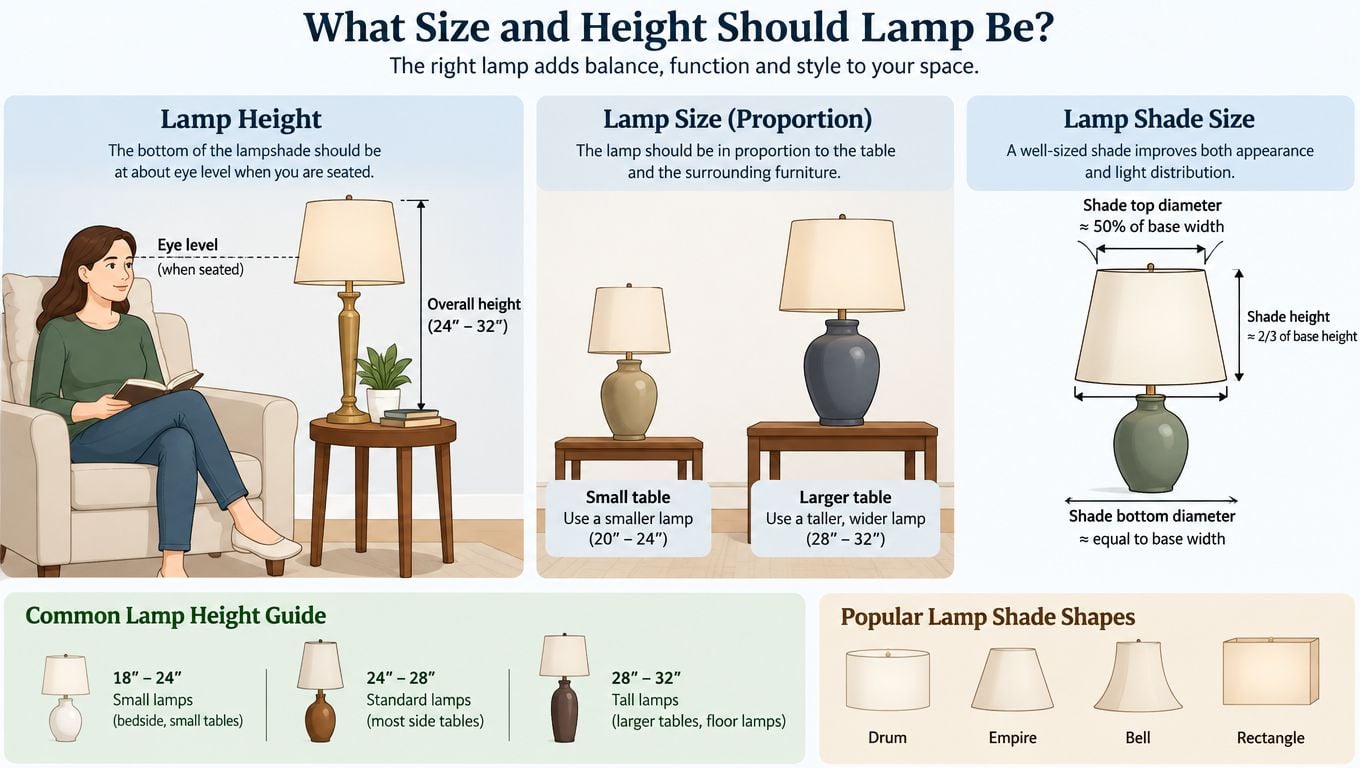
Table lamps need a seated-eye test
For a lamp on an end table, the bottom of the shade should generally sit near the seated eye level, roughly 38 to 42 inches from the floor in many living room arrangements. The exact result depends on the chair, table, and base, so the consultant should judge the lamp from the position where the homeowner would naturally sit.
A shade diameter of about two-thirds of the table width usually produces a balanced composition. A shade that's too narrow can expose the bulb and create glare, while one that's too broad can crowd the arm of a sofa or reduce usable table space. The shade height should be about two-thirds of the lamp base height, keeping the visual weight stable.
Stability matters as much as appearance
A tall ceramic base on a narrow-legged table may look dramatic in a showroom but feel precarious in a busy household. Bases should have enough weight and footprint for the table, especially where children, pets, or frequent entertaining are part of daily life.
Pendant fixtures require equal care. If hung too low, they interrupt conversation sightlines across the room and make the seating arrangement feel divided. Homeowners planning a new end table should also review end table dimensions before selecting a lamp, because the table's depth and height establish the fixture's usable proportions.
Which Lamp Styles Work With Your Existing Decor
The right lamp supports the furniture already in the room. It shouldn't look like a separate purchase placed beside a sofa without consideration for wood tones, metal finishes, upholstery, or architectural character.
Farmhouse interiors benefit from turned wood bases, ceramic urns, and wrought-iron profiles. Oatmeal or burlap linen shades soften the silhouette, while patinated bronze or antique brass relates naturally to distressed oak and slipcovered upholstery. The look should feel collected rather than themed.
Modern rooms need cleaner geometry. Matte black, brushed nickel, polished chrome, and white ceramic work well with rectilinear sofas and neatly proportioned case goods. A hardback linen drum shade reinforces the room's disciplined lines without making the light feel sterile.
Coastal rooms should remain restrained. Whitewashed ceramics, driftwood bases, rope details, and glass constructions pair well with pale linen shades that diffuse light gently. Overtly nautical motifs usually make the room feel temporary, while quiet material references remain timeless.
| Decor Style | Lamp Silhouette | Base Materials | Finish Palette | Shade Pairing |
|---|---|---|---|---|
| Farmhouse | Turned, urn-shaped, or open wrought-iron | Wood, ceramic, iron | Patinated bronze, antique brass, softened wood | Oatmeal or burlap linen |
| Modern | Geometric, architectural, or slim | White ceramic, metal, glass | Matte black, brushed nickel, polished chrome | Hardback linen drum |
| Coastal | Rounded, organic, or softly sculptural | Whitewashed ceramic, driftwood, glass, rope | Pale wood, white, restrained metal | Pale linen with diffused light |
Metal coordination deserves discipline. One dominant warm metal can establish continuity, while a single cool-metal accent prevents the room from becoming overly matched. Wood tones should relate to the flooring or case goods within approximately two shades, giving the composition connection without requiring an identical finish.
The furniture styles explained resource can help homeowners identify the dominant language of a room before introducing new lighting. In a Longwood home with traditional upholstery and contemporary art, the best lamp may bridge both rather than repeat either one.
How to Pick the Right Bulb for Living Room Lamps
Bulb selection controls whether a beautiful lamp feels inviting or uncomfortable. The four specifications that matter most are color temperature, CRI, lumens, and dimmability.
For living rooms, a warm color temperature between 2,700K and 3,000K creates the relaxed atmosphere most homeowners want for conversation and evening use. Residential lighting guidance on color temperature identifies this range specifically for living rooms. A higher temperature can read clinical, especially against warm wood, cream upholstery, or layered textiles.
CRI, or color rendering index, describes how accurately a bulb reveals color. A rating of 90 or higher is a strong choice for investment furniture because it helps upholstery, artwork, wood grain, and decorative finishes appear closer to their intended colors. A warm bulb with poor rendering can still make a carefully chosen fabric look dull or distorted.
Match lumen output to the fixture's job
A reading lamp needs enough output to reach the book without flooding the whole room. Floor lamps used as ambient anchors need greater total output, particularly in open living spaces or rooms with high ceilings.
| Lamp Function | Kelvin | CRI | Lumen Target | Bulb Type | Dimmable |
|---|---|---|---|---|---|
| Reading table lamp | 2,700–3,000K | 90+ | 800–1,100 lumens | A19 LED | Yes |
| Ambient floor lamp | 2,700–3,000K | 90+ | 1,500–2,000 lumens | A19 LED or compatible LED | Yes |
| Decorative accent lamp | 2,700–3,000K | 90+ preferred | 150–300 lumens | Decorative LED | Yes |
| Slender torchiere or socketed sconsetyle fixture | 2,700–3,000K | 90+ | Fixture-dependent | Candelabra or B11 bulb | Yes |
LED lamps can use up to 85% less electricity than incandescent lighting while producing the same level of light, and typical LED lifespans are approximately 15,000 to 25,000 hours. Some guidance describes 25,000 hours as roughly 22 years at three hours per day. LED efficiency and lifespan information supports treating the bulb as part of the long-term value equation, not a disposable afterthought.
Protect the shade and the eyes
A19 LEDs fit many table and floor lamps, while candelabra or B11 bulbs suit narrower fixtures. Vintage filament bulbs are best reserved for accents because their color rendering can fall below 80 CRI, which is less suitable for reading or revealing the true character of upholstery.
Dimming is essential in a multi-use room. It lets the homeowner move from a relaxed evening setting to brighter reading light without changing the fixture. Diffusers and shaded bulbs also control glare, especially when a lamp sits close to eye level. The correct kelvin rating alone won't prevent hotspots, so beam spread must match the openness of the shade.
Choosing Lamps at Slone Brothers With Help From the Design Team
The most efficient lamp selection starts with the room rather than the display shelf. Central Florida homeowners can preview the Slone Brothers interior design consultation services before visiting the Longwood showroom, then create a shortlist based on room, style, height, shade material, and intended function.
A useful preparation process looks like this:
- Record the room. Take photos from more than one angle, note ceiling height and window placement, and identify existing ceiling fixtures.
- List the activities. Mark the reading chair, television seating, conversation area, artwork, and any dark corners.
- Gather finish references. Paint chips, flooring samples, upholstery swatches, wood samples, and metal hardware help the design consultant judge compatibility.
- Bring measurements. Include end-table height, table width, seating height, outlet locations, and basic floor-plan notes.
- Build a complete package. Select ambient, task, and accent fixtures together so the room doesn't become a series of disconnected purchases.
The design team can translate those details into specific lamp shapes, finishes, shade pairings, and bulb requirements. Window orientation matters in Florida because daylight can dominate one side of a room while leaving another side visually quiet after sunset. Existing furnishings matter just as much. A sculptural lamp may suit a customized sectional, but a substantial solid wood table may need a base with more visual weight.
Homeowners should evaluate construction, not only appearance. An investment-grade selection considers structural integrity, finish durability, cord placement, socket quality, shade craftsmanship, and whether replacement bulbs and dimming controls are practical.
Slone Brothers Furniture maintains a curated lighting selection within its home décor offering, including table lamps such as the Cuit Table Lamp. The showroom also coordinates home delivery and white-glove placement across the Orlando metro, with assembly and shade installation handled as part of the delivery experience where applicable. Consultation availability should be confirmed when booking, and local trade relationships can help coordinate lighting with broader furnishing or renovation plans.
Visit the Longwood Showroom to Bring Your Lighting Plan Home
A lamp looks different when it is viewed beside the actual furniture it needs to serve. At the Longwood showroom, homeowners can compare proportions, shade diffusion, base materials, and bulb temperatures in person instead of trying to judge a fixture from an isolated screen.
Before the visit, bring:
- Room photos: Capture the seating, walls, windows, and circulation paths from two angles.
- Ceiling details: Record ceiling height and note existing fixtures or beams.
- Window placement: Identify where daylight enters and which areas become darker in the evening.
- Furniture information: Include end-table dimensions, sofa height, chair height, and the finishes already in the room.
- Electrical notes: Sketch outlet locations and identify any areas where cords could cross a walking path.
The in-store review should begin with scale. A consultant can place a lamp beside a comparable table, assess the shade from seated eye level, and check whether the base feels proportionate to nearby upholstery and case goods. Next comes performance. Warm bulbs, higher-CRI options, diffusers, and dimming controls should be judged by the quality of light they deliver, not just by the label on the package.
The final selection should form a coherent package. Ambient floor lighting can establish the room's base, table lamps can support reading and conversation, and accent lamps can bring attention to artwork or a carefully finished cabinet. Buying the pieces together avoids the common result of one attractive lamp in each corner with no relationship between their output or scale.
Slone Brothers has served Central Florida as a local, family-owned showroom since 1980, offering furniture, mattresses, home décor, custom-order options, complimentary in-house design guidance, and home delivery. The same investment-minded approach applies to lamps. Heirloom furnishings deserve lighting with durable finishes, sound construction, and enough flexibility to perform through changing furniture arrangements and daily routines.
The showroom is located in Longwood, Florida, serving homeowners from Orlando, Lake Mary, Sanford, Winter Park, and Altamonte Springs. Appointment details and current hours should be confirmed before arrival, particularly for an in-home consultation. Calling ahead allows a design consultant to review the room details and pull suitable options before the homeowner reaches the showroom.
Ready to invest in furniture and lighting that support a beautifully finished home for years to come? Visit Slone Brothers Furniture in Longwood, FL, bring room photos and measurements, and connect face-to-face with the experienced design team for curated lamps, complimentary in-home guidance, and white-glove service.