
Sofas Near Me


The old sofa has finally surrendered. One cushion has collapsed, the fabric shows the evidence of daily life, and a homeowner in Central Florida is sketching the living room on the back of a utility bill before searching for sofas near me. That search shouldn't lead straight to the first attractive photograph. A sofa is a structural, visual, and logistical decision, especially in a Longwood home where room proportions, Florida light, traffic patterns, and delivery access all matter.
The sensible path begins with the way the room is used, continues with an in-person evaluation, and ends with delivery that protects the home as carefully as the furniture. For a homeowner in Longwood, Lake Mary, Sanford, Winter Park, or greater Orlando, proximity matters, but qualified local guidance matters more.
Starting Your Search for Sofas Near Me in Longwood
A high-intent sofa search starts before the showroom visit. The homeowner needs to understand what the room must do every day, not just which silhouette looks appealing on a screen.
Start with the household. Is the sofa used for formal conversation, family television, afternoon reading, or long evenings with guests? Does it need to accommodate children, pets, mobility concerns, or frequent entertaining? A low, deep lounge sofa may feel wonderful during a showroom visit but become awkward for someone who needs easier standing support. A structured, higher-backed sofa may suit a formal Winter Park living room but feel too upright in a Lake Mary family room designed for relaxed lounging.
Define the room's real job
Write down the problems the replacement must solve:
- Seating capacity: Determine who regularly uses the room and whether additional chairs are necessary.
- Comfort posture: Decide whether the household prefers upright support, a moderate seat, or a deeper lounging position.
- Maintenance demands: Consider poolside traffic, pets, children, direct sunlight, and the frequency of entertaining.
- Visual balance: Match the sofa's scale to nearby case goods, rugs, lighting, and architectural features.
- Future flexibility: Ask whether the room may change after a move, renovation, or new media arrangement.
The Greater Orlando market includes newer open-plan homes and 1990s floor plans with more defined rooms. A sofa that works beautifully in a broad, contemporary family room may overwhelm a narrower Longwood living room. I-4 corridor commutes also make efficient local shopping valuable. A nearby showroom allows a homeowner to make a focused visit, compare several constructions, and return with a fabric sample or revised measurement instead of restarting the search.
Practical rule: The right nearby sofa store should help solve the room, not simply display a sofa.
A local search should therefore lead to a decision about how to shop, not endless scrolling. A full-service showroom offers construction guidance and customization. An outlet can provide immediate value when the requirements are flexible. Online ordering may suit a highly specific, already-tested design, but it shifts measurement, comfort evaluation, and delivery risk onto the buyer.
The Longwood local furniture search guide can help orient a homeowner before visiting. The important point is simple: a good sofa purchase is planned, measured, and tested in person.
Showroom, Outlet, and Online Sofa Shopping Compared
A full-service showroom, an outlet, and an online retailer solve different problems. For a long-term living-room centerpiece, the showroom usually gives the buyer the strongest control over comfort, materials, configuration, and service.
A showroom lets shoppers sit long enough to notice seat depth, cushion recovery, arm height, and lumbar support. They can handle fabric samples under real lighting, compare leather surfaces, and ask how a frame or suspension system is built. A consultant can also flag a scale problem before an order is placed.
An outlet offers a different proposition. The buyer may find a piece that can leave quickly, but selection, upholstery choices, dimensions, and customization are generally limited. That can work for a second home, a temporary room, or a homeowner whose requirements are broad. It isn't the right default for a carefully specified, heirloom-quality centerpiece.
Online buying removes the showroom visit altogether. Photographs can communicate shape and color, but they can't confirm how the seat supports the body, how a fabric feels, or whether the frame has the solidity expected at its price. Upholstered returns may also involve restrictions, restocking costs, or complicated collection arrangements, so the buyer should read every condition before ordering.
| Factor | Showroom | Outlet | Online |
|---|---|---|---|
| Comfort testing | Sit on multiple pieces and compare support | Test available inventory only | Rely on descriptions and reviews |
| Fabric and leather | Handle broad sample options in person | Usually limited to existing upholstery | Swatches may be limited or separate |
| Customization | Configuration, dimensions, materials, and finishes may be available | Rarely available | Depends on the seller and model |
| Delivery | Coordinated local scheduling and service support | Often tied to available warehouse inventory | Timing and room placement vary |
| After-purchase help | Local contact for questions and service | Support depends on the outlet structure | Communication may be remote |
| Best use | Long-term centerpiece purchase | Flexible, immediate, or secondary furnishing | Specific, already-understood designs |
A sofa also needs to relate to the rest of the room. Homeowners comparing upholstery with flooring or an adjoining renovation can use where to see Flacks Flooring samples to review surface colors and textures in person rather than judging them from separate screens.
The guide to the best places to buy quality furniture is useful for clarifying what a retailer should provide beyond a sales floor. The best choice isn't defined by the largest inventory. It is defined by whether the buying process reduces uncertainty before the sofa enters the home.
Measuring Your Space Before You Visit a Local Sofa Store
A homeowner should measure the room before driving to a local sofa store. The objective isn't merely to find an empty rectangle. It is to confirm that the sofa can live comfortably in the room and physically reach it.
Begin with the room footprint. Record wall lengths, window locations, doors, vents, outlets, television placement, and the traffic paths that must remain open. A sofa that technically fits against a wall can still make the room feel cramped if it blocks a hallway or forces people to cut across the seating area.
Measure the route, not just the destination
Next, measure every point along the delivery path:
- Exterior entry: Record the door width and height, including trim and hardware.
- Interior openings: Measure hallways, doorways, and turns.
- Vertical constraints: Note stairwell height, landings, railings, and ceiling clearance.
- Tight angles: Measure the diagonal available at a turn, not just the straight width.
- Furniture access: Identify whether doors, legs, cushions, or section pieces can be removed.
A Lake Mary ranch may have a narrow foyer that makes a broad sofa difficult to angle through the entry. A Heathrow two-story can present a different challenge, where a staircase turn restricts a piece deeper than 36 inches. These are not showroom problems. They are home-access problems, and they need answers before purchase.
Match measurements to the way people sit
Seat height and depth deserve equal attention. A deeper seat may suit a taller homeowner who lounges, while a more moderate depth can provide better support for upright conversation. Arm height affects how the body rests, and cushion thickness can change the perceived seat height.
A useful preparation method is to sketch the room on graph paper and draw the proposed sofa footprint at the same scale. Taping that footprint on the floor gives the household a physical test of circulation, sight lines, and clearance around tables.
Bring room photographs, measurements, ceiling height, paint or flooring samples, and a simple sketch to the consultation. The room-measuring guide for furniture provides a practical reference. A prepared visit turns vague browsing into a targeted design session and prevents the most expensive mistake, falling in love with a sofa that cannot pass through the front door.
What Quality Sofa Construction Looks Like in Person
A sofa's price becomes easier to judge when the buyer examines what sits beneath the upholstery. Marketing language can sound impressive, but hands and eyes reveal whether the frame, suspension, and cushions support the claim.
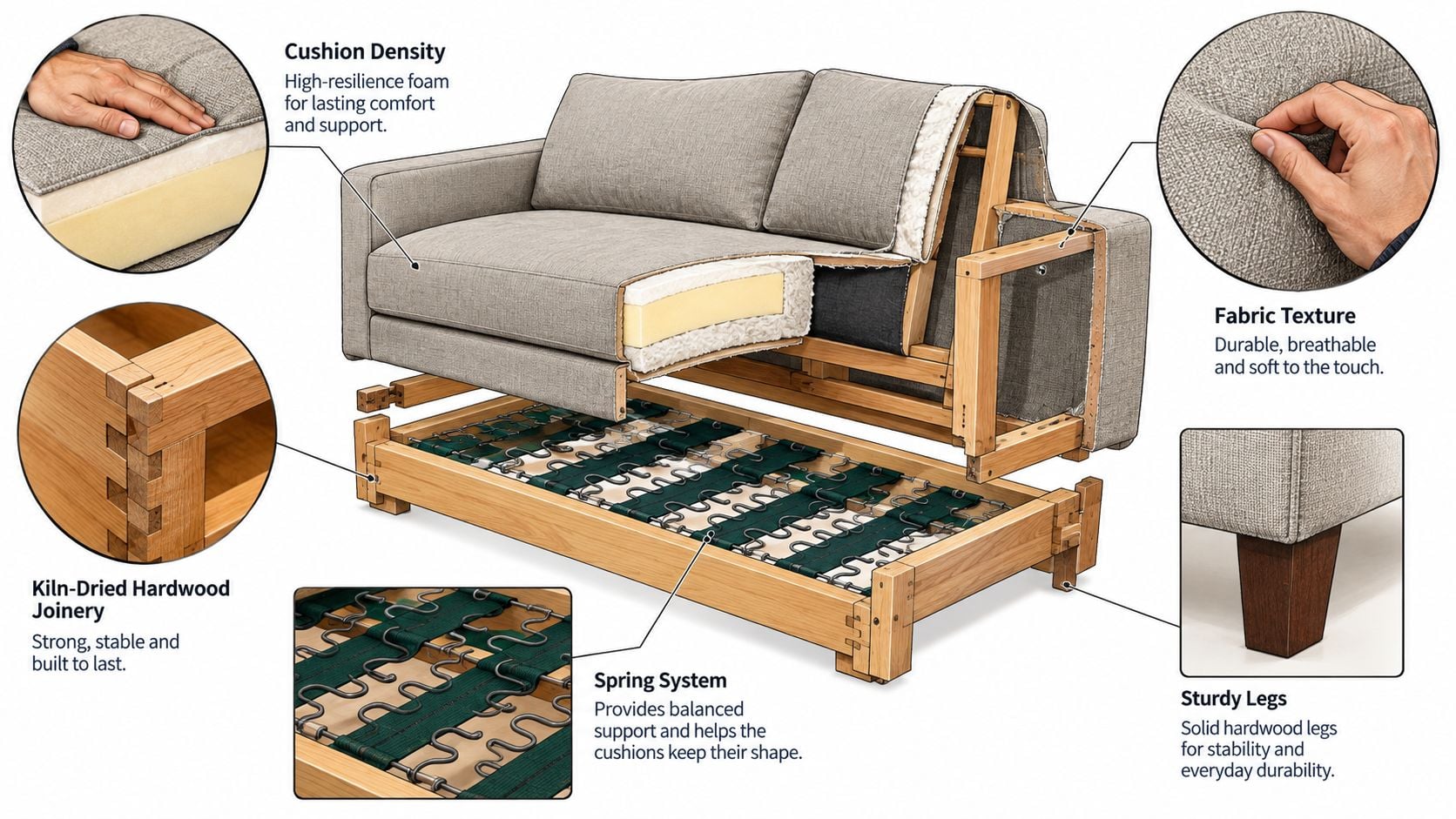
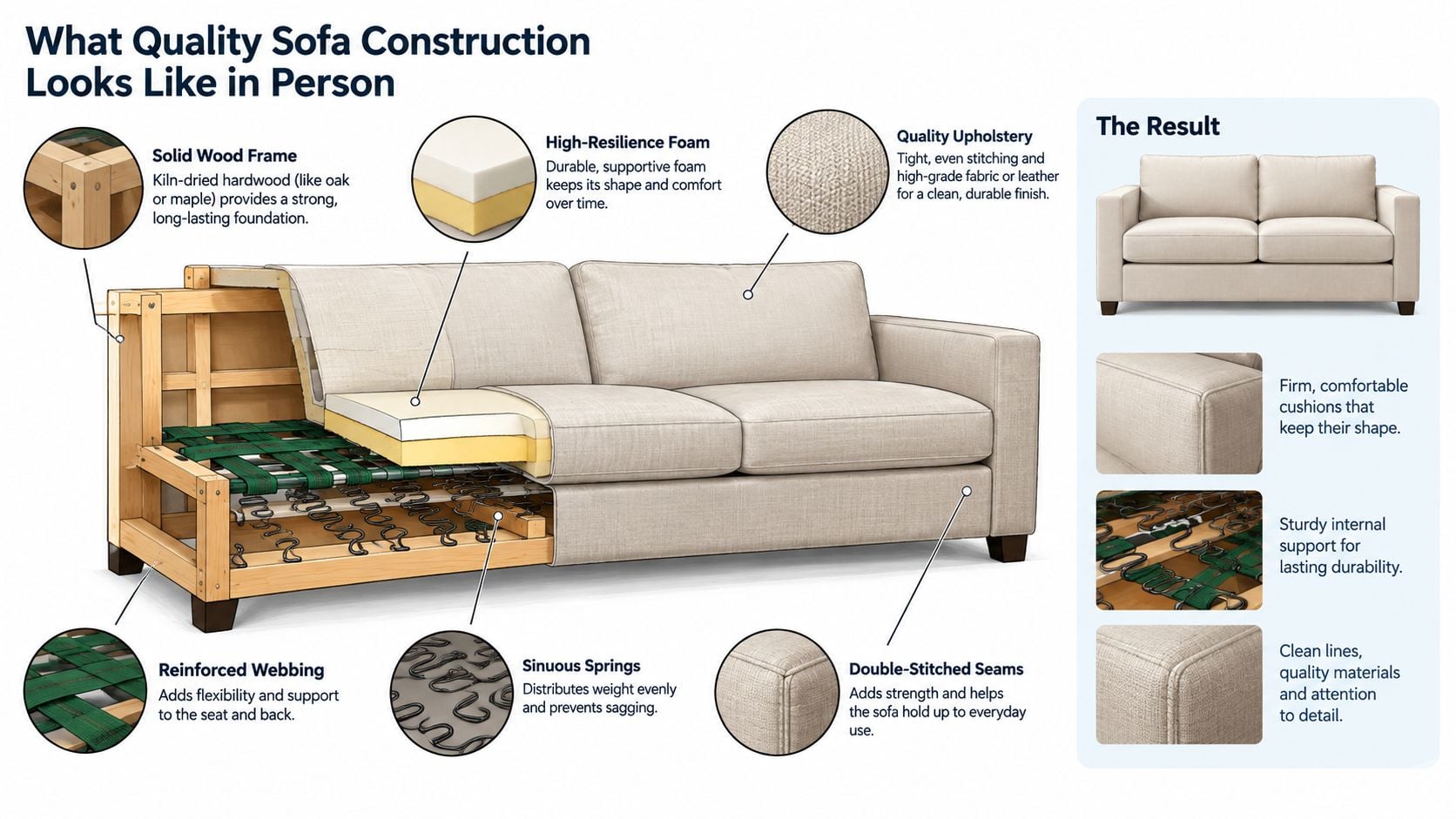
A well-built frame commonly uses kiln-dried hardwood with reinforced corners and joints that are doweled, screwed, or otherwise engineered for stability. Stapled connections and lightweight components may reduce manufacturing cost, but they don't provide the same confidence under years of repeated sitting. Traditional joinery guidance also identifies dovetail and mortise-and-tenon joints as signs of stronger craftsmanship, while solid wood refers to exposed parts made from actual lumber rather than decorative layers over a cheaper core, as explained in this well-made furniture checklist.
Test the structure with deliberate pressure
A showroom evaluation should include more than a quick sit. Press the arms, shift weight across the seat, inspect the underside where accessible, and listen for movement or creaking. Look for even seams, properly aligned cushions, secure legs, and upholstery that doesn't appear strained at corners.
Suspension affects both feel and longevity. Eight-way hand-tied systems offer a traditional, labor-intensive construction method. Sinuous springs can provide reliable support when properly engineered, while webbing varies considerably by design and execution. The right question isn't which label sounds most luxurious. It is whether the entire seat system creates stable support for the intended use.
Cushion construction matters just as much. High-resilience foam wrapped in down or fiber can combine a supportive core with a softer surface, while removable covers make maintenance and future service easier. Buyers should ask how cushions recover, whether they can be rotated, and whether replacement inserts remain available.
Choose upholstery for Central Florida living
Florida homes need upholstery that handles sunlight, humidity, active households, and frequent transitions between indoors and outdoors. Performance weaves, including options designed for stain resistance, can be sensible for families who want a refined appearance without treating the sofa as untouchable. A washable or removable cover can add practical value when children, pets, or poolside traffic are part of daily life. For households looking for protective accessories, this resource on animal covers for sofas offers additional care ideas.
Leather requires its own assessment. Pigmented leather generally provides a more consistent protective surface, while aniline leather shows more natural variation and develops character but demands greater care, particularly in a bright Longwood room. Neither is automatically superior. The correct choice depends on the desired aging pattern, maintenance tolerance, and placement.
Before comparing prices, a buyer should check:
- Frame: Hardwood construction, reinforced corners, and stable joinery.
- Suspension: The system used and how it feels under repeated pressure.
- Cushions: Core material, wrapping, recovery, and serviceability.
- Upholstery: Fiber, leather grade, cleaning requirements, and light exposure.
- Repair path: Whether covers, cushions, hardware, and service remain available.
A retailer's quality assurance process should support those questions with clear answers. A sofa becomes a long-term investment only when the construction can be understood and maintained.
Choosing Between a Sectional, Sofa, or Modular Layout
The right configuration follows the room and the household, not the current trend. A traditional sofa preserves pathways, a sectional concentrates generous seating, and a modular arrangement offers the greatest ability to change direction later.
| Layout | Best Room Type | Best For | Key Trade-Off |
|---|---|---|---|
| Sofa | Narrow living rooms, formal rooms, apartments | Households that need clear circulation and flexible chair placement | May require additional seating |
| Sectional | Open family rooms and broad great rooms | Families, frequent hosts, and dedicated lounging | Can dominate the room and restrict future layouts |
| Modular | Flexible rooms, condos, evolving media spaces | Buyers who may rearrange seating or move later | Greater flexibility can cost more than a fixed design |
When a sofa is the disciplined choice
A traditional sofa often works best in a narrow Longwood great room, a formal living room, or an apartment where two clear pathways matter. Pairing it with a chair or ottoman can create a more adaptable conversation arrangement than placing one large piece against every available wall.
A downtown Orlando loft may benefit from a sofa because its open plan needs visual breathing room between seating, dining, and circulation. A higher back, moderate depth, and carefully chosen arm profile can define the living zone without creating a bulky barrier.
When a sectional earns its footprint
A sectional is the workhorse for a large Lake Mary family room, especially when the household watches television together, hosts regularly, or wants a chaise for daily lounging without a separate chair. The important measurements are the overall width, return depth, chaise length, and distance from the television or primary conversation area.
A sectional can also integrate recliners or sleeper functions, but each mechanism adds planning requirements. Recliners need clearance, sleepers need a deployment path, and a chaise can create a dead zone if it interrupts a doorway or the room's natural route.
Where modular seating makes sense
Modular seating suits buyers who expect the home to evolve. It can help a condo owner work around elevator limits, allow a household to reorganize around seasonal gatherings, or adapt when a media setup changes. Individual pieces may also make future delivery and room access easier.
The trade-off is cost. Modular flexibility can cost 10 to 20 percent more than a comparable fixed sectional, so the premium should buy a real advantage, not merely a fashionable label. In a Winter Park guest suite, that flexibility may be unnecessary. In a multipurpose family room, it can be the feature that keeps the room useful after the next move or renovation.
Custom Orders, Design Help, and Financing for Sofas Near Me
Custom ordering is often the answer when the showroom floor contains the right style but not the right dimensions, fabric, configuration, or comfort. It turns a sofa search into a documented design process rather than a compromise between two imperfect choices.
A design consultant begins with the room. Measurements, photographs, floor plans, Pinterest references, paint colors, and existing furnishings help establish the brief. The build sheet may then specify the frame, cushion fill, seat depth, arm profile, leg finish, fabric, leather, welt detailing, and sectional orientation.
How the custom process works
A practical sequence looks like this:
- Consultation: The homeowner explains how the room is used, what feels comfortable, and what must change.
- Space planning: The consultant tests scale, pathways, and sight lines against the room measurements.
- Material selection: Fabrics, leathers, cushion options, finishes, and performance requirements are compared together.
- Configuration approval: The final dimensions and orientation are checked against entry doors, stairways, and built-ins.
- Production review: The buyer confirms the order details before the piece enters manufacturing.
- Delivery preparation: The retailer coordinates the completed sofa, access route, and installation plan.
Custom furniture takes planning. Independent furniture guidance places many bespoke pieces around 6 to 14 weeks, while complex work can extend to 16 to 24 weeks or longer, depending on materials, finishing, and project complexity, as described in this custom furniture lead-time guide. A made-to-order sofa is therefore a poor choice for an unplanned deadline, but an excellent choice for a home with unusual proportions or a precise design brief.
Some programs offer quick-ship pieces for households facing a move-in date. The consultant should identify what is genuinely available, what still requires production, and whether a discontinued fabric, changed finish, or supplier delay could affect the order. Deposit requirements, cancellation windows, approval points, and substitution procedures should be clear before the order is signed.
Financing should support the decision
Financing can make a considered purchase easier to schedule, particularly when a homeowner is furnishing several rooms after moving to Central Florida. Available structures may include promotional no-interest periods or extended-term plans, subject to the retailer's current terms and credit approval. A Low Price Promise can address price protection separately from the design decision, while the buyer still evaluates construction, service, and delivery.
The distinction matters. Financing should help a homeowner purchase the right piece at the right time, not encourage a rushed selection. Customization has value when it solves a real room problem, such as an older Sanford home with a tight doorway, a built-in that limits depth, or a Longwood living room that needs a specific return dimension.
Delivery, White-Glove Service, and Visiting the Showroom
The purchase isn't complete when the order is approved. For a sofa, delivery is part of the design outcome because the piece must enter the home safely, reach the intended room, and arrive without damage to floors, walls, or doorframes.
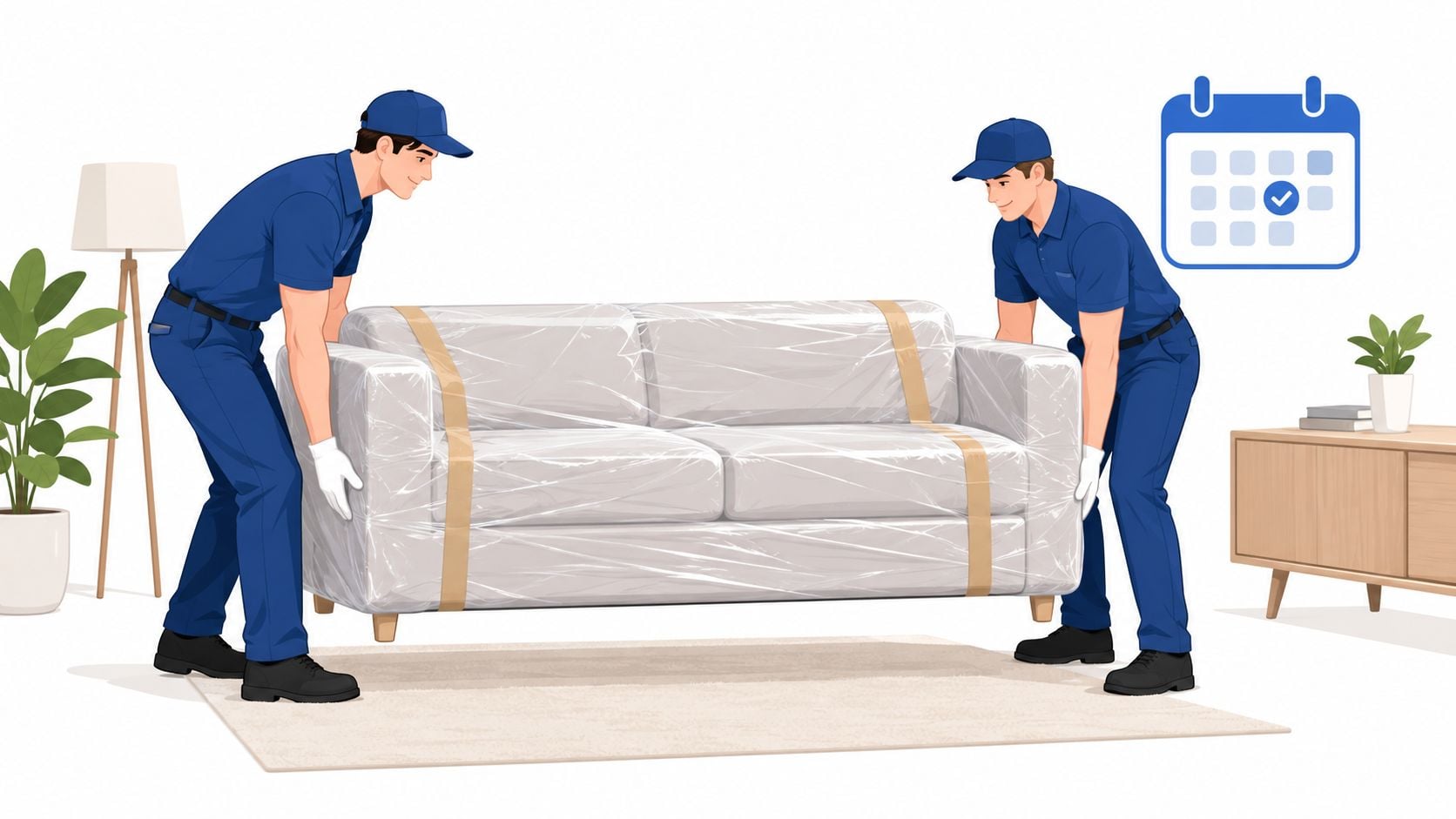
White-glove service should include more than a truck arriving at the curb. A proper local delivery process coordinates a delivery window, uses a trained two-person crew, protects the route, places the sofa in the selected room, and removes packaging materials. The homeowner should receive clear communication about timing and order status, particularly when a custom piece is moving through production and inspection.
Delivery depends on the type of purchase
In-stock furniture, custom orders, and outlet pieces flow through the warehouse differently. An in-stock sofa may be scheduled after local inventory and access details are confirmed. A custom sofa requires production, inspection, and coordination after completion. An outlet piece may be available sooner, but the delivery plan still needs to account for the home's route and placement requirements.
Homeowners can prepare by clearing the entry, removing fragile décor, securing pets, measuring the path again, and confirming any building or community requirements. Additional practical guidance on preparing for a furniture handoff appears in these furniture delivery tips from Home Removals Sydney. The local retailer should then explain what the crew will protect, what the homeowner needs to move, and how service concerns are handled after placement.
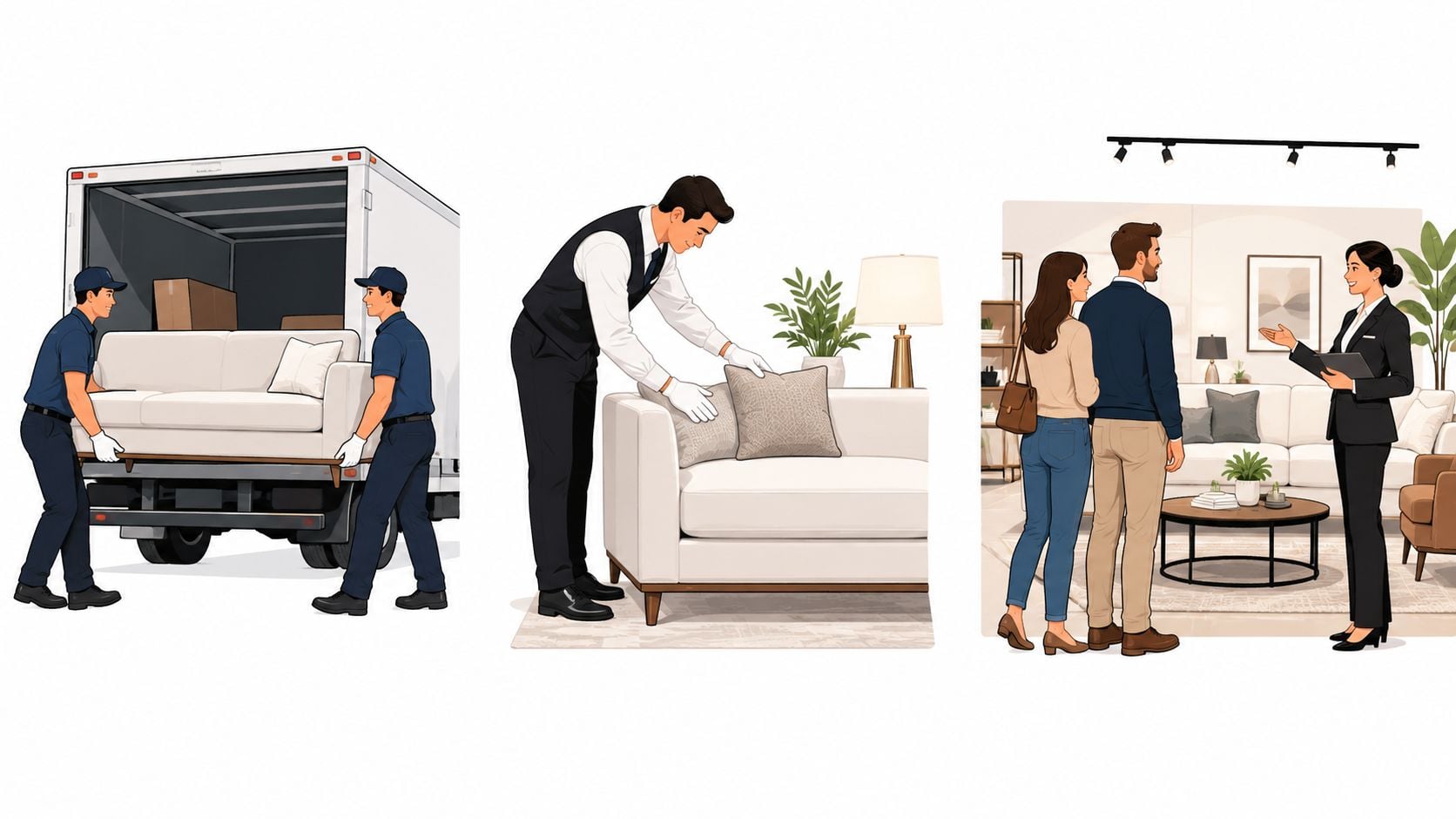
What a worthwhile showroom visit includes
A Longwood showroom visit should feel like a working design appointment, not a race through crowded aisles. The shopper should be able to move through room vignettes, compare sofa proportions, sit in multiple constructions, and review upholstery near complementary tables, rugs, lighting, and décor.
Bring the materials that make the conversation concrete:
- Room photographs: Include every wall, doorway, window, and adjacent furnishing.
- Measurements: Bring the room footprint, access route, ceiling height, and preferred sofa dimensions.
- Color references: Paint chips, flooring samples, rug photographs, and fabric swatches reveal undertones.
- Comfort requirements: Note preferred seat height, depth, firmness, arm support, and recline needs.
- Timing information: Share the move-in date or renovation schedule before considering custom options.
A local, family-owned retailer serving Central Florida since 1980 can remain involved through selection, ordering, delivery, and post-purchase questions. Slone Brothers Furniture provides living-room furnishings, custom-order options, complimentary in-house design services, financing options, home delivery with order tracking, and a clearance outlet for shoppers whose requirements suit available inventory. The white-glove delivery service explains why placement and protection belong in the buying decision.
The showroom's value is not just being close to Longwood, Orlando, Lake Mary, Sanford, Altamonte Springs, or Winter Park. It is the ability to test the piece, solve the room, confirm the route, and keep a real point of contact after the order leaves the floor.
Ready to invest in furniture that lasts a lifetime? Visit Slone Brothers Furniture in Longwood, FL to test sofas in person, review custom upholstery and modular options, and work with experienced design consultants who can coordinate measurements, financing, and white-glove delivery for a beautifully finished Central Florida home.