
Kiln Dried Wood Furniture: Why It Lasts in Central Florida


The familiar advice to buy kiln dried wood furniture leaves out the most important question: How was the piece built to move? Drying matters, but it doesn't turn solid wood into an unchanging material. A beautifully finished table still needs construction that accommodates the conditions inside a Central Florida home.
For homeowners in Longwood, Orlando, and Lake Mary, a lasting investment depends on more than a label. The useful conversation covers the lumber's moisture target, the maker's joinery, and the room where the furniture will live. Those details distinguish thoughtful craftsmanship from a reassuring phrase on a product description.
What Kiln-Dried Wood Furniture Really Means
Kiln-dried wood is lumber dried in a controlled chamber to reach a moisture level suited to its intended use. For indoor furniture, that means preparing the wood for occupied rooms, not just removing enough water to make it usable for construction.
Consider a homeowner comparing a solid-hardwood dining table with another piece described only as kiln-dried. Both descriptions may be accurate, yet neither identifies the final moisture target. The intended application matters because furniture components need precise alignment, particularly where doors, drawers, and wide panels meet.
Moisture Content Targets by Lumber Use
The USDA Forest Products Laboratory's drying guidance distinguishes approximately 6% to 8% for hardwood furniture, cabinets, and millwork, approximately 7% to 9% for softwood used in those applications, and the roughly 19% ceiling commonly associated with kiln-dried softwood dimension lumber.
| Lumber or condition | Typical moisture content | What it means for furniture |
|---|---|---|
| Hardwood furniture, cabinets and millwork | About 6% to 8% | Matches typical indoor equilibrium in much of North America |
| Softwood furniture, cabinets and millwork | About 7% to 9% | Slightly higher target for softwood species |
| Softwood construction dimension lumber | Up to about 19% | Built for framing, not precision furniture |
The framing threshold isn't a suitable substitute for a furniture specification. A structural board and a fitted cabinet door perform different jobs, so their drying requirements shouldn't be treated as interchangeable.
Moisture content describes the water in wood relative to its oven-dry weight, rather than its total wet weight. It also isn't the same measurement as the relative humidity displayed on a room sensor.
Buying rule: A kiln-dried label becomes useful when the maker identifies the lumber, its intended application, and its moisture target.
Wood continues exchanging moisture with surrounding air after manufacturing. A table delivered to Longwood doesn't retain its factory moisture condition indefinitely, even when the drying was performed correctly.
Species selection remains another part of the decision. Slone Brothers Furniture's guide to choosing hardwood for longevity and style helps connect appearance with material choice. The next question for any kiln-dried claim is straightforward: which lumber type and which target does it describe?
How the Kiln Process Turns Raw Lumber Into Stable Stock
Successful kiln drying controls airflow, temperature, humidity, and internal stress together. The operator follows a schedule suited to the lumber rather than applying maximum heat and hoping the boards remain straight.
The process includes several checkpoints, including preparation before heating and protection after the load leaves the kiln.
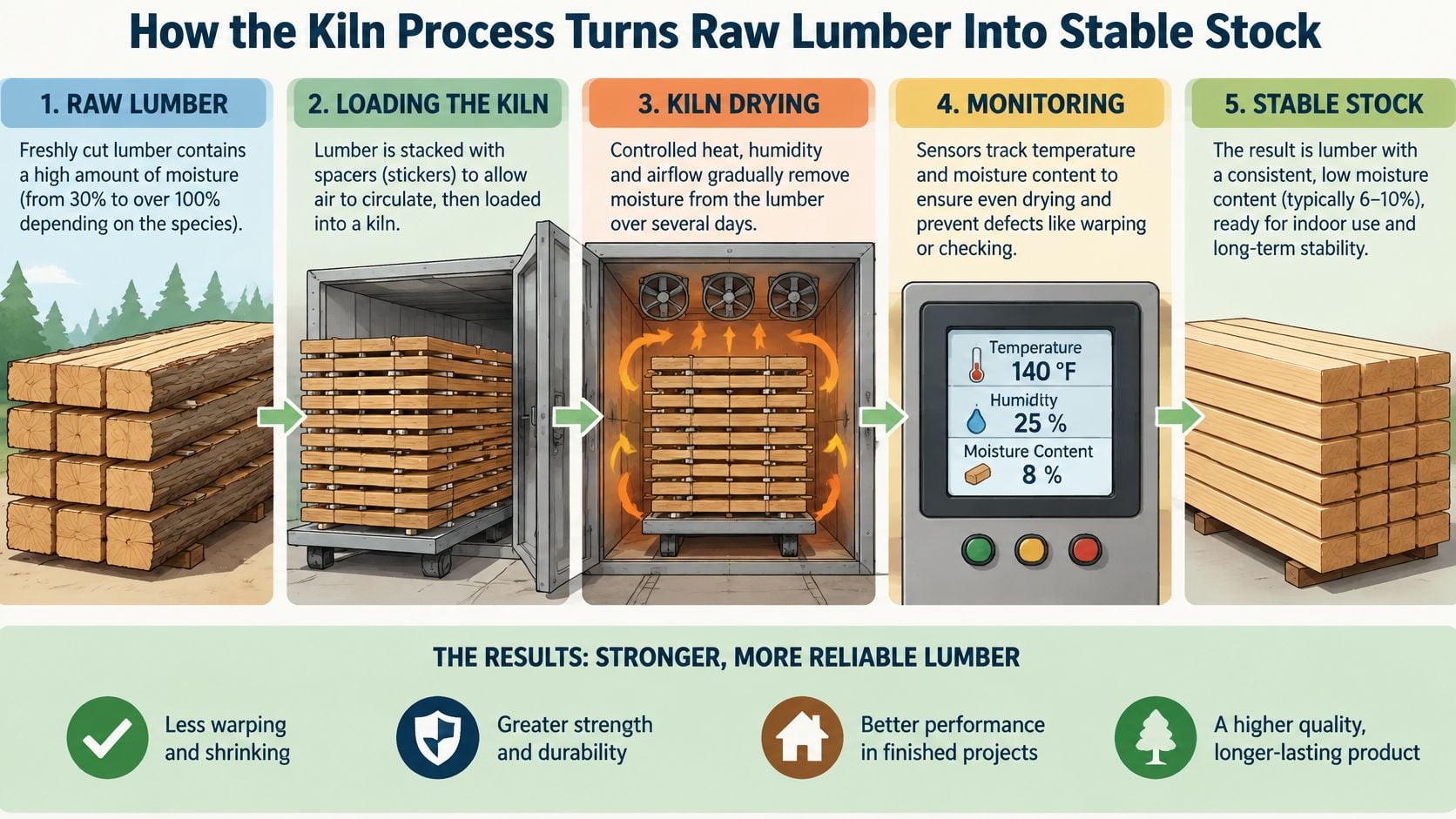
From Stacked Boards to Conditioned Lumber
Sort and stack for airflow. Workers separate rough boards with aligned spacers, often called stickers, so air can pass between layers. Uneven spacing or obstructed airflow can leave some areas drying differently from others.
The operator selects a starting schedule for the species and board thickness. Thick stock and woods with different drying characteristics can't all be treated as equivalent loads.
Increase heat while managing humidity. The surface mustn't lose moisture so aggressively that it tries to shrink around a much wetter core. A U.S. Forest Service lumber-drying survey reported that the most common maximum kiln temperature was 160°F to 180°F, not a universal setting for every load.
Drying speed must be balanced against drying stress. Forest Service research associated most observed hardwood drying defects with stresses developed during drying, with bowing the exception, and found improved outcomes for black cherry and red oak under modified schedules.
Equalize near the end of the cycle. Wetter boards need an opportunity to approach the target without unnecessarily overdrying boards already near it. Late-stage equalization uses a controlled kiln environment to narrow the spread between boards.
Test representative samples and cool the load in a controlled manner. Checking the load before release helps identify unsuitable stock before the maker invests in machining and assembly.
Protect the lumber after drying. Storage should preserve the work already completed, followed by another moisture check before machining. An uncontrolled warehouse can expose carefully prepared boards to conditions that change their moisture again.
What the Finished Piece Can Reveal
A buyer can't reconstruct an entire kiln schedule from a finished dresser. Documentation and manufacturer answers remain more informative than appearance alone.
Still, flat panels, well-fitted joints, and an absence of end checks are useful starting observations. A check is a crack that develops as wood separates during drying, often visible at a board's end or surface.
A carefully run schedule prepares workable stock. The furniture maker must then select, machine, join, and finish that stock appropriately, which is why kiln drying deserves attention without becoming the sole definition of quality.
How Does Kiln-Dried Wood Compare With Air-Dried Lumber?
Air drying relies on weather, shelter, and stacking, while kiln drying follows a controlled schedule. Neither label alone proves that lumber is ready for a particular interior application.
The simplest analogy is baking without a thermostat compared with using a calibrated oven. Both approaches involve heat and time, but only one gives the operator direct control over the surrounding conditions. Wood is more complicated than a recipe, yet the distinction helps explain why repeatable moisture preparation matters.
Kiln-Dried Versus Air-Dried Lumber for Furniture
| Criterion | Kiln-dried lumber | Air-dried lumber |
|---|---|---|
| Moisture control | Targeted to a set range for interior use | Governed by weather, season, shelter, and stacking |
| Time to stable moisture | Set by a controlled production schedule | Continues until the wood approaches the surrounding air's equilibrium |
| Consistency across boards | More repeatable when loading and scheduling are controlled | Can differ between stacks and positions within a stack |
| Drying defect risk | Controlled schedules reduce risk, although aggressive drying can cause checks | Checks, warp, and uneven shrinkage remain concerns with uncontrolled exposure |
| Best fit | Interior furniture requiring predictable material preparation | Rustic or weathered work where variation is accepted, or preliminary drying before further processing |
The comparison shouldn't become a claim that air-dried wood is inferior. Careful air drying can be part of responsible lumber preparation, and a maker may use it before a final controlled drying stage.
Likewise, a kiln can produce disappointing stock if an operator rushes the schedule. Control provides an opportunity for consistency, not an automatic guarantee.
A weathered appearance is a design choice. Unverified moisture is a material-preparation question.
Match the Preparation to the Piece
For a fitted bedroom cabinet in an air-conditioned Longwood home, predictable components matter more than the romance of a drying method. A decorative piece that welcomes irregularity has different priorities from a dining table expected to remain level and operate smoothly.
Even rustic furniture still needs sound assembly. An intentionally uneven surface doesn't excuse a split structural joint or a drawer that binds because its components weren't prepared for the room.
Selecting the best wood for furniture also involves grain, species, proportions, and intended use. The meaningful comparison isn't outdoor drying versus a kiln. It's whether the maker verified that the material was ready for the furniture being built.
What Should You Inspect Before Buying Kiln-Dried Furniture?
The most useful inspection begins with whether the maker checked moisture after drying and again after storage or machining. Visual inspection supports that conversation, but a smooth finish can't establish the moisture condition inside a board.
Purdue Extension explains that a home maintained around 70°F and 35% relative humidity produces an equilibrium moisture content of approximately 6.9%, illustrating why 6% to 8% is a useful interior-hardwood target. Equilibrium moisture content means the condition at which wood neither gains nor loses moisture under a particular temperature and relative humidity.
Understand What Was Measured
The reference test is straightforward in principle. A technician weighs a sample, dries it until its weight stops changing, and compares the lost water with the remaining dry wood.
Oklahoma State University Extension describes a ventilated oven at approximately 103 ± 2°C, about 219°F, with drying generally requiring 24 to 48 hours. Electrical moisture meters offer practical inspection readings, while the oven-dry method supplies the reference measurement.
A showroom visit isn't an invitation to drive meter pins into a finished tabletop. Manufacturer records and appropriately taken readings are preferable to damaging a piece or interpreting an unsuitable meter reading.
Combine Questions With a Physical Check
A design consultation should establish:
- Target moisture condition. What range did the maker specify for the actual lumber?
- Timing of verification. Were readings taken before machining and assembly, rather than only when the kiln cycle ended?
- Material identification. Which species and lumber types form the frame, tabletop, doors, and panels?
- Movement allowance. How are broad panels and tabletops attached without trapping seasonal expansion?
A close look should distinguish natural character from construction concerns. Wood can display grain and color variation, knots, mineral streaks, pitch pockets, tiger striping, and insect markings without those features being quality defects.
Simulated antique markings, or distressing, can also resemble damage. The useful question is whether a mark belongs to the intended finish treatment or represents a new structural or finish problem.
By contrast, open structural joints, cracks running through a board, warped panels, and bubbling or peeling finishes deserve explanation before purchase. Flat panels and tight joints are reassuring observations, though they aren't proof of the drying history.
The construction deserves equal scrutiny. A guide to mortise-and-tenon furniture joinery can help a homeowner recognize how connected components carry loads.
Written answers make comparisons clearer than memory alone. Any concerning area should be photographed while the piece remains available for examination, with the consultant's explanation recorded alongside it.
Does Kiln Drying Make Furniture Healthier for Indoor Air?
Kiln drying tells you how lumber was dried, not what substances may enter a room from the finished furniture. It does not identify the adhesives or finish, or establish how much the piece emits.
EPFL's discussion of wood-based furniture and indoor air quality explains that manufacturing processes, including drying and hot pressing, can influence volatile organic compound emission profiles. For a clearer picture, ask about the materials and finish used throughout the piece rather than relying on the drying label.
Identify the Construction Before Comparing Claims
Most furniture falls into three construction types:
- Solid wood. Components are made from wood rather than a manufactured fiber or particle core. Assembly adhesives and finishes may still be relevant to indoor air.
- Veneer over engineered wood. A thin wood surface covers a manufactured substrate. Ask what the core is made from and what binders it contains.
- Particleboard. Bonded wood particles form the panel. The binder system and any applicable product testing are useful points to ask about.
The construction type alone does not establish indoor-air performance. Solid wood can still have finishes and adhesives, while the word “veneer” does not describe the material beneath its surface.
Ask About the Whole Piece
For a dining cabinet or bedroom collection, include less visible areas in your questions: the back, drawer bottoms, shelves, and concealed components. Ask what finish and assembly adhesives are used, whether emissions testing is available, and what ventilation guidance applies after delivery.
A straightforward materials description helps you connect the construction with the finish and adhesives. Ask the maker: What materials are used in each part? What finish and adhesives are used? Is emissions testing available, and what post-delivery ventilation guidance is provided? Kiln drying alone cannot answer those questions or establish that a piece is formaldehyde-free, low-VOC, or suitable for every sensitivity.
Will Central Florida Humidity Warp Kiln-Dried Furniture?
Kiln drying cannot make furniture immune to humidity. In Central Florida, even a Winter Park or Sanford home can expose wood to changing moisture levels, so a stable piece still needs room to move.
Purdue Extension's guidance on wood movement notes that seasonal equilibrium moisture values in southern coastal states such as Florida can reach at least 12%. This is a regional condition, not a forecast for every air-conditioned room. It does show why the way a piece is built matters alongside how the lumber was dried.

How Movement Appears in a Florida Home
A Winter Park dining table in a wet August can take on moisture as the room grows more humid, causing its solid-wood top to expand across its width. After sustained air conditioning dries the room, the top can contract. The change happens gradually, rather than each time the thermostat runs.
A dresser beside a sun-facing bedroom window faces another kind of stress. Repeated sunlight can heat one area and affect its finish differently from shaded surfaces nearby. The rest of the room may feel comfortable while that uneven exposure continues.
For broad solid-wood surfaces, movement mainly occurs across the grain. A maker needs to account for that direction, rather than fixing a wide panel rigidly wherever a screw fits.
Construction That Makes Room for Change
Well-designed furniture accommodates movement with details such as panels that float in grooves, suitable clearances, and tabletop fasteners that allow controlled sliding. A chair's frame joints need to hold firmly; a tabletop attachment has a different job, allowing the broad surface to shift as conditions change.
A well-built piece is secure without being restrained.
Several room conditions can increase stress on furniture:
- Abrupt humidity changes. Open doors, intermittent conditioning, or a change in how a room is used can shift the air around the piece.
- Direct sun or concentrated heat. A surface exposed to heat may respond differently from the rest of the furniture.
- An unsettled delivery environment. A newly opened, unconditioned, or actively renovated room may differ from the conditions the furniture will experience in everyday use.
Plan delivery around the room, not only the doorway. Climate control should be operating normally before furniture arrives.
Once placed, new furniture needs time to settle in its intended room before final adjustments. Follow the maker's guidance on acclimation, particularly if doors, drawers, or extension mechanisms seem different soon after delivery. Kiln drying controls moisture at the factory; in a Central Florida home, construction determines whether a piece can respond to later changes without undue stress.
How to Keep Kiln-Dried Furniture Stable Through Florida Seasons
Kiln drying prepares wood before it becomes furniture, while routine care helps protect the finished piece in your home. A steady maintenance routine can also help you spot a change early and choose a sensible response, rather than tightening or repairing parts without knowing the cause.
A Practical Maintenance Routine
Monitor indoor humidity. Keep a hygrometer near the furniture and note its readings over time. Follow the manufacturer's recommended indoor humidity range, if provided, and look for sustained changes rather than reacting to one reading. This gives you a useful record if a drawer or joint begins behaving differently.
Check the room's use and furnishings. As a room becomes a home office, guest room, or busy entertaining space, review whether the furniture is being used as intended. Avoid storing damp items against wood, and make sure drawers and doors are not routinely overloaded or obstructed.
Dust gently. Use a soft, dry cloth, or a lightly damp cloth if the finish permits it, then dry the surface. Put cleaner on the cloth rather than spraying it onto the wood, where liquid can gather around joints and edges.
Protect surfaces from contact. Coasters, placemats, and protective pads help prevent moisture or heat from reaching the finish. Blot spills promptly, especially beneath glasses, planters, or decorative trays, where moisture can stay hidden.
Inspect joints, panels, and hardware periodically. Look for changes such as looseness, gaps, or difficulty opening a drawer. Accessible hardware may need attention, but fasteners designed to allow movement should remain able to slide. Check the manufacturer's care instructions before making adjustments.
Care for upholstered pieces as directed. Rotate cushions when their design allows it, and check exposed wood and finishes during routine cleaning. These simple checks can reveal worn protection, spills, or unusual movement before they are overlooked.
When to Seek Advice
A new squeak, widening gap, hairline crack, or sticking drawer is a reason to investigate. Note when it started and whether the room's use or the furniture's contents have changed. Those details help distinguish a care issue from a condition that needs professional evaluation.
Slone Brothers Furniture's wood furniture care guide offers practical maintenance guidance. For a concerning change, a design consultant can help you decide whether to adjust how the piece is used, consult the manufacturer, or seek a service evaluation.
Avoid forcing a swollen drawer, filling a changing joint, or tightening hardware indiscriminately. Those actions can complicate the problem. Clear photographs and a description of what has changed make it easier to discuss an appropriate next step.
Choose Kiln-Dried Pieces Built for Central Florida Homes
Kiln drying controls wood moisture at the factory. In a Central Florida home, humidity continues to rise and fall, so the practical buying question is how the furniture is built to accommodate wood movement. Drying preparation matters, but it is only one part of a sound purchase.
A useful starting point is the maker's explanation of the wood and its construction. Solid wood can be a durable choice when it is prepared and assembled with seasonal movement in mind. No drying label, however, guarantees a particular lifespan.
Slone Brothers Furniture's American-made solid-wood furniture guide offers context for evaluating craftsmanship. MAVIN furniture is American made in Ohio's Amish country, with cherry, oak, maple, walnut, or hickory trees hand-selected by a third generation of lumber specialists. Slone Brothers also offers custom orders, including custom dining furniture, and fabrics and finishes can be customized.
A Room-by-Room Conversation in Longwood
Slone Brothers Furniture is a family-run business that has been creating interiors since 1980. Its complimentary interior design services can help homeowners and businesses make furniture choices suited to their spaces.
Room conditions shape how a piece will be used. Window exposure, placement, proportions, and daily activity can all inform a conversation about furniture selection. Measurements and photographs help a design consultant consider those details alongside the look and function you want.
For a table, dresser, or seating frame, bring those room details to the discussion. They help turn general questions about wood preparation into a choice that fits the actual space.
Slone Brothers Furniture offers custom-order options and complimentary design services for homes or businesses. Visit its Longwood showroom for a face-to-face conversation about furniture choices for Central Florida living.